
Introduction
Organizations today face compounding pressure on multiple fronts: a thinning leadership pipeline, faster-moving markets, and employees who hold their managers to a higher standard than previous generations did. In that environment, leadership quality isn't just a people issue — it's a direct driver of whether a business grows or falls behind.
And yet, when budgets tighten, leadership development is often the first line item cut — at precisely the moment organizations need capable leaders most.
This guide covers the specific, measurable benefits of leadership development training — what organizations gain from it, what they risk without it, and what the research says about building programs that drive real behavior change rather than short-lived momentum.
Key Takeaways
- Well-developed leaders drive stronger financial performance, higher team productivity, and better decision-making at every level.
- According to Gallup, managers account for at least 70% of the variance in employee engagement scores — making leadership quality a direct lever on retention.
- Organizations without structured development face weak talent pipelines, costly external hires, and high-performer attrition.
- Without reinforcement, less than 30% of learning is applied on the job — post-training support is as critical as the training itself.
- Leadership development benefits compound: consistent investment outperforms reactive gap-filling every time.
What Is Leadership Development Training?
Leadership development training is a structured process for building the skills, behaviors, and mindset that help individuals lead teams, execute strategy, and deliver results — at every level of an organization, not just the executive suite.
In practice, it spans a wide range of competencies:
- Strategic thinking and decision-making under pressure and ambiguity
- Communication and influence across teams, functions, and stakeholders
- Change management and leading teams through organizational transitions
- Performance management and coaching direct reports effectively
- Emotional intelligence — the self-awareness and interpersonal skills that determine how leaders show up under stress
These competencies are built through multiple formats — in-person workshops, live virtual sessions, coaching, blended programs, and self-paced learning. The delivery method is secondary to the result: measurable change in how leaders behave, how teams perform, and how organizations grow.
ATD's 2026 research found that 79% of organizations saw improved organizational culture when providing leadership development to all employees, and 68% of learners reported improved job performance as a direct result.
Key Benefits of Leadership Development Training
The benefits below are grounded in operational outcomes — the kind that appear in retention numbers, revenue lines, and performance reviews. They also compound: organizations that build leadership capacity consistently outperform those that react to gaps after the fact.
Benefit 1: Stronger Organizational Performance and Financial Impact
Leadership quality is one of the strongest predictors of organizational performance. Trained leaders make better decisions, execute strategy more effectively, and create environments where teams consistently deliver.
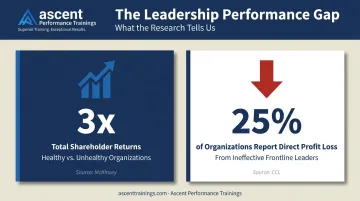
The financial evidence is direct. McKinsey research found that healthy organizations — where decisive, empowering leadership is the norm — deliver 3x the total shareholder returns of unhealthy ones. Decisive leaders who empower their people are 85% more likely to improve decision quality across the organization.
Poor leadership creates the reverse: costly errors, operational firefighting, and wasted resources. CCL data shows that 25% of organizations have experienced direct profit loss from ineffective frontline leaders.
KPIs most directly impacted:
- Revenue growth and profitability
- Team productivity and operational efficiency
- Project completion rates
- Cost per error or rework
- Decision quality and speed
When this matters most: Financial impact is highest during high-growth phases, strategy shifts, or scaling initiatives — situations where leadership capacity either enables or bottlenecks progress. Organizations scaling without intentionally developing their leaders often find that execution collapses faster than headcount grows.
Benefit 2: Higher Employee Engagement, Retention, and a Stronger Talent Pipeline
Employees don't leave companies — they leave managers. The data backs this up consistently.
Gallup reports that 51% of U.S. employees are currently watching for or actively seeking a new job, and that 42% of voluntary turnover is preventable by the manager or organization. Employees who have even one meaningful conversation per week with their manager are 4x more likely to be highly engaged.
Leadership development directly influences whether those conversations happen.
Well-developed leaders build psychological safety, provide meaningful feedback, and create clear growth paths: the conditions that make employees want to stay.
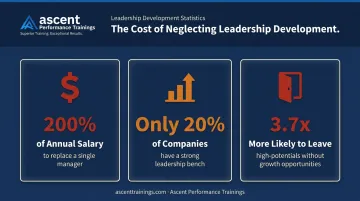
The cost of not creating those conditions is steep. Replacing a manager or leader costs approximately 200% of their annual salary, according to Gallup. SHRM puts the broader range at 50–200% of salary depending on level.
Beyond retention, organizations that develop leaders internally build a bench of ready-to-promote talent. Only 20% of companies currently have a strong leadership bench, according to DDI's 2025 research.
That gap has real consequences when senior roles open. Organizations either scramble to hire externally at high cost or promote people before they're ready — both paths create instability.
High-potential employees make this calculation quickly. DDI found they are 3.7x more likely to leave when their managers don't provide growth opportunities. According to Work Institute, lack of career development has been the #1 reason employees quit for more than 10 consecutive years.
KPIs most directly impacted:
- Employee retention rate and voluntary turnover
- Internal promotion rate
- Employee engagement scores
- Time-to-fill for leadership roles
- Onboarding ramp time
When this matters most: This is especially critical in competitive hiring markets, during rapid headcount growth, or after restructuring — when trust, direction, and development momentum need to be rebuilt quickly.
Benefit 3: Greater Resilience and Readiness to Lead Through Change
One of the most underestimated benefits of leadership development is what it produces before a crisis hits. Organizations face change constantly — McKinsey reports the average employee now experiences 10 planned enterprise changes per year, a fivefold increase from a decade ago. Fewer than one-third of those transformations succeed at both improving and sustaining performance.
The differentiator is almost always leadership readiness.
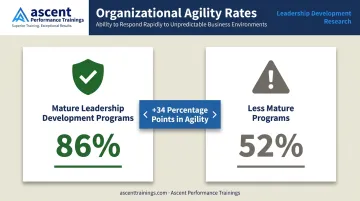
Organizations with strategic leadership development programs are far better equipped to respond. CCL data shows that 86% of companies with mature leadership development programs can respond rapidly to unpredictable business environments — compared to just 52% of companies with less mature programs. That's a 34-percentage-point gap in organizational agility.
Leadership development builds this readiness by developing skills like adaptive thinking, stakeholder communication, conflict resolution, and change management — so leaders practice navigating difficulty before it becomes a real-world emergency. Ascent's Leadership Academy explicitly covers change management and decision-making under uncertainty as core curriculum modules, because these are the competencies that separate leaders who stabilize organizations during disruption from those who amplify it.
Deloitte's 2025 Global Human Capital Trends found that 70% of business leaders identify being "fast and nimble" as their primary competitive strategy. That agility depends entirely on whether leaders at every level are equipped to guide their teams through it.
KPIs most directly impacted:
- Change initiative success rate
- Employee sentiment during transitions
- Project continuity rates
- Cross-team collaboration scores
- Crisis response time
Most critical during: Mergers, leadership transitions, industry disruptions, or sustained market volatility — situations where underprepared leaders often amplify the disruption rather than contain it.
What Happens When Leadership Development Is Neglected
Organizations that delay or defund leadership development rarely feel the impact immediately. They feel it months later, in the form of rising turnover, inconsistent team performance, and an inability to scale.
Those consequences show up in recognizable ways:
- Inconsistent leadership across teams creates fragmented culture, uneven output quality, and cross-functional misalignment — all of which erode performance without a single identifiable cause.
- Weak pipelines leave organizations choosing between expensive external hires and premature internal promotions. Only 20% of companies currently have a strong leadership bench — meaning 80% are already exposed to this risk.
- High-potential disengagement happens fast. Employees who don't see a development path begin looking elsewhere. DDI's data puts that departure risk at 3.7x for high-potentials with managers who don't invest in their growth.
The compounding cost is significant. A single underprepared manager can negatively affect an entire team's output, morale, and retention. Gallup's data shows managers drive at least 70% of the variance in engagement scores — and companies choose the wrong candidate for manager roles 82% of the time.
Given that replacing a manager costs roughly 200% of their salary, the math isn't complicated: proactive development is cheaper than repeated replacement — and the performance gap in between is a cost that rarely shows up on a single line item.
How to Get the Most Value from Leadership Development Training
A leadership development program only delivers its full benefits when it's designed as a continuous process — not a one-time event.
ATD research consistently shows that less than 30% of learning is applied on the job without reinforcement. Classroom-based learning alone rarely changes behavior. The skills have to be practiced, applied, and revisited before they become durable habits.
What Effective Programs Do Differently
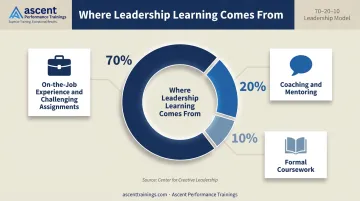
Effective programs are built around the 70-20-10 model from the Center for Creative Leadership: 70% of leadership learning comes from on-the-job experience and challenging assignments, 20% from coaching and mentoring, and 10% from formal coursework. This is why reinforcement and real-world application matter as much as the training program itself.
In practice, this means:
- Connecting learning to real business challenges, not hypothetical case studies
- Using multiple modalities — in-person, virtual, coaching, and self-paced — to reinforce skills across different contexts
- Building in post-training support so behavior change actually transfers back to the job
Ascent Performance Trainings structures its leadership programs — including the 10-week Ascent Leadership Academy — around exactly this architecture. After the core program, participants receive weekly reinforcement videos and monthly 1:1 coaching sessions for eight weeks, designed to move skills from awareness to on-the-job application.
One Chief Revenue Officer described the impact directly: "Most programs leave you after the workshop, but Ascent Performance ensured our team had the reinforcement and coaching needed to sustain long-term success."
Measuring What Matters
Organizations should establish baseline KPIs before a program begins, then track changes post-program against metrics that matter to the business:
- Employee retention and voluntary turnover
- Engagement scores
- Internal promotion rates
- Team productivity
- Revenue and win rate (for commercial leadership)
Attendance rates and post-session satisfaction scores tell you whether people showed up and felt good. These KPIs tell you whether the program moved the business forward. That distinction is what separates a training investment from a training expense.
Conclusion
The benefits of leadership development training are not theoretical. They show up in financial performance, team productivity, talent retention, and the organization's ability to handle disruption without losing momentum.
The organizations that see the greatest returns are those that invest consistently, not reactively. The earlier and more deliberately they build leadership capacity, the stronger their pipeline, their culture, and their competitive position becomes.
The organizations that sustain those gains treat leadership development as a continuous capability — building it systematically into how they develop people at every level. That means choosing programs with a clear methodology, real-world applicability, and post-training reinforcement built into the design.
Ascent Performance Trainings delivers exactly that: programs grounded in 30+ years of practical expertise, delivered across 75+ countries, with an 8-week reinforcement structure that converts classroom learning into durable on-the-job behavior change.
Frequently Asked Questions
What are the benefits of a leadership development program?
Leadership development programs improve organizational performance, increase employee engagement and retention, and build a stronger internal talent pipeline. For individuals, they accelerate career growth and build practical skills in communication, strategic thinking, and change management. Both outcomes compound over time.
What is the 70-20-10 rule for leadership development?
The 70-20-10 model holds that 70% of leadership learning comes from on-the-job experiences, 20% from coaching and mentoring, and 10% from formal training — which is why post-training reinforcement and real-world application matter as much as the program itself.
What are the 5 E's of leadership development?
One widely referenced version covers Envision, Express, Excite, Enable, and Execute — the stages through which effective leaders define direction, communicate it, motivate teams, remove barriers, and drive results. The exact framework varies by organization.
How do you measure the ROI of leadership development training?
Establish baseline metrics before the program begins, then track retention, engagement scores, internal promotion rates, and team productivity over time. Structured frameworks like Kirkpatrick's four levels or the ROI Institute's five-level model help measure behavioral and business impact — not just participant satisfaction.
Who should participate in leadership development training?
Leadership development is relevant at every organizational level — from high-potential individual contributors and first-line managers to mid-level directors, senior VPs, and C-suite executives. The most effective organizations build development pipelines across all tiers, not just at the top.
What makes a leadership development program effective?
Effective programs align to real business goals, combine multiple learning modalities, and include structured post-training reinforcement. What separates genuine capability-building from generic workshops is measuring behavioral outcomes tied to business KPIs — not just attendance or satisfaction scores.