The instinct is to blame the training. Often, the real culprit is something else entirely: a missing enablement layer.
According to Salesforce, sales reps spend 60% of their time on non-selling tasks — hunting for the right deck, entering CRM notes, chasing internal approvals. No training program fixes that. Only a systems-level solution does.
Many organizations treat sales enablement and sales training as interchangeable. They're not. Confusing the two leads to misallocated budgets, underperforming teams, and revenue growth that plateaus despite ongoing investment.
This article gives you clear definitions, a side-by-side comparison, and a practical guide to knowing which approach your team actually needs — and when to use both.
Key Takeaways
- Sales training builds individual skills — objection handling, discovery, closing — through structured learning events
- Enablement is an ongoing strategy that equips reps with tools, content, and processes across every sales stage
- Training is event-based; enablement is continuous and systemic
- High-performing teams integrate both rather than choosing one over the other
- Start by diagnosing your gap: skills, systems, or both — the answer shapes your investment
Sales Enablement vs. Sales Training: Quick Comparison
Here's how the two approaches compare across five key dimensions:
| Dimension | Sales Training | Sales Enablement |
|---|---|---|
| Purpose | Build individual skills and behaviors | Equip reps to apply those skills with the right resources |
| Scope | Individual, event-based | Organizational, ongoing |
| Ownership | L&D team or external trainer | Cross-functional — sales, marketing, enablement |
| Timeframe | Defined start and end | No finish line — evolves with the business |
| Measurement | Knowledge retention, completion rates | Pipeline impact, win rates, ramp time |
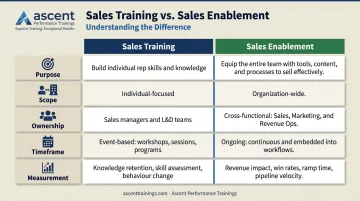
Training builds the capability; enablement puts it to work. Organizations that treat them as separate programs — or mistake one for the other — tend to invest in one while leaving the other underfunded. Both need to operate together for rep performance to translate into pipeline results.
What Is Sales Training?
Sales training is a structured, intentional process designed to develop the specific skills, knowledge, and behaviors that help salespeople perform better. The goal is to change how individual reps think and act during sales interactions — building the confidence and competence that translate directly into results.
The Three Core Types
- Product and technical training — knowing what you sell deeply enough to position it credibly
- Skills training — how to prospect, run discovery, handle objections, negotiate, and close
- Mindset training — the psychology of selling, including mental resilience and performance under pressure
That third category matters more than most sales leaders acknowledge. Tim Carlisle, founder of Ascent Performance Trainings, built his The Inner Game of Performance framework around this idea — drawing on the mental strategies of elite athletes to help salespeople maintain composure and focus in high-stakes selling situations. The right technique breaks down under pressure when the psychological foundation isn't there.
The Reinforcement Problem
The 2023 State of Sales Enablement Report found that 35% of organizations are not confident their reps can retain and apply what they learn from training. Where managers coach effectively, win rates climb 14 percentage points — and reps are 40% more likely to feel confident in their performance.
Post-training reinforcement isn't a nice-to-have. It's what determines whether training actually sticks.
Ascent's approach directly addresses this. Their 8-week post-training reinforcement model delivers weekly AI-generated micro-learning videos, real-world application prompts, and monthly 1:1 coaching sessions — keeping skills active long after the classroom session ends. As one VP of Sales described it: "The post-training follow-up ensured we didn't just retain knowledge but actually applied it. Our team's performance and closing rates have never been higher."
When Sales Training Is the Right Call
- New hire onboarding — getting reps from zero to productive quickly
- Skills gap remediation — low close rates, weak discovery calls, poor objection handling
- Product or market launches — when reps need to position a new offering or sell into a new vertical
What Is Sales Enablement?
Gartner defines sales enablement as "the process of providing the sales organization with the information, content and tools that help sellers sell more effectively." Where training builds skills, enablement builds the infrastructure around those skills.
The difference matters in practice. A rep can know exactly how to run a discovery call but still waste 20 minutes before a meeting searching for the right case study. That's not a skills problem. It's a systems problem.
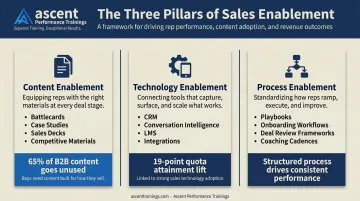
The Three Core Pillars
- Content enablement: Battlecards, case studies, sales decks, and competitive positioning materials organized so reps can find and use them without friction. Forrester estimates that 65% of B2B content marketing assets go unused because they're irrelevant to what reps actually need mid-conversation.
- Technology enablement: CRM, conversation intelligence tools, LMS platforms, and the integrations that connect them. Teams with well-integrated tech stacks report 19 percentage points higher average quota attainment than teams using disconnected tools, per the 2023 State of Sales Enablement Report.
- Process enablement: Playbooks, onboarding workflows, deal review frameworks, and coaching cadences embedded into the sales workflow — not sitting in a shared drive nobody opens.
The Alignment Dimension
Effective enablement requires sales and marketing to work from the same messaging. When they don't, reps improvise on calls while marketers produce content that never gets used. Ensuring reps have on-brand, buyer-relevant materials at every deal stage is one of the highest-leverage moves an enablement function can make.
When Sales Enablement Is the Right Call
- Scaling a growing team — ensuring consistency without relying on tribal knowledge
- Reducing ramp time through structured playbooks and on-demand resources
- Supporting ongoing rep performance when well-trained reps still execute inconsistently
Which Does Your Team Actually Need?
Before choosing, diagnose the root cause. Most performance problems fall into one of two categories:
Skills gap — Reps don't know how to sell. Discovery calls are shallow. Objection handling is reactive. Close rates are declining despite having the right tools in place.
Systems gap — Reps know how to sell but lack the resources to do it consistently. Marketing content isn't being used. Reps spend significant time building their own decks or hunting for answers instead of selling.
Three Situational Recommendations
Choose training if:
- Reps struggle with specific skills — discovery, objection handling, negotiation
- New hires are taking too long to ramp
- Win rates are declining despite solid tools and processes
Choose enablement if:
- Reps are trained but inconsistent in execution across the team
- Marketing content goes unused or reps can't find it when they need it
- Onboarding lacks structure and relies on shadowing senior reps
Choose both if:
- You're scaling rapidly or launching into a new market
- You're experiencing both a skills gap and a systems gap simultaneously
- You're seeing high training investment with low retention and application in the field
- Existing programs aren't connecting — training and enablement are operating in silos
Most scaling organizations land here. The two aren't competing priorities; they're complementary ones.
The Most Common Mistake
The most common mistake is assuming that deploying an enablement platform — a new CRM, an LMS, a content hub — eliminates the need for structured skills training. It doesn't. Technology amplifies what trained reps already do well; it can't build the underlying capability. A sophisticated playbook is useless in the hands of a rep who hasn't learned how to run a proper discovery call.
Why the Best Sales Organizations Use Both
Training without enablement creates what you might call the classroom effect: reps learn the skills but revert to old habits because nothing in their environment reinforces the new behaviors. Enablement without training means reps have great tools but lack the competency to use them effectively.
The integrated model works like this: training builds the foundation — core skills, selling methodology, and the mental readiness to perform under pressure. Enablement ensures those skills are consistently applied, supported, and refined in the field. Each strengthens the other over time.
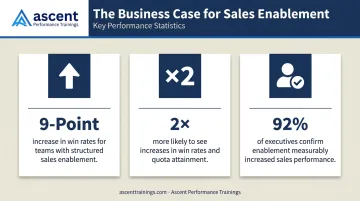
The 2023 State of Sales Enablement Report found that organizations with dedicated enablement reported a 9 percentage-point increase in win rates, and organizations using a formal enablement methodology were 2x more likely to see increases in both win rates and quota attainment. Meanwhile, 92% of executive leaders stated that enablement investment had increased sales performance.
Ascent's training model directly addresses this integration challenge. In-person, virtual, 1:1 coaching, and self-paced modalities are combined with an 8-week post-training reinforcement program — building an enablement layer into every engagement. Reps leave with the skills to perform and a structured system to keep those skills sharp.
Conclusion
Sales training and sales enablement are not competing priorities. They address different layers of the same challenge. Training equips your people with the skills to sell. Enablement empowers them to apply those skills consistently, at scale, with the right resources at their fingertips.
The organizations that outperform their competition build both — reps who know how to sell and the systems that let them do it reliably, quarter after quarter. The real starting point is an honest diagnosis: are your reps lacking the skills, or lacking the support to use them? That answer shapes everything — from how you structure your programs to where you invest first. Ascent Performance Trainings works with organizations on both sides of that equation, from foundational sales skill-building to the enablement frameworks that make those skills stick.
Frequently Asked Questions
What is the difference between sales enablement and sales training?
Sales training builds individual skills — objection handling, discovery, closing — through structured learning events. Sales enablement is an ongoing organizational strategy that provides the tools, content, and processes reps need to apply those skills in the field. Training develops capability; enablement creates the conditions for that capability to perform consistently.
What is SaaS sales enablement?
SaaS sales enablement is the infrastructure — onboarding playbooks, product battlecards, CRM workflows, conversation intelligence tools — that allows trained reps to engage buyers consistently at every deal stage. It's what enables a high-volume SaaS team to execute reliably without reinventing the process on every call.
What are the pillars of sales enablement?
The three core pillars are content enablement (relevant materials for each deal stage), technology enablement (tools that reduce friction and simplify selling activity), and process enablement (playbooks and coaching frameworks that standardize what good looks like across the team).
Can sales enablement replace sales training?
No. Enablement provides the infrastructure and resources, but without skills training, reps may lack the core competencies to use those resources effectively. A well-stocked content library doesn't help a rep who hasn't learned how to run a discovery call. The two approaches are complementary, not interchangeable.
Who is typically responsible for sales enablement?
Sales enablement is typically owned by a dedicated enablement manager or team working at the intersection of sales, marketing, and L&D. Their job is to align content, tools, training, and processes so reps have what they need to sell effectively — without improvising.
How do you know if your sales team needs training or enablement?
Start by diagnosing the root cause. If reps struggle with how to sell — shallow discovery, weak objection handling, low close rates — prioritize training. If they know how to sell but lack consistent tools or messaging, prioritize enablement. For most scaling organizations, the honest answer is both.