The shift to online delivery has created a real opportunity to fix this — but only if organizations build programs with intention. Virtual formats, AI-powered platforms, and on-demand resources make it easier than ever to deliver personalized, consistent coaching at scale. The challenge is knowing how to put the pieces together.
This guide covers what online sales coaching actually is, why it outperforms traditional approaches, and a six-step process for building a program that moves the metrics that matter.
The core argument: an effective online sales coaching program is not about scheduling more calls. It's about building a structured, personalized, reinforcement-first system that changes how reps sell every day.
Key Takeaways
- Online sales coaching reinforces behaviors continuously — training delivers knowledge once; coaching embeds it over time
- Organizations using a dynamic coaching approach achieved a 55.2% win rate — a 32.1% improvement over random coaching
- Effective programs combine deal coaching and skill coaching, not one or the other
- The forgetting curve is real — without reinforcement, most training content fades within a week
- Coaching middle performers yields the greatest overall revenue lift for a sales team
What Is Online Sales Coaching (and How It Differs from Sales Training)?
Online sales coaching is the practice of delivering structured, ongoing guidance, feedback, and skill development through digital platforms. Delivery formats typically include:
- Live one-on-one video sessions
- Asynchronous call reviews
- Group virtual workshops
- Self-paced learning modules
- AI-assisted practice scenarios
The goal across all of them is the same: continuous rep development, not periodic check-ins.
Training delivers foundational knowledge. It tells reps what to do — here's the methodology, here's the process, here's how to handle objections. Coaching helps reps learn how to do it consistently under real sales pressure, over time, with feedback specific to their behavior.
Training is an event. Coaching is a system.
Two Types of Coaching Every Program Needs
Most effective programs combine two distinct coaching functions:
- Deal coaching — guidance on live opportunities to improve outcomes, win rates, and deal velocity
- Skill coaching — ongoing feedback on behaviors and techniques to build long-term performance
Both are necessary. Coaching only on deals risks ignoring the behavioral gaps that cause those deals to stall. Coaching only on skills, without applying them to real opportunities, means reps struggle to transfer learning when it counts.
The online format solves a timing problem that in-person coaching never could: coaching no longer has to wait for a scheduled appointment. The 24/7 AI-personalized learning platform from Ascent Performance Trainings puts reinforcement content in front of reps exactly when they need it — between calls, before a big meeting, or while working through a stalled deal.
Why Online Sales Coaching Delivers Measurable Results
According to CSO Insights' 2019 Sales Enablement Report, organizations using a dynamic coaching approach achieved a 55.2% win rate — a 32.1% improvement over random coaching and a 27.9% improvement in quota attainment compared to organizations with no defined coaching process.
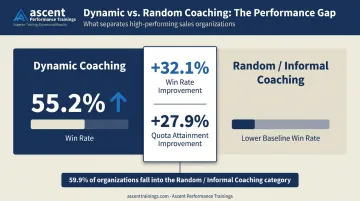
For context: 59.9% of organizations in that same study fell into the "random" or "informal" coaching category. The majority of sales teams are leaving significant performance on the table.
What the Virtual Format Unlocks
Beyond performance, online delivery creates structural advantages traditional programs can't match:
- Geographic flexibility — distributed and global teams receive consistent coaching regardless of location
- Scalable delivery — managers can coach more reps without proportionally increasing time investment
- Better documentation — recorded sessions and digital tools create a history of coaching conversations and behavioral progress
- AI-assisted feedback — platforms can identify skill gaps at the individual level and deliver targeted content automatically
The Retention Argument
Replacing a salesperson is expensive. DePaul University's Center for Sales Leadership found the average cost to replace a sales rep was $97,690, with open positions taking 3.69 months for inside sales roles to fill. For organizations running distributed teams or high-volume sales environments, a structured coaching program that improves rep engagement and development carries a direct, calculable financial return — one that compounds with every rep retained.
How to Build a Results-Driven Online Sales Coaching Program
Effective programs don't happen by accident. They require intentional design before the first session is ever scheduled. Here is a six-step framework for building one that actually drives results.
Step 1: Define Coaching Goals Tied to Business Outcomes
Every program starts with clear, measurable objectives — not vague goals like "improve performance."
Strong coaching goals look like:
- Reduce average sales cycle length by 15% over two quarters
- Increase close rates on discovery calls from 22% to 30%
- Improve objection handling consistency scores in call reviews
- Cut new hire ramp time from 90 days to 60 days
Each goal should connect directly to a revenue KPI. If a coaching objective can't be tied to something the CRO or VP of Sales tracks, it won't sustain organizational commitment.
Step 2: Assess Individual Rep Skill Gaps
Without understanding each rep's specific weaknesses, coaching becomes generic. Before designing the program, use multiple data sources to build an accurate picture:
- Call recordings reviewed for discovery quality, objection handling, and close attempts
- CRM activity showing pipeline health, follow-up behavior, and deal progression
- Win/loss analysis to surface patterns across the team
- Rep self-assessment to surface blind spots and confidence gaps
- Manager observation from shadow sessions or live-call reviews
Ascent Performance Trainings starts every engagement with a capability diagnostic and assessment phase because this step determines whether the program that follows will be targeted or generic.
Step 3: Choose Your Format and Modality Mix
No single format serves every rep or every coaching objective. The most effective programs combine multiple modalities:
| Format | Best For |
|---|---|
| Live one-on-one video sessions | Deal coaching, accountability, deep skill work |
| Group virtual workshops | Team-wide skill development, shared challenges |
| Asynchronous video review | Call analysis, paced reflection |
| Self-paced modules | Foundational knowledge, flexible access |
| AI-assisted practice | Repetition, low-pressure skill rehearsal |
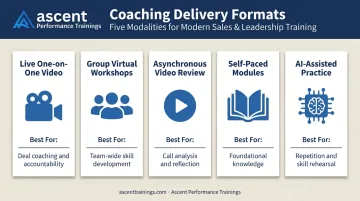
A blended approach matters because reps absorb information differently — and a single-format program will miss a significant portion of your team.
Step 4: Establish a Coaching Cadence
Frequency and consistency matter more than session length. Brief, regular touchpoints outperform infrequent marathon sessions.
A functional online coaching cadence looks like:
- Weekly or bi-weekly one-on-ones focused on a specific skill or deal objective
- Monthly group sessions for team-wide learning and shared problem-solving
- On-demand platform access available between sessions for immediate support
Within Ascent's engagement model, this cadence is built into the program architecture: 60–90 minute live virtual Zoom sessions deliver focused instruction, monthly 1:1 coaching sessions provide personalized accountability, and the 24/7 AI platform bridges the gaps between scheduled touchpoints.
Step 5: Build Post-Session Reinforcement
This is where most programs fail. Research on Ebbinghaus's forgetting curve shows roughly 74% of learned material is forgotten within six days without reinforcement — and sales training is no exception.
Post-session reinforcement doesn't mean more sessions. It means a structured system that keeps key concepts active between formal coaching touchpoints:
- Short recap videos sent within 24 hours of a session
- Targeted practice modules tied to that session's focus area
- Real-world application prompts to use in the next live selling situation
- Structured follow-up in the next session reviewing whether changes were applied
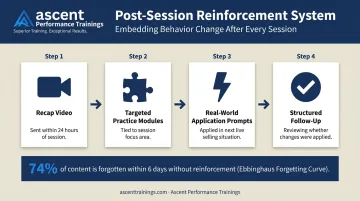
Ascent's 8-week post-training reinforcement program is built on this principle — weekly AI-generated micro-learning videos and real-world application prompts delivered over eight weeks, followed by monthly 1:1 coaching sessions. As one VP of Sales who went through the program noted: "the post-training follow-up ensured we didn't just retain knowledge but actually applied it."
Step 6: Train and Develop Your Coaches
Most sales managers were promoted because they were strong sellers — not because they knew how to develop others. Research cited by SBI indicates 73% of sales managers don't receive the training they need to coach a high-performing team. That gap erodes the return on every other investment in the program.
Effective coaching requires a different skill set than selling:
- Asking discovery-style questions rather than giving directives
- Recognizing and working with individual motivational styles
- Delivering specific behavioral feedback rather than general praise or criticism
- Holding accountability conversations without damaging the rep-manager relationship
Ascent's Sales Coaching Skills for Sales Managers program addresses this directly — covering 1:1 coaching cadence, deal-strategy coaching, call shadow methodology, feedback delivery, and performance management.
The "coach the coach" format is a standout element: managers receive coaching on their own coaching skills during live sessions with their teams. That direct feedback loop is what converts workshop learning into lasting behavioral change.
Best Practices for Online Sales Coaching That Actually Stick
Personalize Every Session
Coaching a new hire on product knowledge and coaching a veteran rep on objection handling are fundamentally different conversations. Use assessment data, call review findings, and rep-specific pipeline trends to shape the focus of each session. When every rep gets the same coaching, no one gets the right coaching.
Combine Deal and Skill Coaching
Weave both into the program cadence every week. Deal coaching improves the opportunities in front of the rep right now. Skill coaching builds the behaviors that will improve every deal going forward. Skipping either leaves performance gains on the table.
Make Role-Play Non-Negotiable
Reps who receive verbal feedback without rehearsal rarely change behavior consistently. Role-play builds muscle memory and embeds new skills before they're tested in real calls. Confidence under pressure is developed through practice, not instruction.
Common formats that work well:
- Manager-led role-play — direct feedback tied to real deal scenarios
- Peer-to-peer practice — lower stakes, higher repetition
- AI-simulated calls — available on demand, no scheduling required
Focus on Middle Performers
CEB/Gartner research consistently shows that coaching the middle 60% of a sales team yields the greatest overall revenue lift. These core performers aren't top earners, but they're not struggling either — they're coachable and numerous.
Top performers are already performing. Bottom performers may need personnel decisions more than coaching hours. Shifting even a fraction of that middle tier upward moves the revenue number more than any other investment.
Build a Feedback Loop, Not a Feedback Moment
Effective coaching requires follow-through. In the next session after giving feedback, review whether the recommended change was applied. Acknowledge progress explicitly. Adjust the focus based on what you observe.
Accountability checkpoints built into the cadence are what turn a single coaching conversation into a pattern of improvement — session after session, quarter after quarter.
How to Measure the ROI of Your Online Sales Coaching Program
Quantitative KPIs to Track
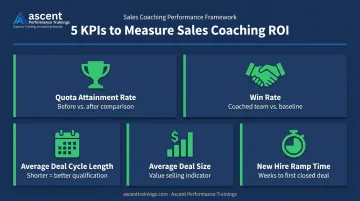
Measure these before and after the program begins, over a minimum of one full sales quarter:
- Quota attainment rates — before vs. after coaching
- Win rate — across the coached team vs. a comparable baseline period
- Average deal cycle length — shorter cycles signal improved qualification and urgency
- Average deal size — a coaching indicator for value selling and negotiation skills
- New hire ramp time — weeks to first closed deal and weeks to full productivity
Qualitative Measurement
Quantitative data shows what changed. Qualitative input explains why — and where to adjust next. Gather it through:
- Post-session rep feedback surveys on relevance and immediate applicability
- Manager assessments of specific behavioral changes over time
- Peer input from group coaching sessions on team-wide progress
Adoption: The Metric That Predicts the Rest
Before drawing conclusions from your KPIs, check whether the program is actually running as designed. If sessions aren't happening on schedule, reps aren't completing on-demand resources, or coaches aren't following a consistent framework, KPI movement won't follow — regardless of program quality.
Review adoption monthly. A process gap caught in week four is fixable. The same gap discovered at quarter-end means lost time and missed targets with little recourse.
What to Look for in an Online Sales Coaching Program or Partner
Methodology and Track Record
Look for demonstrated expertise in your specific sales environment — not generic sales content repurposed across industries. The right partner should have a clearly structured methodology with defined checkpoints and measurable outcomes, not just a curriculum, and should be able to show how their approach has been applied across organizations similar to yours.
Ascent Performance Trainings delivers programs across in-person, virtual, one-on-one, and self-paced formats — backed by Tim Carlisle's 30+ years of expertise and a methodology refined through real engagements in 75+ countries. That kind of cross-industry, cross-market application gives buyers a level of contextual relevance that generic off-the-shelf content rarely matches.
Multi-Modal Delivery
Programs that rely solely on self-paced video or weekly group calls miss two things that actually drive behavior change: personalization and repetition. Look for providers that blend multiple delivery formats, including:
- Live coaching sessions for real-time feedback and skill application
- On-demand resources accessible when a rep needs them — not just during scheduled windows
- Structured practice scenarios that simulate real selling situations
- Self-paced modules that accommodate different learning styles and schedules
Accountability and Measurement
Methodology and modality only matter if there's a system to measure whether they're working. Before committing to any program or partner, ask three questions:
- How do we define success together upfront?
- How will we track progress throughout the engagement?
- What post-program support exists once the formal engagement ends?
The right coaching partner helps you establish baselines, provides visibility into progress, and builds in post-engagement reinforcement to ensure skills translate into durable results — not short-term enthusiasm that fades by next quarter.
Frequently Asked Questions
What is the difference between online sales coaching and sales training?
Training delivers foundational knowledge in structured bursts — it tells reps what to do. Coaching is an ongoing, personalized process that reinforces behaviors, builds skills through practice, and helps reps apply what they've learned in live selling situations. Both are necessary, but they serve different purposes within a performance improvement program.
How often should online sales coaching sessions be held?
Start with bi-weekly one-on-ones, monthly group sessions, and on-demand access between touchpoints as your baseline. Adjust frequency based on rep experience level and onboarding stage — newer reps and those closing defined skill gaps benefit from more frequent contact.
What skills should an effective online sales coach focus on developing?
Both hard skills — discovery questioning, objection handling, closing techniques, pipeline management — and behavioral skills including confidence, active listening, and adaptability. Base priorities on individual rep skill gap assessments rather than a generic curriculum applied across the team.
How do you measure the ROI of an online sales coaching program?
Track quota attainment, win rate, deal cycle length, and ramp time as your core quantitative metrics, alongside qualitative behavioral observation and rep feedback. Measure across at least one full sales quarter to surface real trends rather than short-term noise.
Can online sales coaching work for remote or globally distributed teams?
Virtual formats are particularly well-suited for distributed teams. They remove geographic barriers, support asynchronous access to coaching resources, and enable consistent program delivery regardless of where reps are located — advantages that in-person-only models simply can't match at scale.
How long does it take to see results from an online sales coaching program?
Initial behavioral changes are typically visible within 4–6 weeks of consistent coaching. Meaningful KPI movement across win rates, sales cycle length, and quota attainment usually emerges over a full quarter — especially when post-session reinforcement is built into the program structure, not treated as optional.