What is healthcare customer service training?
Healthcare customer service training helps patient-facing and support teams communicate clearly, resolve concerns, manage escalations, and create a more consistent experience across the customer journey. For healthcare organizations, the program also considers regulated communication, patient and clinician expectations, emotional intelligence, and the need to protect trust during sensitive interactions.
Who should attend healthcare customer service training programs?
These programs are designed for hospital systems, physician group practices, healthcare technology firms, hospice and home health providers, dental and orthodontic groups, healthcare BPOs, revenue cycle organizations, and life sciences companies. Typical participants include customer service representatives, contact center teams, patient access teams, customer success teams, team leads, CX leaders, and healthcare operations managers.
What topics are covered in the program?
Curriculum can include customer-handling skills, emotional intelligence, complaint resolution, escalation management, voice-of-customer programs, customer journey mapping, relationship building, and brand-perception management. Healthcare-focused versions also address patient and clinician experience considerations, communication in regulated environments, complex stakeholder expectations, and practical service behaviors that improve trust and consistency.
Can healthcare customer service training be delivered virtually?
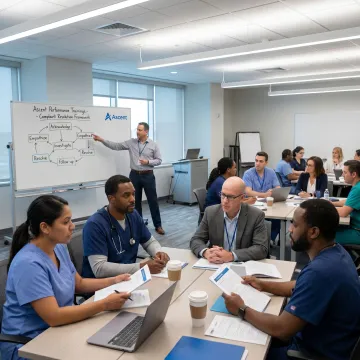
Ascent Performance Trainings delivers programs through in-person classroom workshops, live virtual sessions, on-demand learning, 1:1 coaching, and blended formats. Healthcare teams can combine live instruction with self-paced modules and post-training reinforcement, allowing busy operations, clinical-support, and customer service teams to learn without disrupting essential service coverage.
Can the curriculum be customized for our healthcare organization?
Yes. Programs are tailored to the organization’s healthcare setting, customer profile, team maturity, and service goals. Training can be adapted for hospitals, provider groups, healthcare SaaS companies, revenue cycle firms, home health organizations, medical device companies, and other regulated healthcare environments where patient trust, clinician relationships, and operational consistency matter.
How does post-training reinforcement work?
Ascent offers 8-week post-training reinforcement to help new behaviors stick. Participants receive weekly AI-generated micro-learning videos, real-world application prompts, and monthly 1:1 coaching sessions. This structure supports retention, accountability, and on-the-job application after the initial classroom, virtual, or academy-based training experience.
How do we measure training success?
Organizations often measure impact through customer satisfaction, NPS, complaint trends, escalation volume, first-contact resolution, retention, employee confidence, and manager observations. Ascent’s approach emphasizes practical skill application, reinforcement, and outcome alignment so training is connected to measurable business and customer-experience improvements rather than one-time classroom completion.
How much do healthcare customer service training programs cost?
Pricing is typically shaped by cohort size, delivery format, customization level, coaching requirements, certification needs, and whether the engagement includes post-training reinforcement or online learning access. The best starting point is to define your team’s service challenges, audience segments, and desired outcomes so Ascent can recommend an appropriate program structure.