Introduction
Most sales training programs were built for a world where reps share a floor, managers can walk over for a quick coaching moment, and informal peer learning happens naturally. That world no longer reflects how most B2B sales teams operate.
Remote and hybrid selling is now the default. McKinsey research found that 85% of B2B companies expected hybrid sales to be their most common sales role. B2B buyers now interact across an average of ten channels, up from five in 2016. Your reps are selling through screens, across time zones, without the ambient support of a team environment.
The cost of getting training wrong in this context is direct and measurable: slower ramp times, lower conversion rates, and reps who are technically capable but psychologically under-equipped to perform without a team around them.
This guide covers:
- Why remote training requires a different approach than traditional in-person programs
- How to build a remote sales training program step by step
- What content actually matters for distributed teams
- Best practices that drive lasting behavior change, not just temporary knowledge bumps
- The most common mistakes that waste training budgets
Key Takeaways
- Remote sales training must shift from one-time events to ongoing, on-demand learning
- Effective programs combine structured content, role-play, coaching, and reinforcement — not one method alone
- Skill development and mindset development both require explicit, dedicated training — neither happens by default
- Linking training data to KPIs like win rate and ramp time is what separates programs that drive results from those that don't
- New hire onboarding and tenured rep upskilling require separate tracks — one size wastes time and disengages your best people
Why Remote Sales Training Is Different (and Why It Matters)
The Structural Gap No One Talks About
In-person environments create invisible training infrastructure. A manager overhears a struggling call and offers quick feedback. A top rep shares a phrase that works over lunch. A new hire absorbs process just by watching colleagues. None of this exists for remote teams.
When organizations try to replicate in-person formats virtually — recording a classroom session, posting it online, and calling it remote training — they lose almost all of what made the original effective. A peer-reviewed study comparing training modalities found in-person training produced significantly larger mean knowledge gains than synchronous virtual training (2.82 items vs. 1.43 items). The gap isn't about technology — it's about design. Virtual training delivered without deliberate engagement mechanics simply underperforms.
What Remote Reps Actually Struggle With
Remote sales training must address challenges specific to distributed environments:
- Digital rapport-building — trust without shared physical space requires explicit technique
- Home environments create constant competing distractions that erode focus during sessions
- No team floor means no ambient energy to draw from between calls
- Selling across channels — email, async video, digital proposals, and virtual demos each require different skills
- Time zone complexity makes coordinating outreach and follow-up across regions far harder than it looks on a calendar
The Forgetting Problem
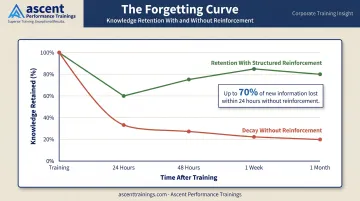
Each of these challenges compounds when the training itself doesn't stick. Ebbinghaus' replicated forgetting curve shows people retain only about one-third of unrehearsed material after 24 hours, and less than 30% after two days. For remote reps who return to their home office after a training event with no reinforcement, knowledge decay is nearly guaranteed.
This is why the program architecture matters more than any single training session.
How to Build a Remote Sales Training Program: Step-by-Step
Building an effective program starts with clear goals, not tool selection. Here's how to structure it.
Step 1: Define Objectives Tied to Business Outcomes
Training goals without measurable outcomes are just activity. Define the specific KPIs your program should move:
- Ramp time for new hires
- Conversion rates at key pipeline stages
- Call quality scores
- Deal velocity or average deal size
- Win rate
Goals should also be segmented. New hire onboarding objectives (speed-to-productivity) differ from tenured rep objectives (advanced technique, competitive positioning, mindset). Programs that treat both groups identically waste time and disengage experienced reps.
Step 2: Choose the Right Delivery Mix
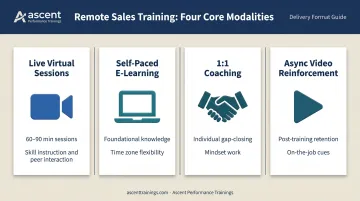
No single format serves all learning needs. The four core modalities for remote sales training — and when each works best:
| Modality | Best For |
|---|---|
| Live virtual sessions (60–90 min) | Skill instruction, peer interaction, real-time practice |
| Self-paced e-learning | Foundational knowledge, time zone flexibility, ramp content |
| 1:1 coaching | Individual gap-closing, advanced technique, mindset work |
| Async video reinforcement | Post-training retention, concept review, on-the-job cues |
ATD's 2025 sales training research — drawn from 242 sales professionals — found highly effective programs were 3.7x more likely to use continuous learning journeys and 3x more likely to encourage mentoring or coaching. In practice, that means programs combining live instruction, coaching, and async reinforcement consistently outperform any single-channel approach.
Ascent Performance Trainings, for example, integrates live virtual micro-learnings (60–90 minute Zoom sessions), a 24/7 AI-personalized on-demand platform, and 1:1 virtual coaching into a connected learning architecture.
Step 3: Structure Content Using a Microlearning Approach
Marathon training sessions don't suit how remote workers consume information. Microlearning — breaking content into short, focused modules covering one concept per session — maps directly to how busy sales reps actually learn.
Organize modules into a logical progression:
- Product and market knowledge
- Sales process and methodology
- Communication and discovery skills
- Objection handling and negotiation
- Closing and account expansion
This sequence prevents reps from practicing advanced skills on a shaky foundational base.
Step 4: Build In Role-Play and Live Practice
Passive content consumption does not build sales skill. Reps need repeated, deliberate practice in realistic scenarios before those skills show up in live deals.
Structure virtual role-play around the highest-stakes moments in your sales cycle:
- Cold outreach and opening calls
- Discovery and qualification conversations
- Objection responses (price, competition, timing)
- Closing and negotiation exchanges
The debrief immediately after each role-play is where most of the actual learning happens. Structured feedback from a manager or peer — not just the exercise itself — is what converts a simulation into skill development.
Step 5: Build a Post-Training Reinforcement System
Most training ROI is lost in the weeks after the workshop — not because the content was wrong, but because reinforcement never happened.
An effective reinforcement system includes:
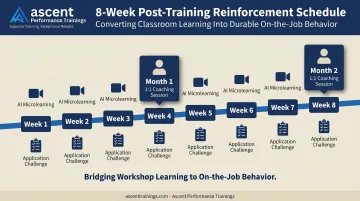
- Weekly microlearning videos, email prompts, and real-world application challenges
- Monthly 1:1 coaching sessions tied to live deals and individual goals
- A structured timeline of 8+ weeks — not the standard two-week drop-off
Ascent Performance Trainings' 8-week reinforcement model is built around exactly this structure: weekly AI-generated micro-learning videos and application prompts, followed by monthly 1:1 coaching sessions. The goal is bridging the gap between what reps learn in a workshop and what they actually do on the job. As one Chief Revenue Officer noted after an Ascent engagement: "Most programs leave you after the workshop, but Ascent Performance ensured our team had the reinforcement and coaching needed to sustain long-term success."
What to Include in Your Remote Sales Training: Core Content Areas
Many programs focus entirely on delivery mechanics and skip the harder question: what do reps actually need to learn? These are the non-negotiable content areas.
Sales Process and Methodology
Every rep needs to understand and execute the company's defined sales process — from prospecting through close — and that process must be adapted for remote selling contexts. Virtual demos, async follow-up sequences, and digital proposal review are not just tactical adjustments; they require explicit training to execute consistently.
Methodologies like MEDDIC, MEDDPICC, SPIN, and consultative selling frameworks should be trained and practiced in virtual formats — not simply introduced and left to self-application.
Virtual Communication and Relationship-Building Skills
Selling remotely requires skills that don't transfer automatically from in-person experience:
- Camera presence and energy on video
- Active listening without physical cues
- Written communication across email and async messaging platforms
- Building trust without shared physical context
These must be explicitly taught and practiced. Assuming experienced in-person reps will naturally adapt to virtual selling is one of the most common and costly mistakes organizations make.
Objection Handling and Sales Psychology
Remote objection handling is harder. Buyers disengage faster on video than in a room, and the physical cues that signal hesitation or interest simply aren't available. Training should cover:
- Structured response models for common objections (not improvised reactions)
- Mental preparation techniques for managing pressure and rejection without nearby team support
- Strategies for re-engaging buyers who go quiet after a call
Tim Carlisle's The Inner Game of Performance draws on elite athletic psychology to build sales resilience and mental focus — directly addressing the psychological demands that remote selling places on reps.
Sales Mindset and Performance Psychology
Remote work amplifies the internal challenges of selling. Isolation, delayed feedback, and limited leadership visibility erode confidence over time. Reps who are technically trained but psychologically under-prepared will underperform under pressure.
Training that covers the mindset side of performance is often what separates high-performing remote reps from average ones — not another product module or closing script. Key areas to include:
- Self-talk and confidence management under rejection
- Resilience strategies for extended sales cycles
- Goal orientation and focus without in-office accountability structures
Best Practices for Remote Sales Training That Actually Sticks
Prioritize Ongoing Training Over One-Time Events
ATD's research found that highly effective sales training organizations were 4.9x more likely to reach full seller productivity quickly and nearly 5x more likely to provide ongoing reinforcement than average organizations.
One-time training events produce a temporary knowledge bump. Continuous learning journeys produce behavior change. The distinction matters because behavior change is what moves pipeline.
Segment Training by Experience Level
New hires and tenured reps have fundamentally different needs:
- New hires need foundational skills, process orientation, product knowledge, and 30/60/90-day milestone plans
- Tenured reps need advanced technique, methodology reinforcement, competitive strategy, and mindset coaching
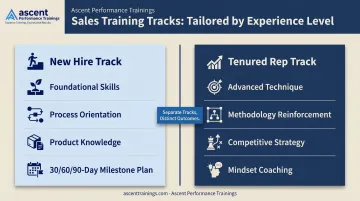
Running both groups through the same program wastes experienced reps' time and slows new hires who need structured ramp support. Treat these as separate tracks with distinct content, pacing, and coaching approaches.
Use Data to Identify Gaps and Personalize Content
Tracking sales KPIs alongside training data allows managers to assign targeted content rather than delivering the same program to everyone. Look at:
- Call conversion rates by rep
- Win/loss patterns at specific pipeline stages
- Deal velocity compared to team benchmarks
- Training completion rates correlated with performance data
Platforms with adaptive learning paths can automate this process, surfacing the right content for each rep based on demonstrated skill gaps. Ascent's AI-personalized online learning platform, for example, removes the burden of manual diagnosis from managers entirely.
Account for Time Zones and Scheduling Realities
Scheduling live training without considering time zones is one of the most avoidable failures in remote sales programs. A few structural adjustments resolve most of it:
- Record all live sessions and make them available on-demand
- Offer multiple session times for global teams
- Weight self-paced content heavily enough that reps in any time zone can complete the majority of training on their own schedule
Shorter live sessions — 60–90 minutes rather than half-day blocks — also make scheduling significantly easier across distributed teams.
Common Mistakes to Avoid When Training Remote Sales Teams
Three mistakes show up repeatedly across remote sales training programs — and each one quietly erodes the ROI of an otherwise solid investment:
- Copying in-person formats without redesigning for a distributed environment
- Skipping reinforcement and assuming a single training event changes behavior
- Ignoring the mindset layer that determines whether skills actually get used
Treating Remote Training as a Copy of In-Person Training
Recording an in-person training session and posting it online is not remote training. The format, pacing, engagement mechanics, and feedback loops all need to be redesigned for a distributed, asynchronous-first environment. Passive video consumption produces lower knowledge retention than well-designed synchronous or blended virtual instruction.
Skipping Reinforcement and Assuming Training Sticks
The pattern is predictable: a company invests in a strong training event, returns reps to their home offices with no follow-up, and then wonders why conversion rates haven't improved three months later. Behavior change requires repetition, coaching, and accountability over weeks — not a single session, however well-facilitated.
Research on the forgetting curve suggests people lose up to 70% of new information within 24 hours without structured reinforcement — meaning most training investments stall before they reach the field.
Neglecting the Mindset and Motivation Dimension
Remote sales training focused entirely on skills and product knowledge misses the variable that most directly determines whether those skills get used under pressure: the internal state of the rep. Technically prepared but psychologically under-equipped reps consistently underperform against their potential. Training that addresses confidence, resilience, and independent motivation belongs in every remote sales program — it directly determines whether new skills transfer when pressure is highest.
Frequently Asked Questions
How do you manage a sales team remotely?
Effective remote sales management runs on three pillars: clear KPI tracking so performance is visible without physical proximity, regular 1:1 coaching check-ins that address both skill and motivation, and structured communication rhythms that keep distributed reps aligned without micromanaging. Consistency in these three areas replaces the ambient accountability that office environments provide naturally.
What should you train a sales team on?
Core training categories include sales process and methodology, virtual communication skills, objection handling, product and competitive knowledge, and sales mindset. Effective programs address both skill (what to say and do) and psychology (how to think and respond under pressure) — both dimensions are required for sustained remote performance.
What are the four pillars of sales?
Most B2B sales processes organize around prospecting, qualification and discovery, presenting and communicating value, and closing and follow-up. Remote sales training should reinforce each pillar in a virtual selling context — adapting prospecting for digital outreach, discovery for video calls, and closing for async deal cycles.
How do you measure the effectiveness of remote sales training?
Track completion rates alongside performance KPIs — conversion rates, ramp time, and win rate — to confirm training is driving real performance gains. Pre/post knowledge assessments measure retention; regular manager feedback loops surface skill gaps that data alone won't reveal.
How long should remote sales training sessions be?
Live virtual sessions should run 60–90 minutes — ATD research identifies 90 minutes as the sweet spot for virtual instructor-led training. Self-paced microlearning modules should target 5–15 minutes per concept, since shorter and more frequent sessions consistently outperform longer ones for both engagement and retention.
What is the difference between remote and in-person sales training?
Remote training relies on digital delivery and async formats, requiring deliberate engagement design that replaces what office environments provide naturally. Without informal hallway coaching or peer observation, every reinforcement moment must be explicitly built into the program structure.