
Introduction
Most teams don't underperform because of technical gaps. They underperform because of how leaders communicate expectations, handle conflict, give feedback, and build trust through daily interactions. The breakdown is rarely loud — it accumulates quietly until engagement erodes and results follow.
Gallup's research puts a number on just how much this matters: managers account for 70% of the variance in team-level employee engagement, and engaged teams deliver 23% higher profitability than their less engaged counterparts. The difference between those two outcomes often comes down to communication.
This article covers the skills that matter most: emotional intelligence, active listening, clarity, adaptability, and feedback. It also addresses the best practices for developing them, the mistakes that undermine progress, and how to choose a training approach that produces lasting change rather than a temporary lift.
Key Takeaways
- Leadership and communication are interdependent skills that together drive a leader's real-world effectiveness
- The highest-impact skills to develop: emotional intelligence, active listening, feedback delivery, clarity, and situational adaptability
- Sustained development requires ongoing reinforcement — a single workshop rarely produces lasting behavioral change
- Track behavior change and business outcomes, not just course completion rates
Why Leadership and Communication Skills Are Inseparable
Leadership is fundamentally an act of communication. A leader achieves results through other people — and the primary tool for doing that is how clearly and authentically they communicate.
When that tool breaks down, the consequences compound fast.
Grammarly and The Harris Poll estimate that workplace miscommunication costs U.S. businesses $1.2 trillion annually. That figure spans all workplace communication, not just leaders — but it illustrates the scale of what's at stake when messages miss their mark.
Communication Shapes Culture, Not Just Clarity
The quality of daily conversations between leaders and their teams shapes organizational culture over time. When leaders communicate with transparency and genuine care, they build psychological safety — an environment where people speak up, take initiative, and collaborate without fear of penalty.
McKinsey's research on organizational health found that organizations actively listening to frontline recommendations are 80% more likely to consistently implement new and better ways of working. Listening isn't passive — it's a performance multiplier.
Communication as a Performance Driver
Strong leadership communication isn't only about being understood. It's about driving action.
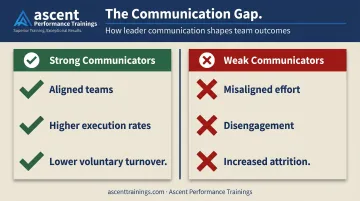
Leaders who communicate well — with clear outcomes, specific expectations, and accountability — produce measurably different results from those who don't:
- Strong communicators: Aligned teams, higher execution rates, lower voluntary turnover
- Weak communicators: Misaligned effort, disengagement, and the quiet frustration that shows up in attrition
These skills are learnable at any career stage. Even experienced leaders carry communication blind spots they've never had reason to examine — until those blind spots cost them something. Structured development — through coaching, practice, and feedback — gives leaders a rare chance to see those gaps before they become expensive.
The Essential Leadership & Communication Skills to Develop
The list of leadership competencies can stretch long. These skills consistently produce the biggest impact on team performance and culture, regardless of industry or level.
Emotional Intelligence and Empathy
Emotional intelligence (EQ) is the ability to recognize and manage your own emotions while navigating the emotional dynamics of others. Leaders with high EQ handle conflict more effectively, inspire loyalty, and make steadier decisions under pressure.
A 2023 peer-reviewed review published in PMC confirmed that emotionally intelligent leaders improve both team behavior and business results. The empathy component matters specifically because when leaders acknowledge what their teams are experiencing and respond with genuine care, people feel valued — and that directly improves engagement, retention, and willingness to take on harder challenges.
In Ascent Performance Trainings' leadership programs, EQ isn't an add-on. It's a foundational curriculum pillar, assessed via EQ diagnostics at the start of the program and developed through workshops and coaching across the full engagement.
Active Listening and Feedback
Active listening goes well beyond passive hearing. It's deliberate engagement: asking clarifying questions, reflecting understanding back, and resisting the pull to respond before fully comprehending.
HBR's analysis of over 3,400 participants in a manager coaching program found that the best listeners weren't quiet absorbers — they acted like a "trampoline," building on the speaker's ideas and creating cooperative conversations. A useful framing: effective leaders often do 80% of the listening and 20% of the talking in the conversations that matter most.
Listening and feedback are inseparable. Leaders must both give specific, constructive feedback and actively seek it from their teams. Asking for feedback while visibly doing nothing with it damages trust faster than not asking at all.
Gallup data makes the stakes plain: 80% of employees who received meaningful feedback in the past week are fully engaged. That's not a soft finding — it's a direct connection between a specific leader behavior and a measurable organizational outcome.
Clarity, Confidence, and Storytelling
Clear communication means speaking in specifics, avoiding jargon, and making it easy for people to act on what they've heard. This matters more in virtual and hybrid environments, where reduced body language cues make ambiguity riskier.
Storytelling is an underused leadership tool. Leaders who frame vision, strategy, and change through compelling narratives build more buy-in than those who rely only on data and directives. McKinsey describes a well-constructed change story as one of the most effective tools for aligning an organization around transformation.
A strong leadership narrative works because it is:
- Memorable — people retain stories far longer than bullet-point directives
- Repeatable — teams can carry and retell the message without distortion
- Connective — it links daily work to a larger purpose, increasing intrinsic motivation
Adaptability and Decision-Making
Effective leaders read their audience and adjust — tone, style, and message — whether they're coaching a direct report, presenting to the board, or navigating a team conflict. Rigidity in communication style is a common barrier to leadership effectiveness, and one of the hardest to self-diagnose.
Decision-making and communication are tightly linked. The best decisions lose impact when they're not communicated with context. Leaders who involve teams in relevant discussions before finalizing plans consistently see three benefits:
- Buy-in increases because people helped shape the outcome
- Blind spots surface before the plan is locked
- Execution quality improves because the rationale is clear
The decision gets better and the communication of it lands better.
Best Practices for Developing Leadership and Communication Skills
Developing these skills requires deliberate, sustained effort. A single workshop rarely produces lasting change.
Make Communication a Daily Practice, Not an Event
Leaders who communicate relentlessly and proactively — not only during formal meetings or crises — build trust in small increments over time. Brief check-ins, visible availability, and consistent updates prevent misunderstandings from compounding and signal that connection with the team is a priority, not an afterthought.
Seek and Act on Feedback Consistently
Structured feedback loops matter. Regularly asking team members what's working and what isn't, then visibly responding with action, creates psychological safety — and signals to the entire team that input is genuinely valued.
When leaders model receptiveness to feedback, it normalizes the same behavior throughout the team — and over time, honest input becomes the default, not the exception.
Invest in Coaching and Mentoring
One-on-one coaching accelerates development faster than group training alone. It surfaces individual blind spots, builds personalized accountability, and lets leaders apply concepts to their actual situations — not hypothetical ones.
Pairing coaching with mentoring adds something formal programs rarely provide: tested, contextual wisdom from someone who has navigated the same challenges firsthand.
Practice in Real Situations, Not Just Workshops
Stretch assignments, cross-functional project leadership, and difficult conversations are among the most powerful development experiences available. The 70/20/10 model from the Center for Creative Leadership frames it this way: approximately 70% of meaningful development comes from on-the-job experience, 20% from coaching and peer learning, and 10% from formal training.
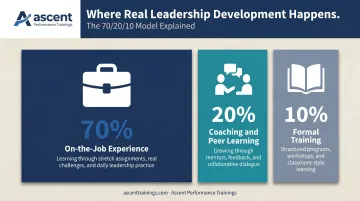
ATD cautions against treating those ratios as a precise empirical formula — they're a useful design heuristic, not a hard benchmark. The underlying principle holds regardless: classroom learning without real application doesn't produce behavioral change.
Reinforce Learning Over Time
The forgetting curve is real. Skills learned in training erode quickly without reinforcement, a challenge Harvard Business Publishing describes as turning the forgetting curve into a "learning-and-forgetting curve" when spaced practice is used consistently.
Best practice: follow formal training with structured, ongoing application — discussion sessions, practice scenarios, and coaching check-ins spaced over weeks or months. This is what converts a training event into a lasting behavioral shift.
Ascent Performance Trainings builds this directly into its program model. The 8-week post-training reinforcement program includes:
- Weekly AI-generated micro-learning videos reinforcing specific skills from the original training
- Real-world application prompts tied to each participant's role and context
- Monthly 1:1 coaching sessions to address challenges and track progress
All designed to keep skills active long after the classroom ends.
Common Mistakes That Undermine Leadership Development
Treating development as a one-time event. Many organizations invest in a leadership workshop and move on, expecting permanent change. Without follow-through and reinforcement, training rarely translates into sustained behavioral change. Real development requires repeated practice, structured reinforcement, and accountability over time.
Neglecting self-awareness. Many leaders focus on developing their teams but rarely examine their own communication habits and default behaviors. Tools like 360-degree feedback, journaling, or structured reflection after key interactions help surface the blind spots that well-intentioned communication can create.
Avoiding difficult conversations. Conflict avoidance is one of the most costly leadership communication failures. SHRM's Q4 2024 Civility Index found U.S. organizations lost over $2.7 billion per day from reduced productivity and absenteeism tied to incivility — and most of that builds from unaddressed tension. Effective leaders address tension early — naming the specific behavior, its impact, and the expected change — before resentment calcifies into a larger problem.
Choosing the Right Training Approach
The best training approach depends on the individual's role, experience level, and specific development gaps. The main modalities each serve different purposes:
| Modality | Best For |
|---|---|
| In-person workshops | Immersive group learning, role-play, real-time feedback |
| Live virtual training | Schedule flexibility, distributed teams, micro-topic depth |
| 1:1 executive coaching | Personalized blind-spot work, high-stakes skill application |
| Self-paced digital learning | Continuous reinforcement, accessible anytime |
The most effective programs combine multiple modalities rather than relying on one format. A cohort might begin with in-person workshops, continue with live virtual micro-learnings, and go deeper through individual coaching — with reinforcement running for weeks afterward.
That structure also shapes what to look for when choosing a training partner:
- Customized content, not generic off-the-shelf curriculum
- Practical, application-focused learning with real-world relevance
- Post-program support that extends beyond the training itself
- Career-stage appropriate design
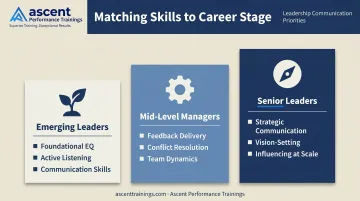
Career stage shapes which skills matter most:
- Emerging leaders build foundational EQ, active listening, and communication skills
- Mid-level managers focus on feedback delivery, conflict resolution, and team dynamics
- Senior leaders work on strategic communication, vision-setting, and influencing at scale
Ascent Performance Trainings' Leadership Academy is a 10-week program that applies this exact framework — pairing in-person, virtual, and 1:1 coaching modalities with an 8-week post-training reinforcement program. Content spans emotional intelligence, communication and influence, decision-making, strategic thinking, and change management, designed for first-line managers through senior leaders.
Measuring Growth and Sustaining Progress
Measuring leadership development should go beyond completion rates or satisfaction surveys.
Behavioral change is the real target. Effective measurement asks whether real habits shifted on the job:
Behavioral change is the real target. Effective measurement asks whether real habits shifted on the job:
- Do leaders communicate more proactively with their teams?
- Are feedback conversations happening more regularly — and earlier?
- Are team engagement scores trending upward over time?
A before-and-after behavioral assessment approach — 360-degree feedback or structured EQ assessments at the start and end of a development program — gives organizations a clear before-and-after picture of behavioral change. The Association for Talent Development (ATD) identifies retention, productivity, quality of work, and engagement as the most relevant leadership development impact measures.
Sustainability requires building development into the rhythm of work, not treating it as a separate initiative. Regular one-on-ones, recurring team feedback sessions, and ongoing learning touchpoints — brief coaching sessions, micro-lessons, relevant reading — keep skills active as leadership challenges continue to evolve.
Frequently Asked Questions
What are the most important communication skills for leaders to develop?
Active listening, clarity and directness, empathy, and the ability to give and receive feedback are the foundational skills to prioritize first. These four create the conditions for trust, alignment, and performance across any team or industry.
Can leadership and communication skills actually be learned, or are they natural talents?
They're learnable. While some people start with natural tendencies, deliberate practice, structured feedback, and coaching consistently produce measurable improvement at any experience level — including for leaders well into their careers.
How long does it take to develop strong leadership communication skills?
Meaningful improvement typically emerges within weeks of focused practice. Deep, lasting change develops over months of consistent effort, reinforcement, and application in real situations — so the honest answer is: both sooner and longer than most people expect.
What is the best way to practice leadership communication in day-to-day work?
Build daily micro-practices into existing routines:
- Listen intentionally in team meetings rather than preparing your next point
- Ask one open-ended question per one-on-one
- Give one piece of specific feedback each week
- Debrief key conversations to identify what landed and what didn't
What's the difference between leadership training and management training?
Management training focuses on processes, systems, and oversight. Leadership training focuses on influence, communication, inspiration, and developing people. The distinction matters because leadership skills apply at every level, not just to those with a formal management title.
How do I know if my leadership communication is actually improving?
Pay attention to behavioral shifts: team members start sharing ideas and concerns without being asked, feedback conversations feel less tense, and misunderstandings from unclear directives become less frequent. Engagement or performance metrics trending upward confirm the change is sticking.