Despite investing heavily in product training and CRM tools, many sales teams underperform because their reps hesitate at the moments that matter most: the cold call opener, the price objection, the close. That hesitation usually isn't a competence problem. It's a confidence problem.
This guide covers how to diagnose where confidence breaks down on your team, a step-by-step approach to rebuilding it, the factors that determine whether your efforts stick, and the most common mistakes managers make along the way.
Key Takeaways
- Sales confidence is a trainable behavior rooted in preparation, repetition, and consistent feedback — not personality.
- Diagnose where and why confidence breaks down before applying any fix — the cause determines the cure.
- Build on three fundamentals: deliberate role-play, deep product mastery, and a culture of ownership.
- Confidence erodes without reinforcement — one-time training is rarely enough.
- The manager's own behavior directly shapes team confidence — modeling matters as much as methodology.
Why Sales Team Confidence Directly Impacts Revenue
When a rep projects doubt, the prospect absorbs it and hesitates to commit. Confidence transfers directly from seller to buyer — and it shows up in the numbers. Gartner research shows that confident B2B buyers are twice as likely to report a high-quality deal compared to low-confidence buyers — and the seller's certainty is a direct input to buyer confidence.
The stakes are rising. With 67% of B2B buyers preferring a rep-free experience, buyers who do choose to engage with a rep expect sharp insight, clear conviction, and a reason to trust the conversation. Reps who can't deliver that give buyers every reason to go it alone.
The Hidden Cost of Low Team Confidence
Low confidence rarely shows up labeled as such on a performance dashboard. It disguises itself as:
- Reduced call volume and avoidance of difficult prospects
- Higher rates of premature discounting to close faster
- Weak objection handling that lets deals slip at the finish line
- Rep attrition driven by chronic underperformance and self-doubt
According to Korn Ferry, high coaching maturity is associated with 14% higher quota attainment, 15% higher win rates, and 18% lower voluntary turnover — evidence that the inverse (low coaching, low confidence) carries real revenue consequences.
Confidence Is a Team Dynamic, Not an Individual Trait
Those coaching and revenue numbers point to something bigger than individual performance: confidence is contagious in both directions. A team culture that normalizes hesitation, blame-shifting, or fear of rejection will erode even the most naturally confident reps over time.
Most managers misdiagnose the surface symptoms — low call volume, poor close rates — while missing the root cause entirely. The sections that follow focus on what actually moves the needle: the coaching behaviors, environment shifts, and skill-building practices that rebuild confidence at the team level.
How to Build Confidence in Your Sales Team: A Step-by-Step Approach
Building team-wide confidence is not a single intervention. It's a sequence of deliberate actions that compound over time. Skipping steps undermines the entire effort.
Step 1: Diagnose Where Confidence Breaks Down
Before applying any solution, map your sales process and identify the exact moments where reps hesitate, stall, or lose control. These breakdown points are not random — they reveal specific confidence gaps.
Practical diagnostic methods:
- Review call recordings for hesitation patterns and tone shifts
- Conduct ride-alongs and observe live conversations
- Run role-play sessions and note where reps stumble
- Analyze win/loss patterns across stages
- Hold one-on-one conversations to surface individual concerns
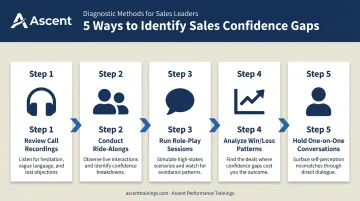
Each rep will have different weak points. One may fall apart at cold outreach; another may close confidently but crumble at the first sign of objection. Treat the diagnosis as a map, not a general observation.
Step 2: Build Deep Product and Prospect Knowledge
Most confidence failures trace back to preparation gaps. Reps who don't fully understand their product, their buyer's pain points, or the competitive landscape cannot speak with conviction. Knowledge mastery is the bedrock of authentic confidence.
Managers should build structured knowledge programs that cover:
- Product use cases specific to the buyer's industry
- An objection-response library built from real calls
- Buyer personas, ICP characteristics, and common decision triggers
- Competitive positioning and differentiation
A SaaS rep trained on MEDDIC qualification and enterprise deal dynamics — with context specific to that buyer's regulatory environment and deal cycle — enters those conversations prepared rather than anxious. Ascent Performance Trainings builds exactly this kind of vertical-specific knowledge into its sales programs, covering financial services, technology, oil and gas, and healthcare among others.
Step 3: Use Role-Play and Deliberate Practice as Core Training Tools
Confidence is built through repetition in safe, low-stakes environments. Role-play is not optional — it is the mechanism through which responses become automatic during real calls.
The analogy holds: research by Ericsson on deliberate practice shows that elite skill development depends on focused, feedback-rich repetition targeting specific weaknesses. Elite athletes train far more than they compete. Your reps should too.
What effective role-play looks like:
- Scenarios built from actual objections your team encounters
- Rotating partners — peer-led and manager-led sessions
- Immediate, specific, behavioral feedback after each round
- Increasing difficulty over time as reps build competence
Vague feedback ("you need to be more confident") does nothing. Specific feedback does everything: "Your voice dropped when they questioned the price — let's work on that exact response." Call recording review acts as a mirror, letting reps hear their own hesitation and self-correct faster.
Ascent's in-person classroom training is built around role-plays that simulate real-world scenarios — specifically because live facilitator coaching and peer practice produce the deepest behavior change of any delivery format.
Step 4: Build an Ownership Mentality and Growth Mindset
There's a consistent difference between reps who own their outcomes — "if I didn't close it, I need to learn from it" — and those who externalize blame. The former group develops confidence faster because they treat every loss as data, not defeat.
Managers can reinforce an ownership culture by:
- Celebrating effort and learning, not just closed deals
- Debriefing losses without blame — focus on what could be done differently
- Encouraging reps to compete against their own previous performance rather than peers
That last point matters more than it seems. Constant peer comparison breeds anxiety; personal benchmarking builds momentum.
Tim Carlisle's book The Inner Game of Performance draws directly on elite athletic psychology — the mental resilience and internal accountability that define top performers in sport translate precisely to sales. Those principles run through Ascent's training programs at the structural level, not as motivational filler.
Step 5: Sustain Confidence Through Ongoing Reinforcement and Coaching
A single training event, no matter how well designed, does not produce lasting confidence. Without reinforcement, learned skills fade before they change behavior. Research by Baldwin and Ford on training transfer is clear: whether skills transfer to the job depends on training design, reinforcement, and the work environment — not just the quality of the initial session.
What an effective reinforcement cycle includes:
- Weekly micro-coaching moments focused on specific behaviors
- Regular role-play sessions, not just quarterly reviews
- Access to resources reps can return to between calls
- Monthly one-on-one coaching to address individual challenges
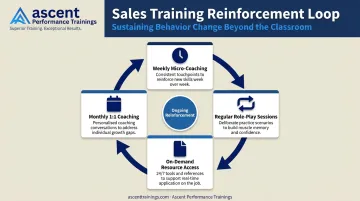
Ascent's programs include an 8-week post-training reinforcement phase — weekly AI-generated micro-learning videos, real-world application prompts, and monthly 1:1 coaching sessions — delivered automatically after classroom training concludes. One CRO captured the difference precisely: "Most programs leave you after the workshop, but Ascent Performance ensured our team had the reinforcement and coaching needed to sustain long-term success."
Key Factors That Determine Whether Confidence-Building Efforts Stick
Two teams can go through identical training and get very different results. Outcomes depend heavily on variables beyond the content itself.
Leadership Modeling
Managers who visibly handle objections with composure, own their own mistakes openly, and speak with conviction about the product signal to the team what the standard looks like. Managers who project anxiety or dodge difficult conversations undermine every confidence initiative they run.
Feedback quality is equally decisive. Gallup data shows that 80% of employees who received meaningful feedback in the past week are fully engaged — and engagement is the precondition for the kind of risk-taking that builds real skill. Timely, specific, behavioral feedback builds confidence. Vague or delayed feedback erodes it.
Psychological Safety in Team Culture
Amy Edmondson's foundational research defines psychological safety as a shared belief that the team is safe for interpersonal risk-taking. In sales, that means reps feel safe to attempt new techniques, make mistakes on a call, and ask for help without fear of embarrassment.
Without it, role-play feels threatening rather than developmental, and reps default to safe behaviors that keep them comfortable — not the stretched behaviors that build confidence.
Google's Project Aristotle identified psychological safety as the single most important dynamic in high-performing teams. Sales teams are no different.
Quality and Consistency of Training Delivery
Confidence built on surface-level tips fades quickly. Durable confidence requires training that combines practical skill-building with mindset development, is delivered by experienced facilitators, and is reinforced over time.
This is why multi-modal programs — combining classroom practice, virtual reinforcement, 1:1 coaching, and on-demand access — outperform single-format training. Each modality serves a distinct purpose, and structured post-training reinforcement (typically six to eight weeks) is what converts workshop learning into durable on-the-job behavior.
Recognition and Feedback Loops
Confidence grows when reps receive timely recognition of progress, not just closed deals. Acknowledge behavioral improvements as they appear:
- A cleaner objection response on this week's call
- Stronger tonality in a pricing conversation
- More proactive outreach volume than last month
Building a recognition habit around momentum — not just outcomes — keeps reps engaged during the difficult middle phase of skill development, when effort is visible but results haven't fully materialized yet.
Common Mistakes Sales Managers Make When Building Team Confidence
Most confidence-building efforts fail not because the intention was wrong, but because of predictable execution mistakes.
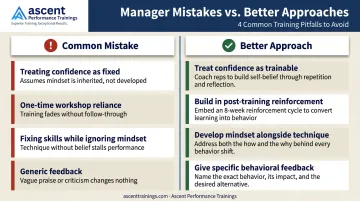
Four patterns show up repeatedly in teams that struggle to build lasting confidence:
- Treating confidence as a fixed trait. Managers who believe some reps "just have it" abandon high-potential people who need structured development. Confidence is trainable — and that assumption has to be built into how you manage.
- Running a one-time workshop and expecting lasting change. Without reinforcement, skills don't transfer. Design, practice, feedback, and environment all determine whether learning sticks; the workshop is the starting point, not the finish line.
- Fixing skills while ignoring mindset. Reps who know exactly what to say but still fear rejection will hesitate at the close. Mental resilience, ownership of outcomes, and response to failure must be developed alongside technique — not assumed to already be in place.
- Giving feedback that's too generic. "You need to be more confident" gives a rep nothing actionable. "Your voice dropped when they pushed back on price — let's rehearse that specific scenario" does. The specificity of your feedback determines whether the rep improves or stays stuck.
Frequently Asked Questions
What are the 5 C's of confidence?
A framework from sports psychology identifies five components: Commitment, Communication, Concentration, Control, and Confidence itself. In sales, these map to process discipline, clear buyer communication, focus under pressure, emotional control, and the projected certainty that moves buyers to act.
What are the main C's of sales?
A common practitioner framework covers Customer-Centricity, Communication, Closing, Consistency, and Continuous Learning — the behaviors that separate reps who build trust and close deals from those whose scripts fall flat under real pressure.
What causes low confidence in sales reps?
The primary causes are inadequate preparation, fear of rejection, insufficient product or buyer knowledge, lack of deliberate practice, and a team culture that doesn't normalize learning from failure. Any one of these can suppress confidence; when they compound, the damage compounds fast.
How long does it take to build confidence in a sales team?
Early improvements can appear within a few weeks of structured training and role-play. Sustained, team-wide confidence typically takes two to three months of consistent reinforcement, coaching cycles, and manager modeling — with the pace determined largely by follow-through quality after training ends.
How can sales managers model confidence for their team?
Managers model confidence by owning their own mistakes openly, speaking with conviction about the product and process, delivering clear and specific feedback rather than vague direction, and staying composed during difficult sales situations. What managers do in front of the team matters more than what they say in training.
What is the role of sales training in building team confidence?
Structured, ongoing training is the primary mechanism for building confidence — it provides the knowledge, practice repetitions, and feedback loops reps need to develop conviction under real pressure. Training that ends at the workshop rarely sticks; training with built-in reinforcement does.