
Introduction
You can know your product cold, nail the demo, and still lose the deal. Not because your solution fell short — but because something in how you communicated didn't land. Buyers sensed pressure instead of understanding. The conversation felt like a pitch, not a partnership.
This is the reality most sales training programs miss. Product knowledge and process get the attention, while communication — the actual skill that determines whether preparation converts to revenue — gets treated as a given.
It isn't.
According to Gartner's 2025 B2B buyer research, 73% of B2B buyers actively avoid suppliers who send irrelevant outreach, and 69% report inconsistencies between what a supplier's website says and what their sales team communicates.
Buyers aren't just choosing products. They're evaluating every interaction.
This article covers what sales communication training actually involves, which skills move the needle, why practice matters more than theory, and how to build a program that produces lasting behavioral change rather than workshop enthusiasm that fades by Friday.
Key Takeaways
- Sales communication is a learnable skill set, and structured training measurably improves performance outcomes regardless of a rep's natural personality.
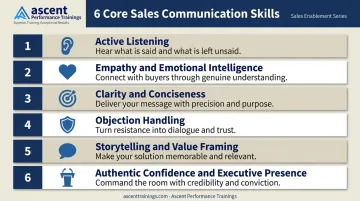
- Active listening, empathy, clarity, objection handling, storytelling, and executive presence are the six skills with the highest impact on deal outcomes.
- Even reps who understand communication techniques in theory revert to old habits under pressure — training must account for this gap.
- Post-training reinforcement determines whether skills actually transfer to the field; the training event alone rarely changes behavior.
- Effective programs blend multiple learning modalities and measure behavioral change, not just course completion.
What Is Sales Communication Training and Why Does It Matter?
Sales communication training is a structured process for developing the verbal, nonverbal, and interpersonal skills that drive productive sales conversations. It's distinct from product training (which tells reps what they're selling) and separate from generic soft skills programs (which address broad behavioral tendencies without connecting them to commercial outcomes).
The focus is specific: how reps listen, question, respond, frame value, and project credibility — in every conversation from a first discovery call to a final negotiation.
The Business Case Is Measurable
The CSO Insights 2019 Sales Enablement Report, based on 918 organizations, found that companies with formal sales enablement achieved a 49% deal win rate versus 42.5% for those without it. When sales methodology and process adoption exceeded 90%, win rates reached 57.8% and quota attainment hit 72.4%.
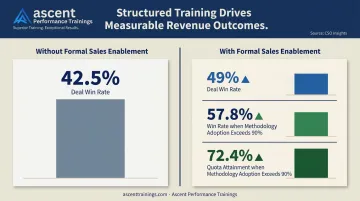
These aren't marginal differences. They represent real, recoverable revenue — and communication quality runs through every one of those interactions. The question isn't whether communication training moves the needle. It's who in your organization needs it most.
Who Benefits Beyond Frontline Reps
Sales communication training isn't only for reps making cold calls. The full beneficiary list includes:
- Sales managers who must coach behaviors they were never formally taught
- Account executives and customer success leaders navigating complex, multi-stakeholder deals
- Technical professionals who engage buyers regularly but lack structured communication development
- Sales leaders and CROs in executive conversations where credibility and presence determine trust
For organizations unifying messaging across geographies and roles, the stakes are higher still. Inconsistent communication at any touchpoint erodes buyer confidence — and that damage compounds across the entire relationship.
Core Communication Skills Every Sales Professional Must Master
Active Listening and Questioning
Most salespeople listen to reply rather than to understand. There's a difference, and buyers feel it.
Purposeful listening means giving full attention to what a buyer says — not mentally formulating your next pitch while they're still talking. Discovery questions that surface the real decision drivers (not just stated needs) deepen this further.
Together, they build the kind of trust that makes buyers willing to be honest about their concerns, their budget, and what it would actually take to move forward.
Frameworks like SPIN Selling are built entirely around this principle: each question type requires genuinely processing the previous answer before moving forward.
Empathy and Emotional Intelligence
Buyers don't want to be sold to. They want to feel understood.
Empathy in sales isn't about being agreeable — it's about accurately identifying what a prospect is actually worried about and positioning your solution as genuinely relevant to their situation. A 2025 peer-reviewed study of 195 B2B sales professionals found that salesperson emotional intelligence was positively associated with performance outcomes, reinforcing that the ability to read and respond to buyer emotions is a real competitive advantage, not a soft add-on.
Clarity and Conciseness
Over-explaining and jargon both do the same damage: they make buyers work harder to understand value, and they signal that the rep hasn't taken the time to tailor the conversation to this specific person.
Clear, simple communication — matched to the buyer's level of familiarity with your category — signals respect for their time and confidence in the solution. If you can't explain the value in two sentences, the message isn't ready.
Objection Handling as a Communication Skill
When a buyer pushes back, they're usually telling you something useful.
Pushback typically signals incomplete information, unaddressed risk, or a need to feel heard before moving forward. The skill is responding with curiosity rather than pressure:
- Acknowledge the concern directly, without deflecting
- Ask a follow-up question to understand it fully
- Reframe or clarify without pushing the buyer toward a predetermined answer
Storytelling and Value Framing
Data and features are forgettable. Stories are not.
Harvard Business Review argues that effective sales pitches should be built around a compelling story that explains why the product meets the buyer's needs — not a product rundown. A concise, relevant story that helps a buyer visualize their own outcome is more persuasive and more memorable than a spec sheet, every time.
Authentic Confidence and Executive Presence
Buyers evaluate credibility continuously throughout a conversation. Tone, pacing, and the ability to sit comfortably with silence all signal whether a salesperson is a trusted advisor or a vendor anxious to close.
Executive presence — the quality that makes someone command a room without dominating it — isn't innate. It's built through deliberate practice, recorded role-play review, and structured feedback. Reps who invest in it close more senior deals and shorten the trust-building phase with C-suite buyers.
The Knowing-Doing Gap: Why Skills Without Practice Fall Short
Understanding active listening and actually listening differently in a live conversation with a skeptical buyer are two entirely different things.
This is the knowing-doing gap: a rep may grasp objection-handling concepts intellectually but freeze, over-talk, or default to old habits the moment a real buyer pushes back under pressure. Theory doesn't close this gap. Practice does.
The Forgetting Curve Problem
New information fades fast. According to ATD's 2023 State of Sales Training, citing Gartner research, B2B sales reps forget 70% of training content within one week and 87% within one month of a workshop.
A single training event, no matter how well-designed, can't overcome this. The content needs to come back — spaced out, applied in realistic contexts, and reinforced through follow-up coaching and manager check-ins.
What Actually Builds Communication Muscle Memory
That's exactly what separates high-performing training organizations from the rest — they don't rely on a single format. ATD's 2023 data shows that 65% of high-performing organizations use in-person role-play simulations, versus just 39% of others — and 79% build in post-training activities, versus 46% of lower performers.
The elements that convert knowledge into muscle memory:
- Role-play scenarios that simulate real buyer types (the resistant prospect, the indecisive stakeholder, the price-sensitive buyer)
- Spaced repetition that revisits key concepts at intervals that interrupt natural forgetting
- Real-time feedback from a coach who has operated in the environments being practiced
- Accountability loops that connect what was practiced to what's happening in live deals
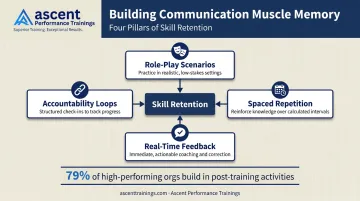
When these elements work together, communication skills stop being something reps know about — and start being something they do automatically, even under pressure.
How to Develop Sales Communication Skills That Stick
Start With a Skills Gap Assessment
Before designing any training, identify which specific communication breakdowns are costing your team. Is it weak discovery questions? Poor objection responses? Losing credibility in executive conversations? Inconsistent messaging across channels?
Training built around real gaps produces results. Training built around assumed gaps wastes time and budget. A capability diagnostic — the kind Ascent Performance Trainings conducts at the start of every engagement — ensures the program addresses what the team actually needs, not what looks good in a proposal.
Use Role-Play as the Primary Skill-Building Vehicle
Simulating real buyer situations in a low-stakes environment lets reps make mistakes, receive feedback, and build instinctive responses before those conversations happen live.
The most effective scenarios are specific to the deals reps actually lose. For example:
- The prospect who went quiet after the proposal
- The economic buyer who questions ROI in the first two minutes
- The champion who supports you internally but keeps stalling the decision
Vague scenarios produce vague improvements. The closer the practice is to the real situation, the faster the skill transfers.
Build Reinforcement In From Day One
Post-training structure determines whether skills transfer to the field. The real design question isn't how to end training. It's how to extend it.
Ascent Performance Trainings' 8-week post-training reinforcement program directly addresses this: participants receive weekly AI-generated micro-learning videos, real-world application prompts, and monthly 1:1 coaching sessions specifically designed to embed behavior change during the period when skill regression is most likely. A CRO who went through the program noted: "Most programs leave you after the workshop, but Ascent ensured our team had the reinforcement and coaching needed to sustain long-term success."
Address the Psychology, Not Just the Tactics
Communication behavior is driven by mindset. Reps who believe in what they're selling, approach conversations with genuine curiosity, and manage self-doubt under pressure communicate more naturally and persuasively than those running a script.
This is the gap most communication training ignores. Tim Carlisle, founder of Ascent Performance Trainings and author of The Inner Game of Performance, has spent 30 years working at this intersection — combining practical communication techniques with the performance psychology that keeps those techniques accessible under pressure, not just in practice sessions.
Measure Behavioral Change, Not Just Completion
Course completion rates measure attendance. They don't measure impact.
The metrics that actually indicate communication training is working:
| Metric | What It Signals |
|---|---|
| Discovery call quality scores | Whether reps are asking better questions |
| Objection-to-advance conversion rate | Whether pushback is being handled constructively |
| Win rate changes | Whether communication improvements are reaching deal outcomes |
| Manager-observed behavior change | Whether field application is happening |
| Sales cycle length | Whether clearer communication is shortening time to decision |
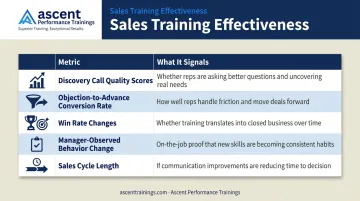
Track leading indicators first. Lagging revenue outcomes follow — typically over a 60–90 day window when reinforcement is sustained.
What to Look for in a Sales Communication Training Program
Not all programs are built the same. Here's what separates programs that deliver lasting behavior change from those that don't.
Blended Learning Modalities
ATD's 2025 blended sales training research found that 93% of highly effective sales training organizations include an in-person, instructor-led component — while also blending virtual instructor-led sessions (66%) and self-study (50%).
A single-format training rarely accommodates the varied schedules, experience levels, and geographies of a full sales team. Look for programs that combine live instruction, on-demand access, and independent practice in an integrated architecture rather than treating each as a standalone option.
Post-Training Reinforcement Structure
Ask any provider directly: what happens after the program ends? If the answer is a PDF summary or a follow-up survey, the skills you paid to develop will follow the forgetting curve right out of your team's repertoire.
Programs that include follow-up coaching sessions, spaced reinforcement resources, and accountability structures over weeks — not just days — deliver longer-lasting results. ATD 2025 found that highly effective organizations are nearly 5x more likely to provide ongoing reinforcement than lower-performing peers. This isn't a nice-to-have; it's the variable most correlated with sustained behavior change.
Facilitator Experience That Matches the Room
Communication skills training lands when the person delivering it has operated in the same environments participants face. Before committing to a provider, evaluate facilitators against these criteria:
- Documented sales leadership background — not just a training certification
- Cross-industry delivery history across sectors relevant to your team
- Measurable program outcomes they can point to, not just client logos
- Vertical fluency — the objection-handling dynamics in a SaaS enterprise deal differ significantly from those in an oil and gas capital equipment pursuit
Tim Carlisle has designed and delivered programs across 75+ countries over 17 years, working with organizations in financial services, technology, oil and gas, healthcare, and professional services. That range of experience means the training adapts to the specific commercial context your team operates in — not a generic script applied across every room.
Frequently Asked Questions
What are the 5 C's of communication skills?
The most commonly cited version includes Clear, Concise, Correct, Complete, and Courteous, though many business communication frameworks extend this to seven C's. In sales, each principle applies directly: unclear messages lose buyers, unnecessary length wastes their time, and courteous communication builds the trust that closes deals.
How do you learn sales and communication skills?
The most effective path combines structured training, deliberate role-play practice, mentorship or coaching, and ongoing reinforcement. Passive learning — watching videos, reading frameworks — builds awareness but not competency. Consistent practice in realistic scenarios accelerates development far faster than content consumption alone.
What are the most important communication skills for sales professionals?
Active listening, empathy, objection handling, clarity, and authentic confidence are foundational. These skills compound on each other: stronger listening leads to better questioning, which produces more relevant positioning and makes objections easier to handle. Together, they build toward higher close rates.
How long does it take to see results from communication training?
Early behavioral shifts — improved discovery questions, better objection responses — can appear within weeks when training includes real practice and feedback. Meaningful performance improvements (higher close rates, shorter cycles) typically require consistent reinforcement over 60–90 days.
Can sales communication skills be learned, or are they natural talents?
These are learnable skills. Even naturally charismatic communicators improve substantially with structured training, and professionals who consider themselves introverted or technical often develop highly effective communication styles through deliberate practice. Talent provides a starting point; training determines the ceiling.