
Introduction
Most sales managers fall into one of two camps: those who coach when they get around to it, and those who treat coaching as a non-negotiable rhythm. The gap between them comes down to structure, not skill.
A sales coaching cadence is a scheduled, recurring system of coaching interactions — a calendar-protected sequence of touchpoints that covers every dimension of rep growth and performance. It's not a reactive conversation after a deal collapses or a quarterly check-in squeezed between pipeline reviews. It's a deliberate framework that makes development predictable.
The numbers make the case plainly. According to the Salesforce State of Sales Report 2026, 46% of sales reps rarely receive feedback on sales conversations — and 40% cite their manager's lack of time as the primary enablement obstacle. Those numbers point to a structural gap, not a skills gap.
This post covers the five elements that form the foundation of any effective sales coaching cadence — and how to turn each one from a calendar entry into a genuine performance driver.
Key Takeaways
- A sales coaching cadence is a structured system of layered, scheduled touchpoints — not a single recurring meeting
- The five elements — 1:1s, pipeline reviews, goal setting, performance reviews, and skills development — work together as a system
- Without calendar-protected time, coaching defaults to reactive firefighting
- Measuring cadence impact through clear metrics separates systems that drive results from those that fade after a quarter
What Is a Sales Coaching Cadence?
A sales coaching cadence is a structured, recurring series of coaching interactions — not isolated one-off conversations, but a deliberate schedule that covers all major areas of rep growth and performance over time.
Two distinctions matter here:
Cadence vs. ad hoc coaching: Ad hoc coaching happens after something breaks. A cadence is proactive — it surfaces problems before they become crises and creates a consistent developmental thread across time.
Coaching cadence vs. sales outreach cadence: These terms get conflated often. A sales outreach cadence governs how reps engage prospects. A coaching cadence is an internal leadership tool focused on rep development — entirely different purposes, same word.
Why a Consistent Sales Coaching Cadence Matters
When managers lack structure, coaching gravitates toward whoever is loudest, newest, or furthest behind quota — not whoever will benefit most from focused development.
The data on this is uncomfortable. CSO Insights found that 62.9% of organizations used a random or informal sales coaching approach — meaning only about a third had any formal or dynamic coaching system in place. The performance gap this creates is significant: dynamic coaching was associated with a 55.2% average win rate compared to 41.8% for random coaching in the same study.
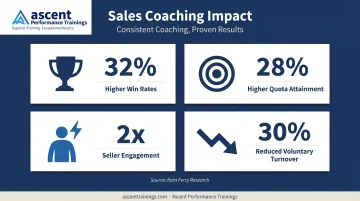
The retention case is equally strong. Korn Ferry research found that consistent coaching and impact measurement were associated with:
- 32% higher win rates
- 28% higher quota attainment
- 2x seller engagement
- Nearly 30% reduced voluntary turnover
These numbers align with what Tim Carlisle, founder of Ascent Performance Trainings, has observed across 30+ years of designing and delivering programs in 75+ countries. Organizations that treat coaching as a scheduled rhythm, not a one-time event, consistently see higher win rates and lower voluntary attrition. That insight shaped Ascent's 8-week post-training reinforcement program, built around weekly micro-learnings and monthly 1:1 coaching sessions to address what happens when the rhythm stops after the workshop ends.
As one CRO who went through an Ascent engagement put it: "Most programs leave you after the workshop, but Ascent Performance ensured our team had the reinforcement and coaching needed to sustain long-term success."
The 5 Key Elements of a Sales Coaching Cadence
Individualized 1:1 Coaching Sessions
This is the cornerstone. Dedicated, scheduled time between a sales manager and each rep focused entirely on the individual's development — not pipeline updates, not quota pressure, but skill-building, mindset, and growth.
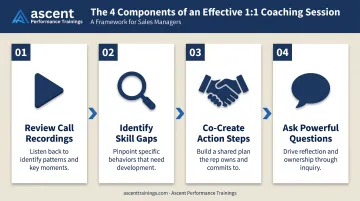
What effective 1:1 coaching actually looks like in practice:
- Reviewing field observations and call recordings
- Identifying specific skill gaps (objection handling, executive engagement, discovery quality)
- Co-creating action steps the rep owns and the manager tracks
- Asking powerful questions rather than delivering lectures
The coach's role in a 1:1 is to draw out insight, not pour it in. A good rule of thumb: if the manager is talking more than the rep, the session is drifting toward a status update.
Frequency guidance: Most high-performing organizations run 1:1 coaching sessions every 2–6 weeks, with newer reps at the higher end of that range. Sales Management Association research found that new, poor-performing, or self-requesting reps were coached roughly twice monthly on average, while high performers received coaching approximately quarterly. High-performing firms provided 15–20% more coaching across all rep types.
The non-negotiable: these sessions must be locked into calendars as recurring, protected time.
Pipeline and Deal Reviews
Pipeline reviews are operationally focused — the manager and rep assess the health, size, and velocity of the pipeline together. Where are deals stalling? Where is activity thin? Where are win rates declining for a consistent reason?
Deal-level coaching goes deeper. Instead of asking "where does this stand?", the manager asks questions that help the rep think through the deal strategically:
- Who are the real decision-makers, and have we reached all of them?
- What objections are likely at the next stage?
- What does the buying committee actually care about?
The rep walks away with a clearer strategy — not just a status confirmed.
Frequency guidance: Pipeline reviews work well weekly, often embedded in team sales meetings. Deal-level coaching happens as needed — either built into 1:1s or triggered by high-stakes upcoming opportunities.
Goal Setting and Planning Sessions
These are the strategic layer — where manager and rep step back from daily activity to set quarterly targets, review progress, and course-correct while there's still time.
Strong goal-setting sessions cover more than quota numbers:
- Improvement targets in close rate, average deal size, or prospecting volume
- Specific skill development goals tied to observed gaps
- Connection between individual rep goals and team/company objectives
The academic case for this is well-established. Locke and Latham's foundational goal-setting research, summarizing studies across 40,000+ participants, found effect sizes of .42 to .80 for specific, difficult goals versus vague "do your best" goals. The principle holds in sales: a rep with a documented, manager-reviewed quarterly plan is working toward something real. A rep with a quota number and no plan is guessing.
Goals without scheduled check-ins are aspirations. Build quarterly "reset" conversations into the cadence — review progress, acknowledge wins, and adjust course before the quarter slips out of reach.
Performance Reviews
Performance reviews are different from coaching sessions — and conflating them is a mistake that undermines both.
Coaching sessions are ongoing and developmental. Performance reviews are formal, structured evaluations tied to a defined review period. They assess two dimensions simultaneously:
- Results achieved — quota attainment, pipeline metrics, win rate against defined targets
- Behaviors demonstrated — how the rep engaged with coaching, where they improved, and where gaps persist
A strong performance review also examines exhibited behaviors versus expected behaviors, strength identification, and areas requiring further training or deliberate practice.
Frequency guidance: Biannual formal performance reviews work well for most teams. The critical point: reviews should never contain surprises if the rest of the cadence is functioning. With consistent 1:1 coaching and deal-level feedback in place, any performance issue should surface and get addressed well before a formal review forces a difficult conversation.
If a formal review catches a problem that's been building for six months without a coaching conversation about it, the cadence has a gap.
Team Assessment and Skills Development
Step back far enough and individual coaching data tells a team-wide story. This element is where sales leaders evaluate whether the team as a whole is built to meet current market demands.
Key questions to examine:
- Are the right people in the right roles?
- Where are the headcount gaps or structural mismatches?
- What skill deficiencies are showing up consistently across multiple reps?
That last question is the link between team assessment and skills development. When weekly 1:1s and pipeline reviews surface the same problem repeatedly — say, reps struggling to engage executive buyers — that's not an individual coaching issue. That's a team-wide skills gap that needs a structured intervention.
The Gartner data on this is striking: 72% of sellers report feeling overwhelmed by the skills required to excel, and 94% of CSOs agree their organizations must update seller talent profiles to meet current revenue goals.
At Ascent Performance Trainings, this is where the coaching cadence connects directly to formal training. Skills gaps identified through coaching conversations — whether in negotiation, objection handling, or executive engagement — feed directly into targeted program recommendations. The Sales Coaching Skills for Sales Managers program, for example, addresses the manager-level gap that often underlies broader team performance problems: coaching skill itself.
How to Structure Your Coaching Cadence: Frequency and Format
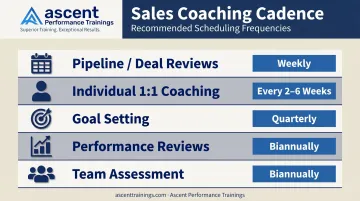
Here's a practical baseline for most B2B sales teams:
| Cadence Element | Recommended Frequency |
|---|---|
| Pipeline / Deal Reviews | Weekly (team meeting) |
| Individual 1:1 Coaching | Every 4–6 weeks (new reps: every 2 weeks) |
| Goal Setting and Planning | Quarterly |
| Formal Performance Reviews | Biannually |
| Team Assessment | Biannually |
Adjust for team size and maturity. A manager with six experienced reps needs a different structure than one managing twelve reps in their first year.
A cadence only works if meetings are blocked in advance, recurring calendar invites are sent, and competing priorities are actively pushed aside. Coaching that lives on a "when we can fit it in" basis typically doesn't survive past Q1.
Supplemental, unscheduled coaching moments — a quick debrief after a call, real-time feedback on a win or a miss — add depth and real-time reinforcement without replacing the structure. They sit between scheduled sessions, not in place of them.
How to Measure Whether Your Coaching Cadence Is Working
A cadence without measurement becomes a ritual. Track both leading and lagging indicators.
Leading indicators (process health):
- Coaching sessions are happening on schedule
- Reps can articulate their development goals without prompting
- Managers are giving feedback based on specific observations, not gut feel
Lagging indicators (performance impact):
- Improvement in close rates
- Reduction in ramp time for new hires
- Decrease in voluntary rep turnover
- Pipeline accuracy improvement
External research shows exactly how much these indicators move the needle. Organizations with dynamic coaching systems averaged 21.3% higher quota attainment and 19.0% higher win rates over the study average compared to those using random or informal approaches, according to CSO Insights.
The gap between knowing this and acting on it remains wide. Sales Management Association research found that measuring coaching impact scored only 2.9 out of 7 for prevalence — most sales teams track coaching activity poorly, if they track it at all. That's a significant missed opportunity. Coaching metrics deserve a seat at the same reporting table as revenue and pipeline data.
Frequently Asked Questions
What is a good sales coaching cadence?
A good sales coaching cadence combines weekly pipeline reviews, regular 1:1 sessions, quarterly goal-setting, and biannual performance reviews. What separates a functioning cadence from a great one is consistency: protected calendar time and recurring invites that actually get kept.
What are the 5 C's of coaching?
The 5 C's are Clarity, Compassion, Curiosity, Confirmation, and Commitment. In a sales coaching context, they translate to clear session objectives, genuine curiosity through open questioning, and mutual commitment to agreed development actions.
What is the 70/30 rule in coaching?
The 70/30 rule holds that the person being coached should speak roughly 70% of the time, while the coach speaks 30%. This reinforces that great coaching is built on questions and active listening — the manager's job is to draw out the rep's thinking, not to lecture or problem-solve for them.
What is the 80/20 rule in sales coaching?
In sales coaching, the 80/20 rule applies the Pareto principle: focus coaching attention on the 20% of behaviors that drive 80% of results. This helps managers prioritize high-impact development rather than spreading effort evenly across every possible improvement area.
How often should sales coaching sessions be held?
Formal 1:1s should occur every 2–6 weeks — newer or struggling reps at the higher end — with weekly pipeline reviews and biannual performance conversations. Frequency scales with rep experience level and overall team maturity.