
Introduction
Picture this: a B2B client calls in furious about an unexpected invoice charge. They're threatening to escalate to their CFO and leave a scathing review on G2. Your agent has about 60 seconds to decide how to respond — and that response determines whether the account churns or deepens.
Conflict is unavoidable in customer service. How teams handle it, though, is a trainable skill set — not a personality trait.
The stakes are real. According to PwC's 2025 Customer Experience Survey, 52% of consumers stopped buying from a brand after a bad product or service experience, and 29% walked away specifically due to poor customer experience.
For B2B organizations where a single account can represent six or seven figures in revenue, one mishandled interaction carries outsized consequences.
This article covers 8 conflict resolution strategies that work in practice, three real-world examples showing them applied across different conflict types, and how structured training converts these strategies into consistent, team-wide behavior.
Key Takeaways
- Effective conflict resolution combines emotional regulation, active listening, and solution-focused communication
- Every difficult conversation is an opportunity to turn a frustrated customer into a loyal one
- Most conflicts fall into four predictable categories: miscommunication, billing disputes, delivery delays, and product/service issues
- Structured coaching builds conflict resolution skills faster and more reliably than leaving teams to rely on instinct
- Knowing when to escalate is as critical as knowing how to de-escalate
Why Customer Service Conflict Resolution Matters
Poor conflict handling doesn't just cost you one account — it costs you reputation.
When customers have bad experiences, they talk. According to the 2017 American Express Global Customer Service Barometer, 95% of customers discuss poor service experiences, with the average person telling 21 others about what happened.
In B2B contexts, where professional networks are tight and peer reviews drive purchasing decisions, a single mishandled complaint can influence multiple prospective clients.
The Agent-Side Cost
The pressure of handling unresolved conflicts without a framework also takes a toll on your team. Salesforce's 2024 State of Service Report found that more than half of service agents report experiencing burnout, and 69% of service decision-makers identify attrition as a major or moderate challenge. Each new agent hire costs between $10,000 and $20,000 when you factor in recruiting, training, and lost productivity during ramp-up — making retention as much a financial concern as an operational one.
Conflict as an Opportunity
Those costs make the upside worth understanding: a well-handled complaint can create stronger customer trust than an interaction that went smoothly from the start. Research on service recovery shows that high-quality recovery can raise post-interaction satisfaction above pre-failure levels — what's known as the service recovery paradox. The effect on satisfaction is real, though it isn't guaranteed to translate directly into repurchase behavior. The practical implication: investing in how your team handles conflict isn't damage control — it's a direct input to customer retention and loyalty.
Common Types of Customer Service Conflicts
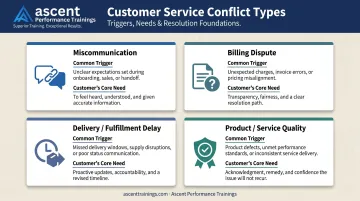
Most conflicts your team encounters will fall into one of four categories:
| Conflict Type | Common Trigger | Customer's Core Need |
|---|---|---|
| Miscommunication | Policy misunderstood or expectation not set clearly | Clarity and respect |
| Billing dispute | Unexpected charge or pricing discrepancy | Transparency and fairness |
| Delivery/fulfillment delay | Missed timeline or no proactive update | Accountability and control |
| Product/service quality | Deliverable doesn't match what was promised | Acknowledgment and a fix |
Two patterns show up consistently across all four types:
- Each calls for slightly different language, but the same core resolution framework applies
- Conflicts often stack — a product defect compounded by a slow follow-up is harder to de-escalate than either issue on its own
That compounding effect is exactly why agents need a flexible framework, not a rigid script. The eight strategies below give your team a structure they can adapt to any combination of conflict types.
8 Customer Service Conflict Resolution Strategies
Strategy 1: Stay Calm and Regulate Your Emotions
Emotional regulation is the foundation every other strategy rests on. When an agent reacts emotionally, they match the customer's agitation instead of anchoring the conversation — and the result is escalation, not resolution.
Practical techniques for staying calm in the moment:
- Controlled breathing — A slow exhale before responding creates a brief reset and prevents reactive replies
- Physical space — Standing or stepping back slightly (in person or between chat messages) creates psychological separation from the tension
- Trigger awareness — Agents who know their specific emotional triggers (accusations of incompetence, raised voices) can prepare for them rather than being caught off guard
The goal isn't to suppress emotion — it's to prevent it from driving the response.
Strategy 2: Practice Active Listening
Active listening means full attention, no interruption, and no premature problem-solving. In practice:
- Use verbal acknowledgments — "I see," "go on," "that makes sense" — to signal you're tracking without redirecting
- Let the customer finish before formulating a solution
- Summarize what you heard before responding: "So if I'm understanding correctly, the charge appeared on your invoice without prior notice — is that right?"
Research published in the International Journal of Hospitality Management found that listening before apologizing — and verbally acknowledging customer concerns — increased customer satisfaction after a service failure. Customers who feel heard are less likely to escalate, because escalation is often a bid to be taken seriously.
Strategy 3: Validate the Customer's Feelings
Validation is not agreement. You're not admitting fault — you're acknowledging that the customer's experience is real and their reaction is understandable.
Effective validation phrases:
- "I can see why that would be frustrating."
- "That's not the experience we want you to have."
- "I completely understand why this feels urgent."
What to avoid: generic phrases like "I understand how you feel" with no specificity. They read as scripted and often land as dismissive.
Strategy 4: Avoid Taking It Personally
Agents who take complaints personally stop resolving and start defending. The mental reframe: the customer is frustrated with the situation, not with you as a person.
A useful technique is internal emotional labeling — briefly naming the customer's emotion to yourself ("they're feeling blindsided") before responding. That brief mental step creates distance between their frustration and your identity, keeping your objectivity intact when the conversation gets heated.
Strategy 5: Avoid Arguing — Stay Solution-Focused
Debating who's "right" rarely ends well — even when the customer has the facts wrong, winning the argument doesn't resolve the issue.
Instead:
- Acknowledge the disagreement without debating it: "I can see we have different information on this — let me look into what happened."
- Redirect to shared goals: "What I'd like to do is find a solution that works for you. Can we focus on that?"
Shifting from fact-checking to problem-solving deflates most conflicts before they escalate further.
Strategy 6: Be Assertive, Not Aggressive
There's an important distinction here. Assertiveness means holding professional boundaries firmly while remaining respectful. Aggressiveness is confrontational and damages trust.
When a customer crosses a line — abusive language, threats — assertive language sounds like:
"I'm here to help, and I genuinely want to work through this with you. I do need us to communicate respectfully for that to happen."
This sets a clear boundary without becoming defensive or punitive.
Strategy 7: Take Responsibility and Apologize When Warranted
An apology is appropriate even when fault isn't clear — agents can apologize for the customer's experience without admitting liability.
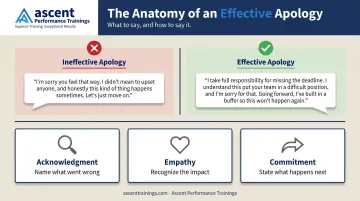
The anatomy of an effective apology:
- Acknowledgment — Name what went wrong specifically
- Empathy — Recognize the impact on the customer
- Commitment — State what happens next
Compare:
- ❌ "I'm sorry you feel that way." — Hollow. Implicitly dismissive.
- ✅ "I'm sorry this charge appeared without warning — that shouldn't have happened, and I'm going to find out what caused it and what we can do." — Specific, accountable, and forward-looking.
Strategy 8: Collaborate on a Solution
Customers who are involved in building the resolution are far more likely to accept the outcome. The two-step approach:
- Ask first — "What would make this right for you?" This surfaces expectations before you make an offer, preventing a mismatch.
- Meet, approximate, or explain — Either fulfill the request, offer the closest viable alternative, or clearly explain what's possible and why
Always close with a concrete next step: a timeline, a follow-up date, or a confirmation of what's been done. Open-ended closings invite repeat contacts.
Customer Service Conflict Resolution in Action: 3 Examples
These three scenarios show how the 8 strategies work together — not as rigid scripts, but as a flexible framework applied to different conflict types.
Example 1: Billing Dispute — Client Feels Overcharged
Scenario: A B2B client in financial services receives an invoice with a line item they claim was never disclosed. They're requesting escalation to a manager.
Strategies applied: 1, 3, 7, 8
The agent stays calm (Strategy 1) and doesn't immediately defend the charge. They acknowledge the client's frustration: "I understand why this is concerning. An unexpected charge with no prior context would raise questions for anyone" (Strategy 3). They pull up the account, review the billing record transparently with the client, and offer a genuine apology for the lack of proactive communication (Strategy 7).
The turning point: When the agent stops defending the charge and starts investigating it alongside the client, the tone of the call changes. The client moves from demanding escalation to participating in the resolution. From there, the agent collaborates on an outcome — a credit, a detailed breakdown, or an adjustment, with a clear confirmation timeline (Strategy 8).
Example 2: Delayed Delivery — Broken Promise at a Critical Moment
Scenario: A customer needed a product delivered before a business launch. The guaranteed delivery date passed with no communication from the vendor.
Strategies applied: 2, 3, 7, 8
The agent listens without interrupting as the customer explains the full operational impact of the delay (Strategy 2). Rather than moving quickly to logistics, they first validate the stress: "Missing a launch deadline because of a delivery failure is a serious situation. I want to understand exactly what happened and fix it" (Strategy 3).
They then offer a genuine apology for the broken promise — specific to what went wrong, not a procedural "sorry for the inconvenience" (Strategy 7).
Critical insight on transparency: Honest updates, even bad news, build more trust than vague reassurance. Telling a customer "the earliest we can guarantee delivery is Thursday, and here's why" is more credible, and more respectful, than "we're working on it." From there, the agent expedites the solution and confirms a clear timeline (Strategy 8).
Example 3: Product or Service Quality Complaint
Scenario: A corporate client reports a software tool isn't performing as described in the contract. They're experiencing financial and operational disruption.
Strategies applied: 5, 6, 8
The agent resists the impulse to defend the product or explain why it should be working (Strategy 5). Instead, they stay assertive about what can realistically be done: escalation to a technical specialist, a replacement, or an interim workaround, without overpromising (Strategy 6).
From there, they co-create a resolution plan with the client, including specific owners and timelines (Strategy 8).
The follow-up as a strategy extension: Checking back after the resolution closes the loop in a way customers remember. A brief follow-up, even a single email confirming everything is resolved, demonstrates accountability and improves retention.
Building a Conflict-Ready Customer Service Team
Individual resilience matters, but it isn't enough. Under sustained pressure, even skilled agents default to poor habits without structured training, consistent practice, and feedback loops.
ATD research found that 98% of organizations now incorporate scenario-based learning into their talent development programs, up from 88% in 2016 — with 72% citing better knowledge retention as the primary driver. Practical, applied training produces measurably different outcomes than theory-only instruction.
What Effective Conflict Resolution Training Looks Like
The highest-impact programs combine:
- Simulated role-play covering billing disputes, delivery failures, and product complaints before agents face them live
- Structured debriefs of real calls and chats, focusing on what worked and what could shift next time
- In-the-moment emotional regulation tools, not just conceptual frameworks
- Language guides for validation, apology, and solution collaboration
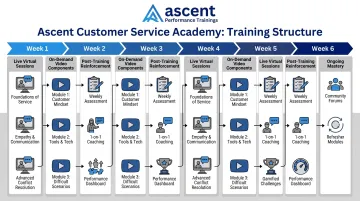
The Ascent Customer Service Academy is built around exactly this model. The 10-week program covers complaint handling, escalation management, emotional intelligence in service interactions, and communication skills, delivered through live virtual sessions, on-demand video, and 1:1 coaching.
It also includes an 8-week post-training reinforcement program with weekly AI-generated micro-learning videos and monthly one-on-one coaching sessions, designed to ensure skills stick beyond the classroom.
What Managers Can Do Between Training Sessions
Structured training creates the foundation. Managers sustain it. Between formal programs:
- Model active listening in team meetings — how managers handle internal disagreements directly shapes how agents handle customer conflicts
- Debrief difficult interactions without blame, focusing on what the agent could apply differently next time
- Frame conflict resolution as a measurable professional competency, not damage control or a soft skill
Frequently Asked Questions
How do you resolve conflict in customer service?
The core sequence: stay calm, listen actively, validate the customer's feelings, avoid debating facts, and collaborate on a concrete solution. The goal isn't to end the conversation — it's to restore trust and leave the customer with a reason to stay.
What are the 5 C's of conflict resolution?
The 5 C's is a training mnemonic rather than a single established framework, and versions vary. A widely used version covers: Clarity, Communication, Collaboration, Compromise, and Control (of emotions) — each one mapping to a specific customer service behavior.
What is the most important skill in customer service conflict resolution?
Active listening. Customers who feel genuinely heard are far less likely to escalate, because escalation is usually a bid to be taken seriously. Listening must come before problem-solving; offering a solution before a customer feels understood often backfires.
How do you handle an angry customer who refuses to calm down?
Maintain calm, use specific validation language, and avoid arguing. If the interaction becomes unproductive or crosses into abusive territory, assertively name the boundary and, if necessary, escalate to a supervisor. Knowing when to hand off is itself a resolution skill — not a failure.
How can managers help their teams improve conflict resolution skills?
Three levers drive improvement:
- Structured training with role-play scenarios
- Real-time coaching after difficult interactions
- Modeling conflict resolution in how managers handle disagreements within their own teams — the most overlooked lever of the three