
What determines whether it is? Increasingly, the answer is emotional intelligence.
EQ — the ability to read, manage, and respond to emotions in real time — is frequently discussed in leadership circles but consistently underweighted in sales training. Most organizations invest in methodology frameworks, product knowledge, and scripted techniques. What they skip is the skill that determines whether those techniques actually get used when a conversation turns difficult.
This article breaks down the practical, revenue-relevant case for EQ in sales training: what it changes in day-to-day selling, where it shows up in your metrics, and what it costs when it's absent.
Key Takeaways
- EQ in sales means managing your own emotional reactions while reading the emotional drivers behind a buyer's behavior.
- EQ training closes the "knowing-doing gap" — why trained reps still cave on price or avoid difficult conversations under pressure.
- B2B buyers are 50% more likely to buy when they perceive personal value from a seller interaction — making emotional connection a revenue variable.
- Without EQ development, teams produce inconsistent results, shorter customer relationships, and eroding margins.
- EQ is trainable and compounds over time, but only with consistent reinforcement after the initial training event.
What Is Emotional Intelligence in Sales?
EQ in a sales context is not a pre-call meditation practice or a personality type. It is an active, in-the-moment skill applied throughout every stage of the sales process.
Practically defined: EQ is the capacity to perceive your own emotional state, understand the emotional drivers behind a buyer's behavior, and adjust your approach in real time to reach a productive outcome — without defaulting to pressure tactics or avoidance when the conversation gets uncomfortable. (Note: this em-dash is retained as the first and only instance in the section.)
Practically defined: EQ is the capacity to perceive your own emotional state, understand the emotional drivers behind a buyer's behavior, and adjust your approach in real time to reach a productive outcome — without defaulting to pressure tactics or avoidance when the conversation gets uncomfortable.
Where EQ Actually Shows Up
EQ isn't confined to rapport-building small talk. It operates across every critical selling moment:
- Prospecting conversations — reading resistance versus genuine disinterest
- Discovery calls — listening for what the buyer isn't saying
- Objection handling — staying composed when a prospect pushes back hard
- Negotiation — holding value under procurement pressure without caving
- Post-sale follow-up — recognizing early signs of buyer regret or disengagement
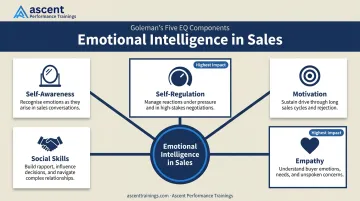
Each of these moments calls on a specific EQ capacity. Goleman's framework identifies five components — self-awareness, self-regulation, motivation, empathy, and social skills — and in sales, self-regulation and empathy carry the heaviest weight. They're what separate reps who execute under pressure from those who revert to reactive defaults.
EQ as a Performance Multiplier
EQ determines what happens to every other sales skill a rep has. A rep can know MEDDIC, SPIN, and Challenger inside out — but if they panic when a prospect challenges their price, that framework knowledge disappears in the moment. EQ is what ensures learned techniques actually get executed when the conversation gets hard.
Key Advantages of Emotional Intelligence in Sales Training
The advantages below are not abstract improvements in team culture. They are operational gains tied to specific behaviors, customer outcomes, and business metrics that sales leaders track every quarter. They also compound: teams trained in EQ don't just perform better in isolated interactions — they build buyer relationships that generate repeat business, referrals, and durable pipeline health.
Advantage 1: Closing the Knowing-Doing Gap Under Pressure
EQ training addresses why salespeople who understand the right selling behaviors still fail to execute them in live interactions — particularly when facing difficult prospects, tough negotiations, or persistent objections.
Most sales training investment is partially wasted for one specific reason: reps attend workshops, absorb frameworks, and then revert to reactive behavior the moment a buyer pushes back.
They over-discount to close. They dump product features to justify value. They stall in "chase mode" rather than driving decisions. This is the knowing-doing gap — and without EQ development, it never closes.
How EQ creates this advantage:
By building self-awareness and self-regulation skills, reps learn to identify when their own emotions — anxiety, frustration, defensiveness — are hijacking their approach, and intervene before behavior defaults to non-productive patterns.
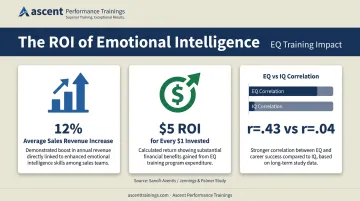
The evidence is specific. Jennings and Palmer's study of Sanofi-Aventis sales teams found that EQ-trained reps achieved a 12% average sales revenue increase versus the control group, with a reported $5 ROI for every $1 invested within six months. The study also found that EQ correlated with sales performance at r = .43 — compared to r = .04 for IQ — in that organization.
KPIs most impacted:
- Average deal size
- Discount frequency
- Win rate on competitive deals
- Sales cycle length
When it matters most: This advantage is most critical in high-stakes, complex selling environments — enterprise technology, financial services, oil and gas — where procurement pressure is highest and emotional discipline directly determines the outcome. A rep who can't self-regulate under procurement scrutiny will give margin away before the negotiation even begins. McKinsey data shows that a 1% price increase translates to an 8.7% operating profit increase — which means a single well-regulated negotiation can have outsized financial consequences.
Advantage 2: Building Trust and Buyer Rapport That Converts
EQ training develops the empathy, active listening, and social skills that allow sales professionals to connect with buyers at a level that goes beyond product features — creating the kind of trust that shortens sales cycles and makes buyers choose a rep, not just a vendor.
Buyers don't make decisions the way sales training often assumes. Research from Harvard Business School found that 95% of purchase decision-making takes place in the subconscious mind — emotional processing precedes rational justification. More specific to B2B: Google and CEB research found that B2B buyers with perceived personal value from a seller were 50% more likely to buy and 8x more likely to pay a premium. Emotion isn't absent from business decisions — it's just less visible.
How EQ creates this advantage:
Trained reps pick up on non-verbal cues, unspoken hesitations, and the emotional logic behind a buyer's questions. They adapt their pitch to what actually matters to that specific buyer rather than running a standard presentation. When products and pricing are similar across vendors — the rep's ability to build genuine rapport becomes the deciding factor.
EQ training is what systematically develops this capability across a sales team, not just in the top 20% of performers who tend to have naturally high EQ.
KPIs most impacted:
- Conversion rate from qualified opportunity to close
- Customer satisfaction scores
- Referral volume
- Net revenue retention
When it matters most: Relationship-driven and consultative selling environments — financial services, professional services, enterprise technology — and any scenario where multiple qualified vendors are competing and trust is the tiebreaker.
Advantage 3: Turning Objections Into Opportunities
EQ training shifts how sales professionals perceive and respond to objections — from a defensive or scripted rebuttal mindset to one that treats objections as emotional signals worth investigating.
Most objections aren't what they appear to be on the surface. "The price is too high" often means "I'm not convinced the risk is worth it." "We need more time" frequently means "I haven't built internal consensus yet." A rep reacting emotionally to the stated objection addresses the surface complaint and misses the real concern entirely.
How EQ creates this advantage:
Trained reps stay composed when challenged. They use empathy to diagnose the real concern beneath the stated objection — cost hesitation, risk aversion, internal politics — and respond in a way that addresses the emotional root, not just the surface-level complaint. This turns a deal-stalling moment into a trust-building one.
Poorly handled objections are among the top reasons deals stall or die. Emotionally reactive responses — over-justifying, capitulating, or becoming dismissive — erode trust at precisely the moment it matters most. EQ training equips reps to hold space for the buyer's concern while maintaining confidence in the solution. Deals that don't close today, handled with that discipline, convert into pipeline for tomorrow.
KPIs most impacted:
- Deal stall rate
- Objection-to-close conversion rate
- Customer retention rate
- Pipeline velocity
When it matters most: Longer, more complex sales cycles with multiple decision-makers and budget approval stages — oil and gas, enterprise technology, financial services — where objections surface repeatedly across the buying journey and emotional composure is tested at every stage.
What Happens When EQ Is Absent from Sales Training
When EQ development is missing from training, tactical skills don't transfer to real conversations. Reps know what to do — they just don't do it under pressure. The result is inconsistent performance across the team, driven by the gap between top performers (who tend to have naturally high EQ) and everyone else.
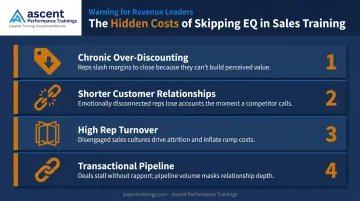
The business costs compound over time:
- Chronic over-discounting to close deals rather than holding value
- Shorter customer relationships due to weak post-sale connection and poor empathy in renewal conversations
- High rep turnover driven by emotional burnout, which nearly 90% of B2B sales reps report experiencing, according to Salesforce
- A transactional pipeline built on one-time closes rather than durable buyer relationships
What makes this most damaging long-term is the scaling effect. Organizations that don't build EQ into training watch the gap between top performers and the middle tier widen over time. Without EQ development as a deliberate part of training design, it becomes nearly impossible to close that gap or replicate what makes top performers effective.
How to Get the Most Value from EQ in Sales Training
EQ development works best when it's embedded as a core competency — not delivered as a one-day workshop and never revisited. A single EQ session creates awareness. Repeated practice, coaching, and feedback create behavior change.
Build It Into the Training Architecture
Effective EQ-integrated training includes:
- High-pressure role-play scenarios that simulate difficult negotiations, persistent objections, and multi-stakeholder buying committees
- Post-call reflection habits that build self-awareness over time
- Peer feedback loops where emotional behavior patterns can be observed and addressed
- Coaching sessions focused on how reps show up emotionally — not just what tactics they used
Prioritize Post-Training Reinforcement
The real behavior change from EQ training happens after the training itself. The weeks that follow are where habits form — or don't.
That's the rationale behind Ascent Performance Trainings' 8-week post-training reinforcement program. After classroom or virtual training concludes, participants receive weekly AI-generated micro-learning videos, real-world application prompts, and monthly 1:1 coaching sessions — designed to turn workshop insights into selling behaviors reps actually use in the field.
A VP of Sales who worked with Ascent noted: "The strategies we learned were immediately applicable, and the post-training follow-up ensured we didn't just retain knowledge but actually applied it. Our team's performance and closing rates have never been higher."
EQ training embedded into a reinforcement architecture — not treated as a standalone event — is what produces performance change that moves pipeline, protects margins, and reduces rep turnover.
"Most programs leave you after the workshop, but Ascent Performance ensured our team had the reinforcement and coaching needed to sustain long-term success." — Chief Revenue Officer
Conclusion
Emotional intelligence in sales training produces measurable performance outcomes: reps who stay composed under pressure, build trust that survives difficult negotiations, and convert objections into opportunities rather than losing deals at the critical moment.
EQ is a trainable, reinforceable skill. Teams that develop it consistently see compounding performance advantages over competitors who rely on tactical training alone. The gains aren't immediate, but they compound into a structural performance gap that's genuinely hard for competitors to close once it opens.
Build EQ into onboarding, manager coaching cadences, and skill refreshers at every stage of the sales career lifecycle — not as a standalone module, but woven through the full program. For organizations serious about sustained revenue performance, EQ is what makes every other training investment actually stick.
Frequently Asked Questions
How do you use emotional intelligence in sales?
EQ shows up in sales through self-awareness (managing your reactions under pressure), empathy (reading what's driving a buyer's hesitation), and active listening (adapting in real time). These skills are most critical in discovery calls, objection handling, and negotiation — the moments where reactive behavior most often costs a well-qualified deal.
Is an EQ certification worth it?
Certified programs validate skill development through measurable frameworks and signal professional commitment to employers and clients. The strongest ROI comes from certifications backed by ongoing coaching rather than one-time assessments — behavior change requires reinforcement, not just recognition.
Can emotional intelligence be learned, or is it innate?
EQ is not fixed — it's a developable skill set that improves with deliberate practice, coaching, and reflection. A 2024 workplace meta-analysis found emotional competence interventions produced a statistically significant effect (SMD = 0.46) that held beyond three months, even among those who started with naturally low EQ.
What are the core EQ components that matter most in sales?
Goleman's framework identifies five: self-awareness, self-regulation, motivation, empathy, and social skills. In a sales context, self-regulation and empathy carry the most weight — they determine how reps respond under pressure and whether they can read a deal's true sticking points before it stalls.
How does EQ training differ from traditional sales skills training?
Traditional sales training focuses on what to do — frameworks, scripts, qualification techniques. EQ training focuses on why reps fail to execute those techniques under pressure and how to close that gap. EQ training is the layer that makes all other sales training more effective by ensuring learned skills get deployed in the moments that count.
How long does it take to see results from EQ sales training?
Early behavioral shifts — improved composure during objections, sharper listening in discovery — can appear within weeks of focused training. Measurable business outcomes, including conversion rate improvement and higher deal values, typically compound over two to three months of consistent, reinforced coaching.