
Here's the real problem: reps go quiet after onboarding. They get a week of training, maybe a script, and then they're on their own. Skills that were never reinforced start to fade almost immediately. RAIN Group reports that 77% of learning is forgotten within six days when there's no follow-up structure to lock it in.
This guide breaks down what a real sales coaching plan looks like: the cold calling fundamentals every rep needs (the three C's and five stages), how to structure weekly, monthly, and quarterly coaching cadences, and how to extend that same discipline into meeting skills so booked calls actually turn into pipeline.
Key Takeaways
- A coaching plan works as an ongoing system with real cadence, not a one-time training event
- Cold calling breaks down into three C's (Confidence, Clarity, Control) across five drillable stages
- Weekly, monthly, and quarterly touchpoints stop skill decay; sporadic sessions don't
- Meeting skills, from discovery to follow-through, deserve the same coaching rigor as the cold call
- Full-funnel metrics, not activity counts, show where coaching is working
What Is a Sales Coaching Plan for Cold Calling and Meetings?
A sales coaching plan is a structured, recurring framework that combines skill-building, live practice, and feedback loops tied to actual call and meeting outcomes. Unlike a one-time workshop or a PDF emailed to the team, it's a system a manager runs every week, month, and quarter.
The distinction matters more than most sales leaders realize:
Training transfers knowledge once, in a classroom or a session, then stops. Coaching reinforces and corrects behavior continuously, using real call recordings and meeting data as evidence.
Harvard Business Review makes a related point worth sitting with: coaching should diagnose whether a rep's performance gap is a motivation problem or an ability problem, because the fix is completely different depending on which one it is. A one-size-fits-all coaching script doesn't work here.
Every functional coaching plan needs four components:
- Specific skill goals tied to a stage of the call or meeting (not "get better at cold calling")
- A cadence of touchpoints that repeats weekly, monthly, and quarterly
- Practice mechanisms like role-play, recorded call reviews, and live shadowing
- Measurable KPIs tied to actual conversion, not just dial counts
This framework mirrors what runs underneath Ascent Performance Trainings' bespoke 1:1 coaching model, built by founder Tim Carlisle after three decades in sales leadership. It pairs live-call review and pipeline coaching with accountability check-ins, pushing reps to apply fixes in real time.
The Fundamentals Every Coaching Plan Must Teach: The 3 C's and 5 Stages of Cold Calling
Before you build a cadence, reps need a shared language for what "good" looks like on a call. Two frameworks do that work: the three C's (the mindset and delivery) and the five stages (the structure).
The Three C's of Cold Calling
Most cold call coaching frameworks agree on three qualities that separate reps who book meetings from reps who get hung up on: Confidence, Clarity, and Control.
- Confidence is tone and pacing. It shows up as not rushing the opener and not apologizing for calling.
- Clarity is message precision. The prospect should know who's calling, why, and what's in it for them within the first ten seconds.
- Control is the ability to steer the conversation, especially through objections, without losing the thread of the call.
A coaching plan shouldn't treat these as one blob of "phone skills." Each C needs its own drill:
- Confidence builds through repeated live-call reps, not lectures about tone
- Clarity gets sharpened through opener and message rewrites, tested against real responses
- Control comes from objection-handling frameworks practiced until they're automatic
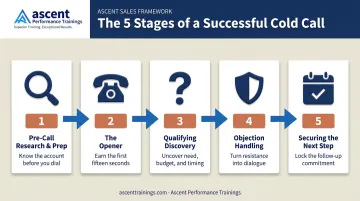
The Five Stages of Cold Calling
A cold call breaks down into five sequential stages, and most reps are strong in two or three while weak in the rest. Sandler's framework breaks it down this way:
- Pre-call research and prep: knowing the account, the trigger, and the reason for calling before dialing
- The opener: stating who you are and why you're calling, fast, without a script-reading cadence
- Qualifying discovery: asking a couple of sharp questions to confirm the call is worth continuing
- Objection handling: addressing pushback without getting defensive or rushing past it
- Securing the next step: locking in a specific meeting time, not a vague "I'll follow up"
Coaching "the call" as one generic skill wastes time. A rep who nails the opener but freezes on objections needs a completely different drill than a rep who's confident but rambles through discovery.
Here's how that looks in practice: a manager runs a ten-minute round isolating just the opener: three reps cycle through it back to back, with feedback given between each rep. Then the group moves to a separate ten-minute round on objection handling. Isolating the stage means feedback is specific instead of "good call, just needs more energy."
Building the Coaching Plan: Weekly, Monthly, and Quarterly Cadences
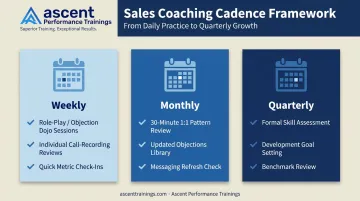
Structure without repetition doesn't work. A coaching plan needs a rhythm that repeats, and each cadence layer serves a different purpose.
Weekly Coaching Touchpoints
Weekly sessions keep skills sharp between bigger check-ins. A solid weekly rhythm includes:
- A group role-play or "objection dojo" session, ten to fifteen minutes, isolating one stage
- Individual call-recording reviews, even just two calls per rep per week
- A quick metric check-in on dials, connects, and conversions to spot early drift
Monthly Coaching Touchpoints
Monthly sessions go deeper than a quick check-in. This is where a manager sits with each rep for roughly 30 minutes and works through:
- The rep's specific pattern, not generic feedback, but "you consistently lose control after the price objection"
- An updated objections library reflecting what prospects are actually saying that month
- A review of whether the messaging still resonates or needs a refresh
Quarterly Coaching Touchpoints
Quarterly sessions zoom out, covering:
- A formal skill assessment measured against both hard and soft skills
- A specific development goal set for the upcoming quarter
- A benchmark review against realistic conversion targets
Even with this cadence locked in, most coaching plans still fail for one specific reason: reinforcement stops right after rollout. A quarter of great training followed by silence delivers the same result as no training at all.
This is exactly why sustained, recurring reinforcement matters more than the initial rollout. Ascent Performance Trainings builds this directly into its post-program model. The approach pairs weekly micro-learning videos with monthly 1:1 coaching sessions across eight weeks, specifically to prevent the skill decay that erodes most one-off training investments.
Coaching Meeting Skills: Turning Booked Calls Into Closed Deals
Cold calling earns the meeting. A completely separate skill set determines whether that meeting turns into real pipeline. A coaching plan that stops at "book the meeting" is only half a coaching plan.
Discovery inside the meeting needs its own coaching focus. Reps should ask layered questions around:
- Time: How urgent is this problem, really, and what's driving the timeline?
- Budget: What's already allocated, and who controls it?
- Impact: What happens if this problem goes unsolved for another two quarters?
Jumping straight into a pitch skips all of this, and it's one of the fastest ways to lose a meeting that was hard-won on the phone.
Meeting preparation habits matter just as much as what happens once the call starts:
- Set a clear, specific objective before every meeting (not "have a good conversation")
- Build a short agenda and share it, even informally, before the call
- Review prior touchpoints with the prospect so nothing feels repeated or forgotten
Follow-through closes the loop. Coach reps to:
- Summarize agreed next steps out loud before ending the call
- Send a written recap within hours
- Hold themselves accountable to whatever they committed to
The same recording-review discipline used for cold calls should extend to booked meetings. If a manager is only reviewing dial activity and never listening to how a rep runs discovery, they're coaching half the funnel and hoping the other half works itself out.
Metrics That Prove Your Coaching Plan Is Working
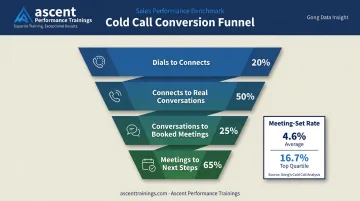
Activity volume feels productive, but it's a poor proxy for whether coaching is actually changing outcomes. Track the full funnel instead:
- Dials to connects
- Connects to real conversations
- Conversations to booked meetings
- Meetings to next steps
For a realistic baseline, Gong's analysis of more than 300 million cold calls found an average meeting-set rate of 4.6% per conversation, with top-quartile reps hitting 16.7%. That gap between average and top performers is exactly what coaching is supposed to close.
Review these metrics at every cadence checkpoint:
- Weekly: catch early drift in connect rates or objection patterns
- Monthly: confirm coaching focus matches where a rep is actually stalling
- Quarterly: benchmark progress against the targets set last quarter
If a rep's dial-to-connect rate is fine but meetings-to-next-steps is flat, coach for discovery and follow-through instead of pushing more dials.
Common Mistakes That Undermine Cold Call and Meeting Coaching
Even well-intentioned coaching plans fall apart in predictable ways.
- Treating coaching as an onboarding event. Skills decay within weeks without reinforcement, and a single week-one bootcamp functions as orientation, not an ongoing coaching plan.
- Coaching only to scripts and activity counts. Dial numbers are easy to track and overweight, but soft skills like active listening and objection handling drive conversion and take more effort to coach.
- Skipping call and meeting recording reviews. Recording review is the highest-leverage coaching activity available, yet teams replace it with generic group training that feels productive without fixing individual gaps.
Fixing these three mistakes alone will do more for conversion than any new script or tool.
Frequently Asked Questions
What is a sales coaching plan?
A sales coaching plan is an ongoing, structured system of practice, feedback, and measurement designed to improve rep performance over time. It's distinct from a one-time training session because it repeats and adjusts based on real results.
What are the three C's of cold calling?
Confidence, Clarity, and Control. Confidence covers tone and pacing, clarity covers message precision, and control covers steering the conversation through objections toward a booked next step.
What are the 5 stages of cold calling?
Pre-call research, the opener, qualifying discovery, objection handling, and securing the next step. Coaching should target each stage individually rather than treating the call as one generic skill.
How often should sales coaching sessions happen?
Weekly, monthly, and quarterly, each serving a different purpose. Sporadic sessions without a repeating cadence rarely produce lasting behavior change.
What's the difference between cold call training and cold call coaching?
Training transfers knowledge once, usually in a classroom setting. Coaching reinforces and corrects that knowledge continuously, using real call data and feedback loops over weeks and months.
How do you measure whether a coaching plan is actually working?
Track full-funnel conversion metrics, dials to connects, connects to conversations, conversations to meetings, over time. One-off activity counts don't show whether skills are actually improving.