
Introduction
Most organizations invest heavily in training — and then watch the results evaporate within weeks. According to ATD's 2025 State of the Industry report, average direct learning expenditure reached $1,254 per employee in 2024. Yet research consistently shows that without structured follow-through, most of what employees learn fades before they ever apply it.
The problem isn't the training itself. It's what happens — or doesn't happen — after the session ends.
Training reinforcement is the structured process that bridges the gap between a learning event and lasting behavior change on the job. Organizations that build reinforcement into their programs see skills stick — and show up in performance metrics.
This article covers:
- The science behind why training fades so quickly
- The key pillars of an effective reinforcement program
- Practical strategies for implementation
- How to structure your reinforcement timeline
- How to measure whether it's actually working
Key Takeaways
- Training introduces skills; reinforcement is what converts those skills into habits
- Memory decays rapidly without repeated exposure — spacing and active recall are the proven antidotes
- Effective reinforcement programs combine behavior-based objectives, manager involvement, and varied delivery methods
- The 70-20-10 model confirms that formal training is only 10% of the learning equation
- Measurement that matters tracks behavioral change and business outcomes, not completion rates
What Is Training Reinforcement and Why Does It Matter?
Training reinforcement is the ongoing process of extending learning beyond the initial training event. Through spaced content, coaching, and accountability structures, it converts short-term exposure into long-term, on-the-job behavior change.
The distinction matters because most organizations treat them as the same thing — and pay for it in skills that never stick.
Think of it as a four-step process:
- Learn it — the training event introduces new information or skills
- Encode it — the brain begins storing what it encountered
- Recall it — repeated retrieval strengthens the memory trace
- Apply it — the skill becomes a usable behavior in real work contexts
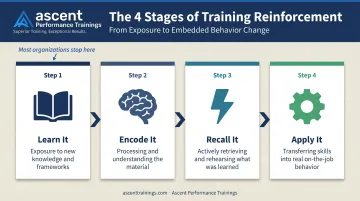
Most organizations stop at step one. Without steps two through four, the investment in step one disappears.
The Financial Argument for Reinforcement
With per-employee training spend at $1,254 annually (ATD, 2025), the cost of poor retention is measurable. Research by Saks and Belcourt tracked how quickly transfer decays after training ends:
| Timeframe | % Who Applied Training |
|---|---|
| Immediately after the event | 62% |
| After six months | 44% |
| After twelve months | 34% |
Transfer doesn't just slow down — it actively decays. For L&D and revenue leaders, that decay curve represents a concrete return-on-investment problem — one that better post-training structure can directly address.
The Science Behind Why Training Fails Without Reinforcement
Four decades of memory research point to the same conclusion: training without reinforcement doesn't stick. Here's what the science actually shows — and what it means for program design.
The Forgetting Curve
Hermann Ebbinghaus's foundational memory research — successfully replicated by Murre and Dros in a 2015 PLOS ONE study — established that forgetting follows a steep early curve. Memory retention drops sharply in the first hours and days after learning, then levels off. In practical terms: without reinforcement, employees lose the majority of training content before they ever have a meaningful opportunity to use it.
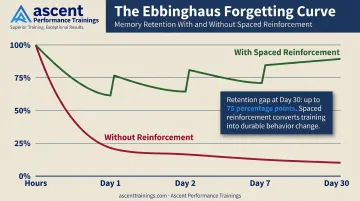
This isn't a flaw in your trainers or your content — it's how human memory works.
Why Spacing Works
Cepeda et al.'s 2006 quantitative synthesis — spanning 839 assessments across 317 experiments — found that distributed practice consistently improves verbal recall compared to massed learning. Revisiting material at spaced intervals signals to the brain that the information is worth retaining, gradually shifting it from fragile short-term storage to durable long-term memory. For program designers, the implication is clear: a single review session is not reinforcement. Spacing is what makes reinforcement actually work.
Retrieval Beats Re-Reading
Roediger and Karpicke's 2006 research on test-enhanced learning found that actively retrieving information produces stronger long-term retention than passively restudying the same material. The act of pulling information out of memory — even imperfectly — strengthens the memory trace more than reviewing it.
That's why active retrieval methods consistently outperform resending slides or recordings:
- Quizzes and knowledge checks that require recall, not recognition
- Reflection questions tied to real job situations
- Scenario-based exercises where learners apply concepts under pressure
The harder the brain works to retrieve something, the more durable the memory becomes.
A Word on Habit Formation
The commonly cited "21-day habit" claim doesn't hold up. Research summarized by UCL, and confirmed by a 2024 systematic review, found that habit automaticity typically takes 59–66 days at the median, with some behaviors requiring considerably longer. For any reinforcement program targeting genuine behavior change — a new sales methodology, a leadership communication approach — plan in months, not weeks.
The Key Pillars of a Strong Training Reinforcement Program
Pillar 1: Clear Behavior-Based Objectives
Reinforcement programs fail when they're built around vague learning goals. A strong program starts by defining what the trained behavior looks like in practice — observable, specific, and tied to real work contexts.
Not: "Improve discovery call skills." But: "During discovery calls this week, use a structured qualification framework to surface at least one previously unaddressed stakeholder need before advancing the opportunity."
Behavior-based objectives give coaches, managers, and learners a shared definition of success. Without them, reinforcement becomes a content delivery exercise rather than a performance improvement system.
Pillar 2: Spaced, Bite-Sized Content Delivery
Rather than one post-training recap, effective programs distribute reinforcement content across multiple intervals — for example, at days 2, 7, 14, and 30 following the training event. This cadence applies established spacing research and is designed to intervene right before forgetting would otherwise accelerate.
Microlearning is a practical vehicle for this. ATD's 2025 research reports that microlearning use in organizational development has increased 28% over eight years, most often as a supplement to formal learning. The format works best when it delivers active retrieval practice — not just content reminders.
Pillar 3: Active Recall Over Passive Review
Reinforcement content should force learners to retrieve information, not just re-encounter it. Formats that work:
- Multiple-choice questions in the first few days (testing early recall)
- Short-answer questions requiring application examples
- Scenario-based exercises placing learners in realistic situations
- Reflection questions asking how they used the skill on the job
The correctness of the answer matters less than the act of retrieval itself. Struggling to remember is part of what makes the memory stick.
Pillar 4: Manager and Coach Involvement
Reinforcement programs without manager engagement consistently underperform. Baldwin and Ford's transfer model identifies supervisor support as one of the strongest predictors of training transfer — and subsequent research confirms it.
Managers who observe behavior, provide feedback, model correct approaches, and hold accountability conversations create a reinforcement loop that extends well beyond any scheduled content touchpoint. Coaching isn't a nice-to-have element of reinforcement. It's a structural requirement.
Pillar 5: Multi-Modal Delivery Across Time
Coaching and manager involvement anchor the process — but no single format sustains behavior change across eight weeks on its own. Effective reinforcement combines:
- In-person or virtual coaching sessions
- Self-paced refresher content
- Weekly knowledge prompts or videos
- One-on-one accountability check-ins
Ascent Performance Trainings builds this multi-modal structure into its 8-week post-training reinforcement program, delivering weekly AI-generated micro-learning videos, real-world application prompts, and monthly 1:1 coaching sessions. A VP of Sales who completed the program noted: "The post-training follow-up ensured we didn't just retain knowledge but actually applied it. Our team's performance and closing rates have never been higher."
Different formats reach learners at different moments and through different cognitive pathways — which is why variety isn't optional. It's what turns a single training event into lasting behavior change.
Practical Strategies to Reinforce Training and Drive Real Behavior Change
Spaced Repetition and Knowledge Boosts
Send brief "knowledge boost" questions at timed intervals after training. Revisiting material just before it fades — the spacing effect — is what drives lasting memory consolidation, not a one-time classroom session.
Practical content types by phase:
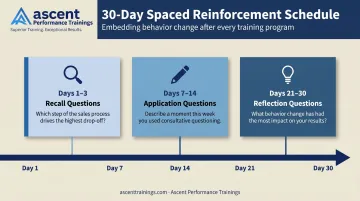
- Days 1–3: Multiple-choice questions testing recall of key concepts
- Days 7–14: Short-answer questions requiring application examples ("Describe how you used this skill in a real conversation this week")
- Days 21–30: Reflection questions connecting training to business outcomes ("What changed in how you approached that negotiation?")
Coaching and On-the-Job Observation
Structured coaching bridges the gap between knowing and doing — it addresses what content-only delivery cannot:
- Observe real behavior (not self-reported behavior)
- Provide specific, targeted feedback tied to actual performance
- Model correct approaches in context
- Recognize progress, creating positive reinforcement for continued application
Close calls and real-world mistakes are some of the highest-leverage reinforcement moments available. When a sales rep loses a deal or a manager handles a difficult conversation poorly, revisiting the relevant training content in that context drives stronger retention and application than a scheduled review alone.
Peer Learning and Social Accountability
Structured peer discussions — team debriefs, small group check-ins, or "how did you apply this?" conversations — allow learners to reinforce each other's skills through shared experience. Social accountability increases follow-through. When a colleague knows you committed to trying a specific approach this week, you're more likely to try it.
The key is structure — unstructured peer conversations rarely create accountability. Formats that work include:
- Breakout rooms in virtual sessions with a specific debrief prompt
- Small group exercises in classroom settings tied to a shared scenario
- Team-based accountability check-ins ("What did you try? What happened?")
Without a defined format, these conversations stay surface-level. With one, they become a reinforcement tool.
How to Structure Your Training Reinforcement Timeline
Effective reinforcement unfolds in phases, not as a single follow-up. A practical three-phase structure:
| Phase | Timing | Focus |
|---|---|---|
| Phase 1: Immediate Recall | Days 1–7 | Quizzes, brief content refreshers, early knowledge boosts |
| Phase 2: Application | Weeks 2–4 | Coaching conversations, thought questions, scenario exercises |
| Phase 3: Reflection & Accountability | Weeks 5–8 | Group review, manager check-ins, real-world scenario discussion |
The 70-20-10 Model as a Design Guide
The 70-20-10 model — developed by McCall, Lombardo, and Eichinger at the Center for Creative Leadership — frames where learning actually happens:
- 70% from on-the-job experience and practice
- 20% from coaching, feedback, and social learning
- 10% from formal training and instruction
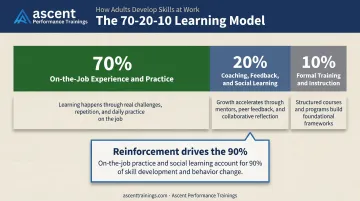
The training event is only the 10%. A well-structured reinforcement timeline deliberately builds in the 70% (job assignments and application practice) and the 20% (coaching conversations and peer learning) across the post-training period. Without reinforcement, organizations invest in the 10% and leave the other 90% to chance.
Duration Should Match Skill Complexity
That 90% doesn't fill itself — and how long reinforcement needs to run depends heavily on what's being learned. Not every program needs eight weeks. A general guide:
- Compliance refreshers or process updates: 2–3 weeks of structured follow-up
- Communication or customer service skills: 4–6 weeks
- Sales methodology or leadership behavior change: 6–8 weeks minimum, with research by UCL habit scientist Phillippa Lally suggesting new behaviors take an average of 66 days to become automatic
Ascent's standard post-training reinforcement program runs eight weeks across sales, leadership, and customer service programs — a duration consistent with the complexity of behavior change these skills require.
Measuring Whether Your Reinforcement Program Is Working
Move Beyond Completion Rates
ATD's 2023 TD Magazine research found that only 54% of organizations conduct Level 3 behavior evaluations and 38% conduct Level 4 results evaluations. Most organizations measure whether training happened — not whether it changed anything.
The core measurement question is simple: are employees demonstrating the trained skills in their actual job performance?
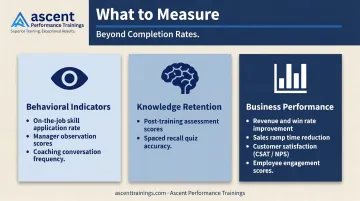
What to Track
Behavioral indicators:
- Manager observation notes and coaching records
- Observable changes in call quality, conversation structure, or leadership interactions
- Application rate from weekly prompts (are employees reporting real-world use?)
Knowledge retention:
- Quiz scores at 2, 4, and 8 weeks compared to immediately post-training
- Accuracy trends across the reinforcement cycle
Business performance:
- Win rate and close rate improvement for sales training
- Ramp time reduction for onboarding programs
- NPS or CSAT movement for customer service training
- Employee engagement scores for leadership development
Use Data to Improve Continuously
Measurement is the feedback loop that keeps a reinforcement program honest. When employees continue to struggle after several weeks, the data tells you where to respond — adjust content formats, increase coaching frequency, or revisit the original training on that specific skill.
This adaptive approach is what distinguishes a reinforcement program from a one-time reinforcement push. A program keeps evolving based on what the numbers actually show.
Frequently Asked Questions
What is training reinforcement?
Training reinforcement is a structured, ongoing process of delivering spaced content, coaching, and active recall activities after a training event. The goal is to help employees retain what they learned and apply it consistently on the job — rather than forgetting it within days of the session.
What are some examples of training reinforcement programs?
Common examples include weekly microlearning quizzes sent post-workshop, monthly one-on-one coaching sessions, manager observation check-ins, peer discussion forums, and short video refreshers. The most effective programs combine several of these methods across a structured 4–8 week timeline.
What are the 4 types of reinforcement used in training programs?
The four types come from B.F. Skinner's operant conditioning framework: positive reinforcement, negative reinforcement, positive punishment, and negative punishment. In workplace training, positive reinforcement — recognizing and rewarding correct behaviors — is the most effective approach in practice.
What is the 70-20-10 rule for training?
The 70-20-10 model holds that 70% of learning comes from on-the-job experience, 20% from coaching and social learning, and 10% from formal instruction. Reinforcement is the mechanism that drives the 70% and 20%, which is where real skill development actually occurs.
How long should a training reinforcement program last?
Duration depends on skill complexity. Most experts recommend 4–6 weeks for simpler skills and 6–8 weeks for complex behavior change like sales methodology or leadership development — with habit research suggesting automatic behaviors often require 60+ days to fully embed.
How do you measure the effectiveness of a training reinforcement program?
Measure through behavioral observation (are employees using the skills?), knowledge retention scores tracked over time, and business performance metrics tied to the trained skill — such as win rates, ramp time, or customer satisfaction. Completion rates and satisfaction surveys measure activity, not behavior change.