Introduction
Most organizations don't fail at SPM because they chose the wrong software. They fail because they treat implementation as a technology project when it's actually a people project.
Research from McKinsey shows that 70% of organizational transformations fail to meet their stated objectives — and even successful ones capture only 67% of the financial benefits they targeted. SPM implementations follow the same arc: early momentum fades, follow-through weakens, and results plateau well before targets are reached.
This article focuses on the four implementation challenges that derail most SPM efforts — goal-setting gaps, coaching failures, team resistance, and misaligned incentives — and the practical solutions that actually resolve them.
Key Takeaways:
- SPM fails most often due to people and process issues, not technology gaps
- Successful rollout depends on clear goals, consistent coaching, and genuine team buy-in
- Sustaining results requires ongoing reinforcement — a strong launch alone isn't enough
- Aligning incentives with behaviors, not just revenue numbers, drives long-term performance
Why SPM Implementation Fails More Often Than Expected
Organizations frequently treat SPM as a one-time process overhaul rather than a sustained cultural shift. They invest in tools, run a kickoff, set targets, then check back three quarters later and wonder why nothing moved.
Implementation energy peaks at launch, then fades. Without active reinforcement, teams revert to familiar habits, managers stop coaching to the new framework, and the system collects dust behind a dashboard nobody checks.
The root causes surface consistently:
- Vague ownership — no one is accountable for sustaining the SPM process after go-live
- Undertrained managers — frontline leaders lack the coaching skills to use performance data effectively
- Disconnected tools — CRM, compensation, and performance systems don't talk to each other
- No reinforcement plan — the rollout had a launch date but no sustainment cadence
The engagement data is stark. McKinsey found that transformation success rates drop to 3% when line managers and frontline employees aren't actively engaged — versus 26–28% when they are. That gap doesn't close on its own.
A better platform won't solve this. What closes the gap is manager coaching capability, genuine rep buy-in, and a reinforcement cadence that runs well past go-live — the structural conditions that let SPM actually take hold.
Challenge 1: Setting Goals That Drive Real Performance
Generic revenue targets are a weak SPM foundation. When a rep's only goal is "hit $1.2M by December," there's nothing to manage between January and November except anxiety.
Effective SPM goals operate on two levels simultaneously:
- Outcome goals — quota, revenue, win rate, pipeline value
- Activity goals — calls per week, discovery meetings booked, proposals submitted, follow-up cadence
Both matter. Activity goals give reps a daily compass; outcome goals confirm whether that activity is converting. Without both, managers have nothing concrete to coach to.
Research by Locke and Latham found that specific, challenging goals produced higher performance than vague or "do your best" goals in 90% of studies reviewed — a foundational result that underpins every SMART framework in sales today.
Applying SMART Goals to Sales Performance
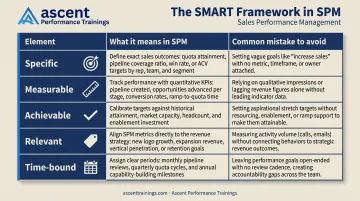
The SMART framework is standard. The application in sales is where most teams get it wrong:
| Element | What it means in SPM | Common mistake |
|---|---|---|
| Specific | Named metric with clear definition | "Improve pipeline" instead of "Add 5 qualified opportunities per month" |
| Measurable | Tracked in CRM, not estimated | Goals that live in spreadsheets nobody updates |
| Achievable | Calibrated to rep tenure and territory | Applying top-performer targets to new hires |
| Relevant | Tied to the rep's actual role and accounts | Giving a renewal rep new-logo quotas |
| Time-bound | Monthly milestones, not just year-end | Annual targets with no interim checkpoints |
Balancing Ambition With Reality
One of the most practical goal structures in SPM is the three-tier model:
- Floor — minimum expected performance (rep stays on plan below this)
- Target — the stretch goal that's achievable with strong effort
- Ceiling — exceptional performance that triggers accelerated commission
This keeps both underperformers and top performers engaged. Without a ceiling, your best reps coast once they hit quota. Without a floor, underperformers have no clear accountability threshold.
According to Alexander Group, 61% of sales leaders identify quota-setting as their number one challenge — and the answer lies in combining bottom-up seller input with top-down leadership allocation, built on account-level analytics rather than top-line revenue projections. Regular reviews matter too — market conditions shift, territories get reorganized, and goals set in January can be irrelevant by April without a structured check-in cadence.
Challenge 2: Closing the Training and Coaching Gap
Setting goals tells reps what to achieve. Training and coaching determines whether they can.
The most common SPM failure assumption: once goals are visible, reps will figure out how to hit them. They won't. Without structured skill development, reps default to whatever habits got them this far — and performance plateaus at their current ceiling.
The distinction that matters isn't onboarding versus ongoing training. It's one-time information delivery versus continuous behavioral development. Most organizations do the former and expect the results of the latter.
ATD research found that nearly 60% of participants cited lack of accountability for applying learned skills as the top barrier to sales training effectiveness. Companies spend an average of $2,326 per person annually on sales training — and much of it dissolves because there's no reinforcement structure to convert learning into habit.
Building a Coaching-First SPM Culture
CSO Insights found that dynamic sales coaching improved quota attainment by 21.3% and win rates by 19% over study averages. Sales Management Association data shows firms that provide optimal coaching realize annual revenue growth rates 16.7% greater than those that provide none.
The obstacle isn't coaching quality — it's coaching frequency. Sales Management Association also found that managers average just 36 minutes per week of one-on-one coaching per rep. That's not enough to change behavior.
Effective coaching within SPM is manager-led but system-supported. Managers should be spending their time guiding behavior, not chasing numbers.
When CRM data and performance dashboards surface pipeline gaps, conversion drops, or activity shortfalls automatically, managers can walk into a 1:1 with a specific conversation starter rather than a generic check-in.

For organizations that lack the internal coaching infrastructure to make this shift, structured external programs can fill the gap. Ascent Performance Trainings offers a Sales Coaching Skills for Sales Managers program that targets the management skills most correlated with team performance — and most often underdeveloped at the frontline manager level:
- Pipeline coaching and deal-strategy coaching
- Call shadow and observation techniques
- Accountability conversations
- Motivation frameworks for diverse rep profiles
The program's 8-week post-training reinforcement structure directly addresses the accountability gap ATD identified. Each week, participants receive AI-generated micro-learning videos and real-world application prompts. Monthly 1:1 coaching sessions then help managers address individual challenges and embed new behaviors in live selling situations, not just classroom settings.
Challenge 3: Overcoming Team Resistance and Driving Buy-In
Resistance to SPM is rarely about the system itself. It's about fear — that scrutiny will increase, that targets are unattainable, that performance data exists to expose rather than develop.
Acknowledge this directly. Leaders who treat rep skepticism as an obstacle to manage will get compliance at best. Leaders who treat it as legitimate feedback to address will get buy-in.
The change management steps that actually move the needle:
- Communicate the why before the what — explain why SPM is being implemented, what problem it solves, and what changes for reps specifically
- Involve frontline reps early — reps who help define the metrics are far less likely to game them
- Show leadership living in the system — if managers aren't reviewing their own performance data publicly, reps won't trust that theirs is being used fairly
McKinsey research shows that transformations are 8x more likely to succeed when senior managers communicate openly about progress throughout implementation — not just at launch.
Turning Skeptics Into Champions
The fastest way to shift peer perception is peer proof. Identify the reps who are early adopters — those who engage with the new system, see results, and talk about it. Give them visibility. Let them share outcomes in team meetings.
Psychological safety is the other key variable. The numbers make the gap plain:
- 89% of employees say psychological safety is essential to their work environment (McKinsey)
- Only 2 in 10 employees feel their performance is managed in a way that motivates outstanding work (Gallup)
The fix is framing. SPM positioned as surveillance produces defensive behavior and metric-gaming. SPM positioned as a development tool — where data surfaces coaching opportunities rather than punishing shortfalls — produces engagement.
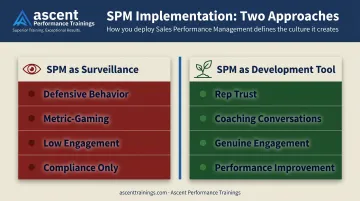
That framing isn't cosmetic. It has to be backed by consistent manager behavior: using performance conversations to diagnose and develop, not just evaluate.
Challenge 4: Aligning Incentives Without Demotivating Your Team
The most common incentive design problem in SPM is straightforward: compensation structures that reward volume above everything else. That misalignment pushes reps toward short-term pressure tactics that conflict directly with the pipeline quality and customer retention goals SPM is meant to drive.
A deal closed through pressure that churns in 60 days isn't a win. But if the commission plan treats it as one, the structure is actively rewarding the behavior you're trying to change.
Building a Balanced Incentive Architecture
Effective incentive design in SPM pairs monetary and non-monetary levers:
Monetary:
- Base commission tied to revenue or quota attainment
- Tiered bonuses that accelerate above target (not just at target)
- SPIFs for specific product lines or behaviors that support strategic priorities
Non-monetary:
- Public recognition in team settings — Gallup research shows only 1 in 3 US workers strongly agree they received meaningful recognition in the past week
- Career development access tied to performance milestones
- Leadership visibility for high performers (stretch assignments, advisory roles, presenting in QBRs)
The recognition gap has real retention consequences. Gallup-Workhuman found well-recognized employees are 45% less likely to have left their organization two years later — and employees receiving high-quality praise are 65% less likely to be actively job-searching.
Don't Design Incentives Only for the Top
Incentive programs that reward exclusively the top performers miss the majority of the team. The reps who move quota most at the organizational level aren't your top 10% — they're the middle tier, the solid performers who respond to incremental recognition and achievable stretch goals.
Tiered structures that reward improvement — not just peak performance — keep the full team engaged. Consider what a well-designed plan acknowledges:
- A rep moving from 75% to 90% of quota (not just the one who hits 120%)
- Consistent improvement across two consecutive quarters
- Behavioral milestones like pipeline quality, activity volume, or deal velocity gains
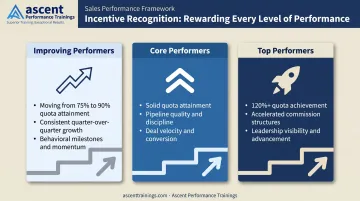
If your incentive plan ignores that middle-tier progress, you're optimizing for a small portion of the team while the majority coasts or disengages.
Coaching managers to recognize and respond to performance across all tiers — not just the top — is a core focus of Ascent's Sales Management training. The program covers compensation design and motivation frameworks so managers understand how incentive architecture shapes rep behavior and can coach effectively at every level of the team.
Building a Culture That Sustains SPM Results
The biggest mistake after a successful SPM launch is treating it as a completed project.
Performance management is a practice you maintain, not a system you implement once. McKinsey found that 20% of transformation value is lost post-implementation — after the hard work of change is supposedly done. The same erosion applies to SPM: without active sustainment, gains fade, habits revert, and the system becomes background noise.
A sustainable SPM culture looks like this in practice:
- Run performance reviews monthly, not just quarterly — frequent enough to catch issues before a quarter is lost
- Give reps real-time visibility into their own data; reps who track their own metrics manage themselves more effectively than those waiting on manager feedback
- Keep coaching conversations developmental rather than evaluative — the tone determines whether SPM feels like a growth tool or a surveillance system
- Have managers review their own pipeline conversion and coaching cadence openly, which creates the psychological conditions for reps to do the same
For organizations that want to institutionalize this rather than rely on periodic interventions, structured ongoing development is the reinforcement layer SPM needs to hold those gains. Ascent Performance Trainings builds its programs around exactly this premise. The 10-week Ascent Sales Academy and Ascent Leadership Academy pair certification with eight weeks of behavior-change reinforcement and ongoing 1:1 coaching — because the training program is where behavior change starts, not where it ends.
Frequently Asked Questions
What are the 5 C's of performance management?
The 5 C's — Clarity, Communication, Collaboration, Consequences, and Coaching — provide a holistic framework for managing performance. In sales, these map to clear goal-setting, transparent manager-rep dialogue, cross-team alignment, defined accountability, and developmental coaching grounded in performance data.
What are the 4 P's of performance management?
The 4 P's — Purpose, People, Process, and Progress — balance the structural and human sides of performance management. Purpose ties team effort to organizational goals; People ensures reps have the skills to execute; Process governs measurement and review; Progress tracks whether any of it is moving the needle.
What are the most common reasons SPM implementations fail?
The top reasons are vague or poorly calibrated goals, managers who lack coaching skills to act on performance data, insufficient rep buy-in during rollout, and no reinforcement plan after launch. The technology is rarely the problem — the people and process infrastructure around it is.
How long does it typically take to implement sales performance management?
A basic SPM framework can be operational within a quarter. Embedding a true performance culture — consistent coaching, rep trust, regular goal recalibration — typically takes 6–12 months of sustained reinforcement and iteration.
How do you measure the success of a sales performance management system?
Key indicators include quota attainment rates, rep ramp time, coaching frequency, employee engagement scores, and revenue growth trends. The most telling signal is whether coaching conversations have shifted from evaluative to developmental.
What is the difference between sales performance management and sales enablement?
SPM sets goals, measures outcomes, and manages performance. Sales enablement equips reps with the content, tools, and training to execute against those goals. The two are complementary: SPM without enablement holds reps accountable for skills they haven't been given, while enablement without SPM builds capability with no clear direction or measurement.