According to Zendesk's 2025 CX Trends Report, 63% of consumers are willing to switch to a competitor after just one bad experience. That number alone makes customer service training a strategic priority, not a nice-to-have.
This guide covers the core skills every training program should build, the most effective exercises and activities to use, and how to construct a program that produces lasting behavior change — not just a short-term post-workshop bump.
Key Takeaways
- Customer service training improves agent confidence, satisfaction scores, and customer retention
- Effective programs develop both soft skills (empathy, active listening) and hard skills (complaint handling, product knowledge)
- Hands-on exercises like role-play and scenario drills produce deeper retention than passive instruction
- Training must be ongoing — one-time workshops produce short-term gains that fade without reinforcement
- High-impact programs target real team gaps, use varied delivery formats, and measure results against KPIs
Why Customer Service Training Matters
Customer service training equips teams with the mindset, skills, and tools to deliver reliable, positive experiences — from the first interaction through to complaint resolution. It covers far more than politeness: agents need the confidence to handle pressure, the competence to solve problems, and the judgment to represent the organization well under difficult conditions.
The business stakes are real. Zendesk's research shows that CX "Trendsetters" — organizations with superior service capability — achieve 22% higher customer retention rates and 49% higher cross-sell revenue compared to peers. Those gaps don't close on their own.
Well-designed training creates measurable lift across the entire service operation — for customers, agents, and the business simultaneously:
- Customers — faster resolutions, more consistent experiences, and interactions that feel genuinely helpful rather than scripted
- Agents — greater job confidence, less stress, and clearer standards for what "good" looks like
- The business — stronger retention, improved loyalty metrics, and revenue outcomes tied directly to service quality
The ROI is well-documented. What separates organizations that see it from those that don't comes down to how the training is designed and reinforced.
Core Skills Every Customer Service Training Program Should Cover
Soft Skills
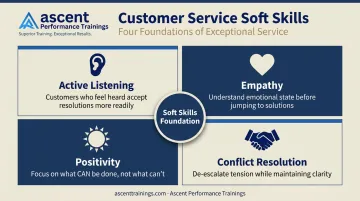
Four soft skills drive the majority of positive customer outcomes:
- Active listening — Customers who feel genuinely heard are more likely to accept resolutions and less likely to escalate. A 2021 study published in ScienceDirect found that active listening increases customer satisfaction by increasing customers' perception of preferential treatment.
- Empathy — Understanding the customer's emotional state before jumping to solutions changes the entire tone of an interaction. Research confirms that employee empathy directly influences customer satisfaction through customer-oriented behavior.
- Positivity — Language choice shapes perception. Agents who default to what can be done — rather than what can't — produce measurably better outcomes, even when the resolution is the same.
- Conflict resolution — The ability to de-escalate tension without losing clarity or composure is a trainable skill, not a personality trait.
Soft skills are not innate. They can be developed through deliberate, structured practice. An agent trained specifically in empathy techniques handles escalations differently — customers feel understood first, which lowers emotional temperature before the resolution conversation even begins.
Hard Skills
Hard skills require the same intentional investment:
- Agents who can't answer basic product questions confidently erode trust within the first minute of a call
- Standardized complaint handling procedures ensure consistent resolution quality regardless of which rep picks up
- Proficiency with CRM platforms, ticketing systems, and knowledge bases directly affects how quickly agents resolve issues
Hard skills are typically delivered through knowledge-based methods: product demos, policy walkthroughs, process documentation, and quizzes. Soft skills require something more experiential.
There's a gap many programs miss: agents should be trained on the company's specific tone guidelines, escalation protocols, and service standards — not just generic industry best practices. What "professional" sounds like in a financial services context differs substantially from a SaaS customer success environment.
Best Customer Service Training Ideas, Exercises & Activities
Role-Play and Scenario-Based Exercises
Role-play remains one of the highest-impact training methods available. A meta-analysis of 225 studies found that active learning reduced failure rates from 33.8% under lecture-based instruction to 21.8% under active learning approaches. The principle translates directly to service training.
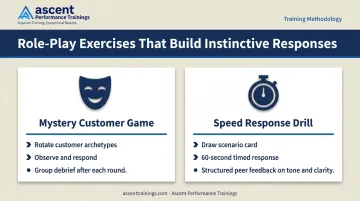
Mystery Customer Game One participant plays an unpredictable customer archetype — the frustrated loyalist, the vague communicator, the entitled first-timer, or the repeat escalator — while others observe and respond. After each round, the group debriefs on what worked, what escalated the situation, and what could be adjusted. Rotating through different customer types keeps agents from over-rehearsing a single script.
Speed Response Drill Agents draw scenario cards and have 60 seconds to respond professionally. Peers then give structured feedback on clarity, tone, and whether the response actually resolved the scenario. The time pressure is the point: it builds instinctive, composed responses under the kind of stress agents face during high-volume periods.
Communication and Listening Games
The Telephone Game A message passes through a chain of participants. By the end, it's almost always distorted. Active listening failures become visible and tangible — a more memorable lesson than any lecture on the topic.
Silent Conversation Agents must resolve a written-only customer complaint with no verbal communication allowed. This builds skills specifically for chat and email support, where tone must carry without vocal cues. Most agents are surprised by how much they've been relying on vocal warmth to do the heavy lifting.
Tone of Voice Challenge Participants pull slips with common service phrases — "I understand your frustration," "Let me check on that for you" — and deliver them in three different tones: warm, neutral, and clipped. The group then discusses how each version lands. For written communication, the exercise is especially revealing: many agents don't realize their default tone reads as dismissive until they hear it played back.
Empathy and Perspective-Taking Activities
Stepping Into the Customer's Shoes Teams map the full customer journey for a specific customer profile — identifying where friction, confusion, or delays occur. The goal is to shift agent mindset from transactional ("I resolved the ticket") to customer-centric ("What was that experience actually like?"). It works especially well for inbound teams that rarely see what the customer went through before they picked up the phone.
Customer Support Storytelling Agents receive a scenario — a delayed delivery affecting a small business owner, a billing error on an enterprise account — and must build out the customer's backstory, emotional state, and ideal resolution. Narrative context deepens empathy and tends to produce more specific, human resolutions — the kind that actually retain customers.
Knowledge and Confidence Builders
Product Knowledge Jeopardy Teams compete to answer questions about products, policies, and FAQs for points. The format matters: wrong answers don't feel like failures in a game setting — they reveal knowledge gaps without attaching shame to them. Leaders can track which categories produce the most incorrect answers and use that data to prioritize follow-up training.
What this exercise surfaces:
- Policy and procedure gaps agents didn't know they had
- FAQ categories that need stronger onboarding coverage
- Confidence levels across different product lines or service tiers
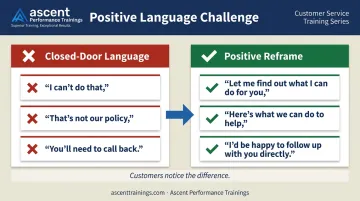
Positive Language Challenge Agents receive slips with negative or neutral phrases: "I can't do that," "That's not our policy," "You'll need to call back." Their task is to reframe each one positively. This isn't about being dishonest with customers — it's about finding what is possible. With regular practice, agents stop defaulting to closed-door language — and customers notice the difference in how supported they feel.
Attitude and Motivation Exercises
Attitude Anchors Agents identify two sets of resources:
- Maintenance anchors — things that sustain positivity during long or difficult shifts (music, a short walk, a specific mindset habit)
- Repair anchors — actions that help them reset after a hard call
For high-volume frontline teams, emotional exhaustion is a real performance risk — and most agents have never been asked to think about how they manage it deliberately.
Extra Mile Brainstorm Teams receive a common service failure — a missed SLA, a product defect, a billing error — and must design a response that not only resolves the issue but exceeds the customer's expectations. The collaborative format surfaces creative solutions and builds a shared service-excellence vocabulary across the team.
How to Build an Effective Customer Service Training Program
Start on Day One
Beginning training on an agent's first day sends a clear organizational signal: service standards are taken seriously here. It sets performance expectations early, gives new hires the context to self-assess fit, and directly reduces early attrition — one of the most expensive talent problems customer service teams face.
Ascent's New Hire Onboarding program for customer service reps covers:
- Role-specific content and product/value proposition immersion
- Internal tools, systems, and process walkthroughs
- A structured 30/60/90-day ramp plan with measurable proficiency milestones
This foundational layer creates the platform that deeper skill development builds on.
Make It Multi-Modal and Ongoing
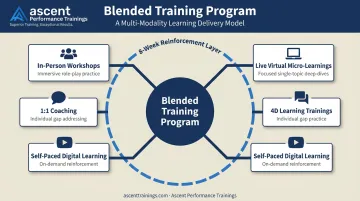
No single training format produces lasting behavior change on its own. The strongest programs combine:
- In-person workshops for immersive, role-play-based skill practice
- Live virtual micro-learnings for focused, single-topic deep-dives that fit around busy schedules
- Self-paced digital learning for reinforcement and on-demand access
- 1:1 coaching to address individual gaps and performance challenges
The Ascent Customer Service Academy structures this across a 10-week program combining live virtual sessions, on-demand video, 1:1 coaching, and an 8-week post-training reinforcement layer. That reinforcement phase — weekly AI-generated micro-learning videos, real-world application prompts, and monthly coaching sessions — is what turns classroom learning into skills agents actually use.
The research supports this approach. A 2023 meta-analysis of 29 studies confirmed that blended learning improved performance and achievement compared with single-format delivery. Spaced repetition adds another layer: spreading learning over time produces significantly better retention than massed training.
Tie Training to Measurable Outcomes
Training without measurement is a budget line, not a capability investment. Track these KPIs before and after each program cycle:
| KPI | Industry Benchmark |
|---|---|
| CSAT Score | 80%+ = world-class (SQM Group) |
| First-Contact Resolution (FCR) | 70–79% = good; 80%+ = world-class |
| Average Handle Time (AHT) | ~6 min general; varies by sector |
| Escalation Rate | 10–15% general; 15–25% technical support |
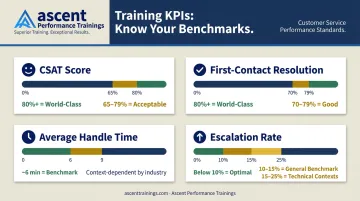
Use the gap between current performance and benchmark to identify which skills need the most investment. Revisit the data quarterly and adjust the program accordingly. Without that feedback loop, you're running a program — not building a capability.
Conclusion
Great customer service is built through intentional, structured training — one that shapes both the skills and the mindset your team members bring to every interaction. The exercises and frameworks in this guide are starting points. The real work is building a program that reinforces behavior change over time, not just over a two-day workshop.
Whether you're building a customer service training program from the ground up or refreshing one that's lost momentum, Ascent Performance Trainings designs programs around your industry, team profile, and performance goals. The 10-week Ascent Customer Service Academy includes an 8-week post-training reinforcement program to convert classroom learning into durable on-the-job behavior change.
Get in touch with the team to scope a program for your organization.
Frequently Asked Questions
What are effective and engaging customer service training ideas?
The most effective training combines hands-on exercises — role-play, scenario drills, communication games — with structured peer feedback. Variety across formats keeps engagement high; agents retain skills far better through active practice than passive instruction or lecture alone.
What are the key C's of customer service to include in training?
A widely referenced practitioner framework identifies five: Communication, Compassion, Competence, Consistency, and Composure. A well-designed training program deliberately builds each of these qualities through both knowledge-based content and experiential exercises.
What skills should customer service training cover?
Programs should address both pillars: soft skills (empathy, active listening, conflict resolution, positivity) and hard skills (product knowledge, complaint handling procedures, and proficiency with support tools). Neither alone is sufficient for consistently strong customer outcomes.
How long should a customer service training program last?
New hire onboarding typically runs four to six weeks for foundational proficiency. Effective training is never truly finished, though. Ongoing refresher sessions, coaching check-ins, and skills reinforcement should be built permanently into the role as products and expectations evolve.
How do you measure the effectiveness of customer service training?
Compare CSAT scores, first-contact resolution rates, and escalation frequency before and after each training cycle. Agent confidence self-assessments can also surface skill gaps that quantitative metrics alone won't catch.
Should customer service training be a one-time event or ongoing?
One-time training events produce short-term gains at best. Lasting behavior change requires repeated practice, spaced reinforcement, and consistent coaching over time — especially as products change and new team members join.