
Introduction
Most deals aren't lost on price. They're lost in the negotiation itself.
Today's B2B buyers arrive at the table having done their homework. According to HBR research, buyers complete 57% of their purchase decision before ever engaging a sales rep — and Gartner reports that 61% now prefer a rep-free buying experience altogether. When sellers do enter the conversation, they're often facing a buying committee of over a dozen stakeholders — each with competing priorities, all capable of stalling a deal.
Generic pitches don't close deals in this environment. Negotiation does.
The gap between average performers and top closers rarely comes down to product knowledge or charisma. It comes down to how they negotiate: how they listen, respond under pressure, defend value, and create agreements both sides actually want.
This article breaks down the core skills that separate strong negotiators from the rest, the mindset shifts that make those skills stick, and the common mistakes that stall or sink deals. It also covers how structured training turns negotiation into a consistent, measurable capability — not just a talent a few reps happen to have.
Key Takeaways
- Sales negotiation is about creating agreements both parties value — not "winning" at the buyer's expense
- Preparation, active listening, and emotional intelligence are the three most critical negotiation skills
- Objections are interest signals, not rejections — reframing them that way changes the entire dynamic
- Conceding on price too early is the most damaging mistake in sales negotiation
- Reinforcement and coaching are what turn negotiation skills into lasting behavior change
Why Sales Negotiation Skills Are Non-Negotiable in Today's Market
The B2B buying environment has changed structurally, not just tactically. Buyers no longer need sellers to educate them on solutions — they arrive informed, skeptical, and often already leaning toward a vendor before the first conversation happens.
What they haven't done is made a final decision. That's where negotiation becomes the decisive skill.
The Buying Committee Problem
Forrester's 2026 State of Business Buying research found that a typical B2B purchase now involves 13 internal stakeholders and 9 external influencers. That's not a one-to-one conversation — it's a multi-party alignment challenge where a single objection from one stakeholder can send a deal back to square one.
Reps who rely on a strong pitch to carry them through this environment will consistently stall at the negotiation stage. Those who can navigate competing priorities, surface unstated concerns, and build consensus across a buying committee are the ones who close.
What the Research Says About Training and Win Rates
The business case for formal negotiation training is well-documented:
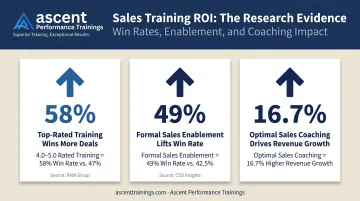
- Organizations rating their sales training 4.0–5.0 out of 5 achieve a 58% win rate versus 47% for those rating training 3.0–3.9, according to RAIN Group
- CSO Insights data shows organizations with formal sales enablement average 49% win rates versus 42.5% without it
- Firms providing optimal sales coaching generate annual revenue growth 16.7% higher than those providing none
Negotiation as a Relationship Builder
Most sellers treat negotiation as the final hurdle — but handled well, it's actually where trust deepens.
When a seller works through a buyer's concerns thoughtfully, explores creative solutions instead of defaulting to discounts, and demonstrates genuine understanding of the buyer's priorities, the negotiation itself becomes proof of what the partnership will look like. Buyers remember how that conversation felt. That impression shapes renewal decisions, referrals, and expansion revenue long after the contract is signed.
Core Sales Negotiation Skills That Drive Results
Negotiation competency isn't a single skill. It's a cluster of capabilities that, when working together, produce consistently better deal outcomes.
Preparation and Research
The negotiation begins before any conversation takes place. Reps who enter a deal knowing the buyer's industry dynamics, current business pressures, competitive landscape, and decision criteria show up as advisors — not vendors pitching at them.
Effective pre-negotiation research includes:
- Understanding the buyer's key business objectives and how this purchase connects to them
- Knowing the budget cycle and any timing pressures driving the decision
- Identifying who the key stakeholders are and what each one prioritizes
- Anticipating the objections most likely to surface based on the buyer's industry and deal stage
Reps who skip this step don't just show up unprepared — they cede control of the conversation from the first exchange.
Active Listening
Research from the Program on Negotiation at Harvard Law School identifies active listening as one of the most critical skills for building trust and uncovering what counterparts actually need — not just what they say out loud.
In practice, active listening means:
- Asking open-ended questions that invite the buyer to expand on their concerns
- Paraphrasing back what you've heard to confirm understanding
- Noticing hesitation, vague language, and what's pointedly left unsaid
- Resisting the urge to fill silence with a pitch
The buyer who says "we need to think about it" is rarely just stalling. Something is unresolved. Active listening surfaces it.
Emotional Intelligence
Negotiations get tense. A buyer pushes back hard on pricing. A stakeholder contradicts something the champion said last week. The timeline slips. How a rep responds in those moments determines whether the deal survives.
A Negotiation Journal study of 200 participants found that negotiator emotional intelligence positively affected rapport and jointly beneficial outcomes.
Staying composed under pressure, reading the buyer's emotional state, and responding with empathy rather than defensiveness keeps dialogue open — and productive.
Clear, Value-Focused Communication
Skilled negotiators don't defend a number. They articulate outcomes: efficiency gains, risk reduction, long-term ROI, and measurable business impact. That shift — from price conversation to value conversation — changes the entire frame of the negotiation.
The key is tailoring that message to the specific buyer. A CFO's concerns are different from a VP of Operations — generic pitch language misses both.
Flexibility and Creative Problem-Solving
When a buyer pushes back on price, the worst response is to immediately drop it. A more effective move is exploring what's actually driving the pushback — often it's not the number itself, but the perceived risk or structure around it.
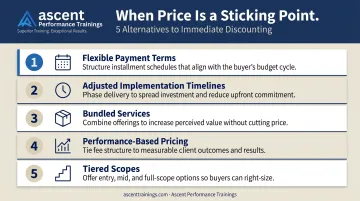
Options worth exploring when price becomes a sticking point:
- Flexible payment terms or phased billing
- Adjusted implementation timelines
- Bundled services that add perceived value
- Performance-based pricing structures
- Tiered scopes with a clear path to expand
Immediate discounting trains buyers to push harder next time. Creative problem-solving keeps the deal intact without eroding the value you've built.
Knowing When to Hold and When to Concede
Strategic concession is a discipline. The goal is to give ground on lower-priority items while protecting the core value of the deal. Conceding too quickly signals weakness and trains buyers to keep pushing. Holding firm on price with a clear, well-reasoned rationale builds credibility.
The most practical tool here is knowing your walk-away point before the negotiation starts. When that's defined in advance, you're not making decisions reactively under pressure — you're executing a plan.
The Mindset Behind Successful Sales Negotiation
Tactics only work when the underlying mindset supports them. For many reps, the mindset is the real obstacle.
The Adversarial Trap
The most common mindset failure is framing negotiation as a contest — where one party wins and the other loses. That framing produces defensiveness, premature concessions, or outright conflict avoidance. All three outcomes damage the deal.
The more productive frame is collaborative problem-solving. The buyer has a business problem. The seller has a solution. The negotiation is the process of figuring out how to make the exchange work for both parties. That's not naive — it's strategically sound.
Objections Are Information, Not Rejection
When a buyer raises a concern, they are not saying no. They are signaling that something remains unresolved. This reframe is one of the most practically impactful mindset shifts in sales negotiation.
Instead of defending, discounting, or deflecting, the right response to an objection is curiosity: "Help me understand what's driving that concern." The answer tells you exactly what you need to address to move the deal forward.
Fear-Based Reactions That Undermine Deals
That clarity about what to address only helps if a rep can stay composed under pressure. Several internal barriers cause reps to undercut themselves before the buyer even applies real pressure:
- Fear of rejection — leading reps to soften their position preemptively
- Fear of conflict — causing avoidance of the honest conversations that actually advance deals
- Discomfort with silence — prompting unnecessary concessions to fill the pause

HBS Online research notes that anxious negotiators tend to make more modest first offers, exit earlier, and earn less. The fix is building genuine belief in the value of what's being offered. That belief comes from preparation, practice, and accumulated experience — not from forcing a confident posture.
Confidence vs. Arrogance
Confident negotiators assert their position clearly without shutting down dialogue. They hold firm because they've done the work to understand why their offer is worth it — and they can articulate that clearly.
Arrogance, by contrast, signals that the rep has stopped listening. When a buyer senses that, dialogue shuts down — and so does the deal. The reps who close consistently are the ones who stay curious even when they're holding firm.
Common Sales Negotiation Mistakes to Avoid
Most negotiation failures trace back to a small set of repeatable mistakes.
Conceding on price too early damages deals before they're lost. When a rep drops price before the buyer has pushed back firmly, it signals that the original number was inflated — and trains the buyer to keep pressing. Holding on price while exploring what's actually driving the hesitation is nearly always the stronger move.
Reps who skip objection prep arrive reactive instead of composed. Budget constraints, competitor comparisons, internal approval delays — these come up in almost every complex deal. A well-prepared rep has honest, specific responses ready before walking into the room.
Emotional reactions are the third failure pattern — and one of the costliest. Richardson's 2025 Selling Challenges research found buyer indecision is the primary obstacle in closing complex deals. Reps who take pushback personally either over-concede to relieve tension or turn defensive, shutting down dialogue at the worst possible moment.
Practical tactics for staying regulated:
- Pause before responding to a difficult objection
- Use neutral clarifying questions ("Can you help me understand that concern better?")
- Propose a short follow-up rather than negotiating in a reactive state
How Sales Negotiation Skills Training Accelerates Performance
Experience alone doesn't build strong negotiators. Without structured feedback, reps tend to repeat their existing habits — including the ones that cost them deals.
Why Informal Learning Falls Short
ATD research shows that approximately 72% of learned information is forgotten within two days without reinforcement. That's not a failure of motivation — it's how human memory works. One-time training events, regardless of quality, produce temporary behavior change.
The reps who improve most consistently are those who practice in structured environments, receive direct feedback on their technique, and return to the material repeatedly over time.
The Most Effective Training Modalities
ATD data also shows that active practice such as role-play averages around 75% retention versus 5% for lecture-style learning. The most effective negotiation training programs combine:
- Role-play simulations: Realistic buyer scenarios where reps apply frameworks under pressure and receive direct facilitator feedback on technique
- 1:1 coaching: Individualized sessions targeting each rep's specific blind spots, including deal-specific preparation before high-stakes negotiations
- Workshop-based learning: Team sessions that build shared language, frameworks, and consistent approaches to common deal scenarios
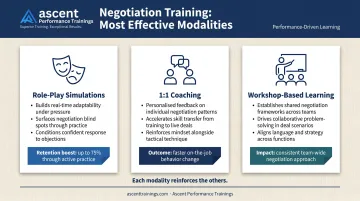
Each modality reinforces the others — removing any one of them limits how deeply the skills transfer to live deals.
Reinforcement Is What Makes Training Stick
RAIN Group reports that highly effective sales training programs are 1.5x more likely to include reinforcement activities. Ascent Performance Trainings builds this principle directly into every program: their 8-week post-training reinforcement model delivers weekly AI-generated micro-learning videos and real-world application prompts, plus two monthly 1:1 coaching sessions — ensuring skills are practiced and embedded in day-to-day selling rather than fading after the initial workshop.
A VP of Sales who completed Ascent's program noted that "the post-training follow-up ensured we didn't just retain knowledge but actually applied it — our team's closing rates have never been higher."
Industry-Specific Training Produces Better Results
Generic negotiation training teaches principles. Industry-specific training teaches how those principles apply to the commercial realities a rep faces every week.
Ascent's negotiation skills programs, led by founder Tim Carlisle with 30+ years of experience across 75+ countries, are built around the deal structures, buyer behaviors, and procurement dynamics of specific industries: financial services, oil and gas, technology and SaaS, professional services, and healthcare. Role-play scenarios use actual deal types and buyer personas from the participant's sector, not generic B2B examples.
Procurement-facing tactics common in enterprise SaaS deals differ significantly from those in EPC contracting, and the training reflects that distinction. Reps practice the exact conversations they'll have, not approximations of them.
That specificity is what separates training programs that move win rates from those that merely move survey scores.
Frequently Asked Questions
What are the core skills of negotiation and selling?
The foundational negotiation skills are active listening, clear communication, emotional intelligence, preparation, and creative problem-solving. Selling adds value articulation, rapport-building, and objection handling — skills that work in tandem with negotiation skills throughout the full deal cycle.
How do you describe negotiation skills on a resume?
Use specific, results-oriented language — for example, "negotiated contract terms resulting in a 15% improvement in average deal size." Highlight capabilities like active listening, objection handling, value-based selling, stakeholder alignment, and BATNA development rather than generic phrases.
What is the most important skill in sales negotiation?
Active listening is most consistently cited as the decisive skill. It reveals what the buyer actually needs and what's genuinely stalling the deal — allowing the negotiator to respond to real concerns rather than surface-level objections.
How can I improve my sales negotiation skills?
Practice through role-plays, seek feedback after real negotiations, and reframe objections as information rather than resistance. Structured training with coaching and multi-week reinforcement builds more durable habits than self-study.
What is a win-win negotiation in sales?
A win-win negotiation results in both buyer and seller feeling their core needs were met. It's achieved by expanding beyond price — exploring terms, scope, timing, and added value — until both parties gain something meaningful.
How does active listening help in closing deals?
Active listening uncovers the buyer's unstated concerns and real priorities, allowing the rep to address the actual obstacles rather than responding to surface-level objections. Deals close faster when reps respond to what's actually blocking progress — not what the buyer said first.