
This role sits at the intersection of Learning & Development and sales execution. When done well, it directly moves the numbers that matter: win rates, ramp time, quota attainment, and revenue. When done poorly — or left unfilled — organizations absorb the cost quietly, through slow onboarding, inconsistent messaging, and reps who never fully reach their potential.
According to CSO Insights, organizations with sales enablement functions report win rates 6.5 percentage points higher than those without. That's not a marginal difference — it's a measurable business outcome tied directly to how well training is designed and delivered.
This guide covers everything you need to understand this role: what it actually involves, the skills that separate good from great, and the best practices that turn training programs into lasting behavior change.
Key Takeaways
- A Sales Training Manager owns programs, budgets, and business outcomes — it's a strategic leadership role, not a facilitation one.
- The role requires a blend of hands-on sales experience, instructional design knowledge, and leadership capability.
- Post-training reinforcement, not the training event itself, is what determines whether behavior actually changes.
- Every program must tie back to a measurable KPI. If it can't, it needs to be redesigned.
What Is a Sales Training Manager?
A Sales Training Manager designs, implements, and oversees training programs that equip sales teams with the skills, knowledge, and strategies needed to hit targets. The role bridges the Learning & Development function and the Sales department — requiring fluency in both worlds.
Sales Trainer vs. Sales Training Manager
This distinction gets conflated constantly, even by hiring managers:
| Sales Trainer | Sales Training Manager | |
|---|---|---|
| Focus | Delivering training sessions | Strategic oversight of programs |
| Scope | Individual contributor | Manages programs, budgets, sometimes staff |
| Output | Training hours delivered | Business outcomes achieved |
| Reporting | Tactical execution | Reports to senior leadership |
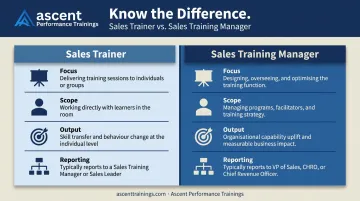
A Sales Trainer is an individual contributor who delivers sessions. A Sales Training Manager owns the entire function — from needs assessment through measurement — accountable for whether the investment actually produces results.
Why Organizations Invest in This Role
ATD's 2023 State of Sales Training research found that 89% of organizations employed remote salespeople, yet only 32% offered a fully structured training program for remote sellers. That structural gap shows up directly in slower ramp times and lower quota attainment.
Closing that gap has a measurable payoff. CSO Insights found that dynamic sales coaching — the kind a skilled Sales Training Manager architects — correlated with a 21.3% improvement in quota attainment and a 19% improvement in win rates over study averages. For revenue leaders weighing the hire, those figures make a compelling case.
Core Responsibilities of a Sales Training Manager
Designing and Developing Training Programs
The work starts well before anyone enters a training room. Effective Sales Training Managers conduct thorough needs assessments first — gap analyses, surveys of sales staff, conversations with sales leadership, and review of performance data — before building a single slide.
From there, they design modular curricula covering two tracks:
- New hire onboarding — structured programs with 30/60/90-day plans, measurable proficiency milestones, ICP fluency development, and role-play scenarios to compress ramp time
- Ongoing development — continuous learning tracks for tenured reps focused on advancing specific skills (negotiation, multi-stakeholder selling, account expansion)
Training materials span multiple formats: facilitator guides, role-play scripts, video lessons, case studies, and assessments. Different formats serve different stages — procedural knowledge lands best in structured guides, while judgment and adaptability develop through scenario-based practice.
Delivering Training and Coaching
Sales Training Managers lead and facilitate across several formats:
- In-person workshops with live facilitation, group exercises, and peer learning
- Virtual sessions designed to replicate classroom dynamics (not just recorded lectures)
- One-on-one coaching conversations that address individual performance gaps
- Group role-plays that simulate real buyer scenarios
When specialized knowledge is needed, they coordinate with external training providers — managing those relationships to ensure external content aligns with the company's methodology, language, and culture. The Sales Training Manager retains ownership of outcomes regardless of who delivers the content.
Measuring Impact and Collaborating Across Teams
Most Sales Training Managers track completion rates. Fewer track whether behavior actually changed — and that gap is where programs lose their ROI.
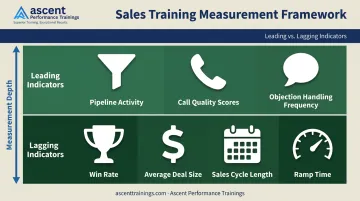
Effective measurement looks at:
- Pre/post knowledge assessments to verify learning gain
- Leading indicators: pipeline activity, call quality scores, objection handling frequency
- Lagging indicators: win rate, average deal size, sales cycle length, ramp time
ATD research found that only about 40% of participants said sales training helped their organization meet goals to a high or very high extent — a gap that points directly to measurement and accountability failures.
Sales Training Managers also work across the organization to keep programs connected to business priorities:
- Partnering with HR on onboarding infrastructure and headcount planning
- Coordinating with marketing on product positioning and messaging consistency
- Aligning with sales leadership on shifting strategic priorities and pipeline gaps
- Presenting program ROI to senior management to justify budgets and shape future investments
Essential Skills and Qualifications
Sales expertise and process knowledge anchors credibility with experienced reps — and without it, no methodology framework will land. Most organizations expect 5–7 years of hands-on sales or sales management experience, plus working familiarity with CRM systems, key methodologies (MEDDIC, SPIN, Challenger, Sandler), and the full sales cycle.
Communication and facilitation determines whether concepts land. This goes beyond presenting clearly — it includes reading a room, adjusting explanations in real time, and facilitating uncomfortable group discussions about performance gaps.
Analytical thinking and data fluency now shape how training budgets get defended. Sales Training Managers need to identify performance gaps through CRM data, interpret training metrics, and make evidence-based decisions about where to invest resources — because gut instinct rarely survives a CFO review.
Leadership and coaching mindset ties the rest together. The role demands motivating sales teams who may actively resist training, mentoring individual reps through performance challenges, and continuously adapting programs as market conditions and team compositions shift.
Best Practices for Sales Training Managers
Anchor every program to a measurable business objective. If a training initiative cannot be connected to a specific KPI — improved close rate, reduced ramp time, increased average deal size — it should be redesigned before delivery. Regular skills gap analyses replace generic programs with targeted interventions.
Use blended learning, not a single format. Research supports this: a meta-analysis found blended learning produced a +0.35 positive effect size compared with face-to-face instruction alone. Combining instructor-led workshops, virtual sessions, self-paced e-learning, and peer role-plays accommodates different learning styles and fits training into the actual rhythm of a salesperson's week.
Build structured post-training reinforcement into every program. This is the piece most organizations skip, and the reason most training fails to stick. The Ebbinghaus forgetting curve shows rapid knowledge loss within days of initial learning. Without deliberate follow-up, behavior doesn't change.
CSO Insights found that only 15.5% of organizations had reinforcement programs that exceeded expectations — and those organizations saw win rates increase by 15.3%. ATD found that 79% of high-performing organizations used post-training activities, versus only 46% of others.
Ascent Performance Trainings builds an 8-week reinforcement program into every engagement: weekly AI-generated micro-learning videos, real-world application prompts, and monthly 1:1 coaching sessions designed to turn classroom skills into measurable performance gains.
As one Chief Revenue Officer described it: "Most programs leave you after the workshop, but Ascent Performance ensured our team had the reinforcement and coaching needed to sustain long-term success."
Use technology strategically, not reflexively. ATD reports that 65% of organizations now use an LMS for sales training. The right tools serve the strategy:
- LMS platforms manage content delivery and track completion
- CRM data surfaces performance gaps at the individual rep level
- Virtual platforms enable consistent training for distributed teams
Technology should support the training design, not substitute for the human judgment required to build it.
Measure behavioral change, not completion. Build a measurement framework that tracks leading indicators (pipeline activity, call quality, objection handling) alongside lagging indicators (revenue, win rate) before and after training. Gather direct feedback from reps and managers to continuously refine content relevance. Completion rates tell you people showed up. Behavior change tells you training worked.
Career Path and Advancement
Typical Progression
Most Sales Training Managers follow a path through sales execution before moving into training:
Sales Rep / Account Executive → Sales Supervisor / Sales Coach → Senior Sales Trainer / Training Specialist → Sales Training Manager
Senior advancement from this role leads to Director of Sales Enablement, VP of Sales, or Chief Learning Officer. At that level, the ability to connect training investment to revenue outcomes is the primary hiring criteria.
Compensation Benchmarks
Current US salary data across major platforms:
- Salary.com (2026): Average $119,366, with a range of $106,239–$144,125
- Glassdoor (2025): Median total pay ~$112,000, most likely range $89,000–$142,000
- Payscale (2025): Average base salary ~$94,515, with total pay up to ~$141,000
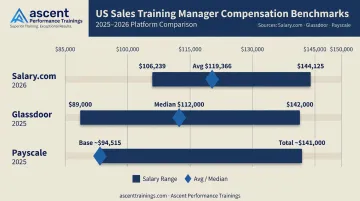
Compensation varies by industry, company size, and geography. Roles tied directly to measurable revenue outcomes — and those with demonstrated ROI track records — sit at the upper end of these ranges.
Education and Certifications
Most roles expect a bachelor's degree in business, marketing, or a related field. Professional certifications add credibility:
- Sales methodology certifications (Sandler, SPIN, MEDDIC-based programs)
- ATD's CPTD (Certified Professional in Talent Development) — requires 5+ years of experience
- ATD's APTD (Associate Professional in Talent Development) — validates foundational L&D knowledge
- ATD's Training & Facilitation Certificate — focused on facilitation skills and hands-on practice
Practical experience designing and delivering programs carries as much weight as formal credentials. Organizations hiring at this level want proof of execution, not just coursework.
Ongoing Development
Credentials and experience get you to the door. What separates those who advance to senior leadership is a commitment to continuous development beyond the formal requirements:
- Active membership in organizations like the Association for Talent Development (ATD)
- Regular attendance at sales enablement and L&D conferences
- Deliberate development of cross-functional business acumen — finance, product, marketing
- Seeking out train-the-trainer certifications to deepen facilitation craft and build internal capability transfer skills
Frequently Asked Questions
What is the role of a sales training manager?
A Sales Training Manager builds and runs training programs that improve sales team performance, bridging sales strategy and frontline execution by aligning training content to business goals and measuring outcomes against KPIs like win rate, ramp time, and revenue.
What is the difference between a sales trainer and a sales training manager?
A Sales Trainer is typically an individual contributor focused on delivering training sessions. A Sales Training Manager holds a strategic oversight role — responsible for program design, budget, team management, and ensuring training aligns with company goals and produces measurable results.
What skills are most important for a sales training manager?
The role requires hands-on sales experience, instructional design knowledge, strong communication and facilitation skills, data analytics ability, and a coaching mindset — including the ability to motivate resistant reps and connect every program to a measurable business outcome.
How much does a sales training manager make?
US average salaries range from approximately $94,515 (Payscale base) to $119,366 (Salary.com average), with total compensation reaching up to $141,000–$144,000 — varying by industry, company size, geography, and whether the role is tied to measurable revenue outcomes.
How do you measure the success of a sales training program?
Success should be measured through behavioral change indicators — pipeline activity, call quality, objection handling frequency — alongside business outcomes like win rate, deal size, and ramp time. Training completion rates confirm attendance; they do not confirm behavior change.
What qualifications do you need to become a sales training manager?
Most roles require a bachelor's degree in business or a related field, 5–7 years of sales or sales management experience, and ideally certifications in sales methodologies or adult learning — with hands-on program design experience often weighted as heavily as formal education.