Why Managing Hybrid and Remote Teams Is Harder Than It Looks
Traditional management instincts were built for offices. Walk the floor, read the room, reward whoever shows up earliest. None of that translates when your team is split across living rooms, coworking spaces, and time zones.
The scale of this shift is hard to overstate. According to Gallup's Hybrid Work indicator, 52% of remote-capable U.S. employees now work hybrid and 26% work exclusively remote. That means most managers are already leading distributed teams—whether they feel equipped to or not.
The core tension is structural, not personal. Proximity bias, communication gaps, and uneven access to information aren't character flaws—they're predictable outcomes of managing people across fundamentally different work environments. Good intentions don't fix them. Specific skills do.
The good news: these skills are learnable. Below are the five that matter most for hybrid and remote managers right now.
Key Takeaways
- Hybrid leadership runs on deliberately designed communication rhythms, not spontaneous hallway conversations.
- Trust is built through clarity and autonomy—surveillance and RTO mandates undermine both.
- Empathy is a functional leadership skill that reduces burnout before it becomes a performance problem.
- Proximity bias threatens team fairness and demands structural fixes, not good intentions.
- Measuring outcomes instead of hours is the most critical mindset shift for hybrid managers.
Skill 1: Mastering Intentional Communication
In an office, communication happens by accident. Overheard updates, hallway decisions, a quick read of someone's body language—none of this exists in a distributed team. Every meaningful exchange has to be designed.
Synchronous vs. Asynchronous: Choosing the Right Mode
The first decision every hybrid manager needs to make is when to communicate, not just what to say.
- Synchronous (video calls, live meetings): Use for complex decisions, relationship-building, and anything requiring real-time nuance
- Asynchronous (email, recorded updates, shared docs): Use for information sharing, cross-timezone teams, and updates that don't need an immediate response
Managers who default to one mode create problems. Leaning too heavily on synchronous leads to meeting overload: Microsoft's Work Trend Index found that weekly time in Teams meetings rose 252% between 2020 and 2022, and 68% of workers reported lacking enough uninterrupted focus time. Going all-async, on the other hand, creates information gaps and a sense of disconnection.
Building a Communication Rhythm
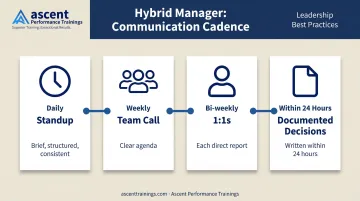
The most effective hybrid managers replace what used to happen organically with a predictable cadence:
- Daily standups (brief, structured, consistent)
- Weekly team calls with a clear agenda
- Bi-weekly or monthly 1:1s with each direct report
- Documented decisions shared in writing after every key meeting
Consistency matters as much as frequency. Remote employees who can predict when they'll hear from their manager don't feel like an afterthought.
Common Failure Point: Uneven Information Flow
Over-communicating with in-office employees while under-communicating with remote ones is one of the most common hybrid management mistakes—and one of the least visible. Audit your own behavior: do remote team members have the same access to decisions, context, and updates as office-based colleagues?
Practical norms that help:
- All decisions documented in writing within 24 hours
- No major announcements in side-channel messages
- Meeting recordings and summaries circulated to the full team
Skill 2: Leading with Empathy and Emotional Intelligence
Empathy in management means recognizing what a team member is actually experiencing — burnout, isolation, unclear expectations, competing home demands — and adjusting your response to match reality, not assumption.
Remote and hybrid workers often mask struggles. Without a manager physically nearby, there's less opportunity to notice when someone is overwhelmed, and less psychological safety to raise it unprompted.
New Signals to Watch For
Body language and energy levels that would be obvious in person are invisible on Slack. Hybrid managers need to develop new diagnostic cues:
- Slower response times than usual
- Drop in meeting engagement or camera-off patterns
- Decline in output quality, not quantity
- Withdrawal from voluntary team interactions
None of these signals are definitive, but each one is worth a genuine check-in.
What Empathetic Check-Ins Actually Look Like
Skip "how's the project going?" and ask questions that surface real obstacles:
- "What's getting in the way for you right now?"
- "Do you have what you need to do this well?"
- "How's your workload feeling this week—manageable or stretched?"
The data supports this approach. Gallup research shows that managers account for 70% of the variance in team engagement, and employees under top-quartile managers are significantly more likely to be engaged (50% vs. 36%) and plan to stay (54% vs. 39%).
Burnout Is an Empathy Problem Before It's a Productivity Problem
Remote employees often overcompensate — longer hours, constant availability, no clear end to the workday. Future Forum found that 42% of desk workers reported burnout, and burned-out employees were 3.4x more likely to plan to leave.
Leaders who model healthy boundaries — no after-hours messages, visible PTO, time zone respect — give their teams implicit permission to do the same.
Skill 3: Building Trust Through Autonomy, Not Oversight
The "illusion of control" trap catches many hybrid managers. When you can't see your team, it's tempting to compensate with more check-ins, mandatory online status indicators, or activity monitoring tools — and that instinct tends to backfire.
According to the APA's 2023 Work in America Survey, 42% of U.S. workers felt micromanaged, and 64% of those workers felt tense or stressed during the workday. And the retention stakes are significant: 60% of exclusively remote employees say they'd be extremely likely to look for a new job if remote flexibility were taken away.
Trust by Agreement, Not by Presence
In hybrid teams, trust is built upfront. Set clear expectations on:
- Goals: What does success look like for this role and this quarter?
- Communication norms: How and when do we check in?
- Decision authority: What can someone decide independently vs. what needs escalation?
- Timelines: What are the milestones and deadlines?
When employees understand exactly what's expected, the manager's role shifts from monitoring to enabling — removing blockers, providing context, and giving people what they need to succeed.
Accountability Without Surveillance
Visibility and surveillance are not the same thing. The right structures give everyone context without creating a monitoring culture:
- Shared project dashboards with live status updates
- Weekly written updates from team members (async, low-effort)
- Transparent progress tracking visible to the full team
When everyone can see what everyone else is working on, status-request meetings become unnecessary.
Psychological Safety as a Performance Variable
Employees who feel safe enough to say "I don't know" or "I'm behind" surface risks early — before they escalate. Employees who don't feel safe hide problems until they become crises. In a distributed team, where issues are harder to spot through proximity, psychological safety functions as direct risk mitigation. Managers who actively build it are protecting project outcomes, not just team morale.
Skill 4: Creating an Inclusive Culture Across Locations
Understanding Proximity Bias
Proximity bias is the natural tendency for in-office employees to receive more visibility, credit, and career opportunities—not because of better performance, but because of physical presence. Future Forum found that 41% of executives identified proximity bias as their top concern about hybrid work.
It doesn't require bad intent. It happens automatically when a manager has more face time with some employees than others.
Structural Practices That Counteract It
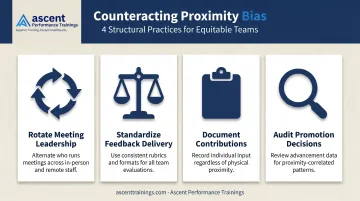
Good intentions don't fix proximity bias. Structural changes do:
- Rotate meeting leadership — remote and in-office employees alike should run team calls
- Standardize feedback delivery — recognition and constructive feedback should follow the same format for everyone, regardless of location
- Document contributions — make visible what gets done, not just who's in the room
- Audit promotion and project decisions — each quarter, check whether in-office employees are being disproportionately selected for high-visibility work
Time Zone and Schedule Fairness
If your team spans multiple time zones, one group shouldn't always bear the cost of inconvenient meeting times. Three practices make a measurable difference:
- Rotate meeting times so the same region doesn't consistently take early-morning or late-night slots
- Record all meetings and make recordings available within 24 hours
- Circulate written summaries so team members who couldn't attend live stay fully informed
Skill 5: Shifting to Outcomes-Based Performance Management
In hybrid and remote settings, managers cannot manage process. They can only manage results.
This requires a fundamental shift: define what "done well" actually looks like before assigning work, then evaluate on output rather than hours logged or activity levels.
A Practical Framework
- Set SMART goals at the individual and team level — Specific, Measurable, Achievable, Relevant, Time-bound
- Conduct bi-weekly check-ins focused on progress and blockers, not status updates
- Track KPIs tied to business impact — revenue, customer outcomes, quality metrics — rather than effort indicators like emails sent or hours online
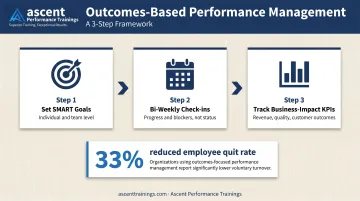
That upfront clarity pays dividends — and the data backs it up. A 2024 randomized trial published in Nature of 1,612 employees found that structured hybrid work reduced quit rates by 33% with no significant effect on performance reviews or promotion rates. Manager perceptions of productivity shifted from an expected -2.6% to +1.0% after the experiment — evidence that outcomes-based thinking changes how managers evaluate their teams.
Replacing the Feedback Gap
Without hallway interactions, informal feedback disappears. Hybrid managers need to replace it deliberately:
- Brief, specific, frequent feedback cycles (not just annual reviews)
- Public recognition in team channels for remote employees who may feel invisible
- Structured 1:1 agendas that include feedback as a standing item
How to Develop These Skills with Structured Leadership Training
Most managers were promoted because they were excellent individual contributors—not because they were trained to lead distributed teams across time zones and communication modalities. These are learnable skills, but they don't develop on their own.
Gartner's 2023 research found that 75% of HR leaders said managers were overwhelmed by growing responsibilities, and 73% said leaders weren't equipped to lead change. Leader and manager development ranked as the top HR priority for 2024, with 59% of HR leaders planning to increase investment.
Structured development closes that gap faster than trial-and-error. Role-playing difficult remote conversations, practicing empathy-based check-ins, learning outcomes-based frameworks in a supported environment—these accelerate the behavior changes that experience alone takes years to produce.
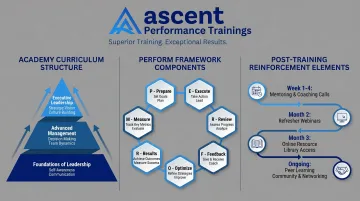
Ascent Performance Trainings offers leadership development programs built specifically for these challenges. The Ascent Leadership Academy (a 10-week program) builds foundational competencies across four areas:
- Emotional intelligence and self-awareness
- Communication and influence
- Decision-making under uncertainty
- Cross-functional collaboration
For organizations whose managers are already distributed, Ascent's Virtual & Remote Team Training program goes deeper: async communication norms, hybrid team chemistry, asynchronous performance management, and remote leadership presence.
Tim Carlisle's PERFORM Leadership framework, developed over 30 years of training leaders across 75+ countries, gives managers a structured methodology to apply directly to their own teams. Every program is reinforced through an 8-week post-training period—weekly application prompts, AI-generated micro-learnings, and monthly 1:1 coaching sessions—designed to convert classroom learning into durable on-the-job behavior change.
Frequently Asked Questions
What is the biggest challenge of managing a hybrid team?
The biggest challenge is maintaining equity between in-office and remote employees. Proximity bias—where visibility determines career opportunity—operates without conscious intent, meaning remote employees can fall behind on recognition and advancement even when their performance is equal or better.
How do you build trust with remote employees?
Trust is built through clear upfront expectations, consistent follow-through, and genuine autonomy over how employees achieve their goals. Regular, transparent communication reinforces it over time. Activity tracking and constant check-ins undermine it.
What communication tools work best for hybrid teams?
Slack, Microsoft Teams, and Zoom handle real-time communication; Asana and Trello manage project visibility. The tool matters less than having clear norms for when and how each one is used. Without those norms, any platform creates noise.
How is managing a hybrid team different from managing a fully remote team?
Hybrid teams introduce proximity bias that fully remote teams don't face. When some employees are in-office and others aren't, managers must actively counteract the visibility advantage that physical presence creates—fully remote teams start on more equal footing.
How can leaders prevent burnout in hybrid and remote teams?
Three levers matter most: model healthy boundaries yourself (no after-hours messages), monitor workloads proactively rather than waiting for problems to surface, and build enough psychological safety that people feel they can say when they're overwhelmed.
Can hybrid team leadership skills be trained and developed?
Yes. These are skills, not personality traits. Structured training programs, coaching, and deliberate practice are the most effective development path—particularly through programs purpose-built for hybrid and remote leadership contexts, like those offered through Ascent Performance Trainings' Leadership Academy.