Introduction
Most sales managers are promoted because they were exceptional at selling — not because anyone trained them to lead. This gap is well-documented: Harvard Business Review notes that companies routinely undertrain new sales managers, assuming strong individual performers will naturally succeed in leadership roles. They rarely do without structured support.
The consequences show up fast. Gartner reports that only 18% of sales managers lead high-performing teams, and 40% report feeling overwhelmed in their roles.
At a median annual salary of $138,060 and roughly 49,000 new openings per year, according to the Bureau of Labor Statistics, underprepared managers aren't just an HR problem — they're a revenue problem.
This guide covers what sales managers actually do, the skills they need, formal education and certification requirements, the critical mindset shift from rep to leader, and the training methods that produce lasting results — not just temporary post-workshop enthusiasm.
Key Takeaways:
- Most sales managers are promoted for selling skills, not leadership capability — structured training closes that gap
- Sustainable team performance requires both hard skills (forecasting, hiring) and soft skills (coaching, communication)
- Dynamic coaching correlates with a 19% win-rate improvement and 21.3% quota-attainment increase (CSO Insights)
- Multi-modality training with post-program reinforcement outperforms single-event workshops on retention
- Continuous development is what distinguishes high-performing managers from average ones
What Does a Sales Manager Actually Do?
The BLS defines the role as planning, directing, and coordinating the delivery of products or services to customers — but that description undersells the scope. In practice, a sales manager sits between the sales team and the broader organization, translating company strategy into rep-level execution while pushing team performance data back up the chain.
Core Responsibilities
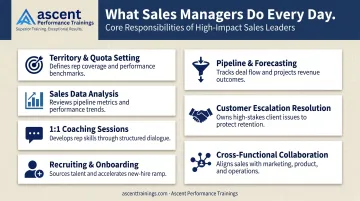
Daily and strategic tasks typically include:
- Setting territory assignments, quotas, and revenue goals
- Analyzing sales data to identify performance trends and gaps
- Conducting 1:1 coaching sessions with individual reps
- Recruiting, hiring, and onboarding new sales staff
- Managing pipeline health and forecasting accuracy
- Resolving escalated customer issues
- Collaborating cross-functionally with marketing, product, and operations
How Scope Varies by Organization Size
In large enterprises, a sales manager often oversees a specific product line, geographic region, or customer segment, with dedicated support from sales operations, enablement, and HR. In smaller businesses, the same person may own all of it: recruiting, training, forecasting, culture, and individual deals.
That scope difference has real consequences for performance outcomes. Gartner notes that effective managers can boost seller performance by up to 6x — but only 55% of CSOs say frontline managers consistently meet performance expectations. Which means the role is both high-leverage and, at most organizations, significantly undertrained.
Essential Skills Every Sales Manager Must Develop
There's a persistent mismatch in how sales managers are selected versus what the job actually demands. Most are promoted for hard skills — quota achievement, product knowledge, deal execution. The role then exposes significant gaps in soft skills that no amount of personal selling ability can compensate for.
Effective sales managers need both.
Hard Skills for Sales Management
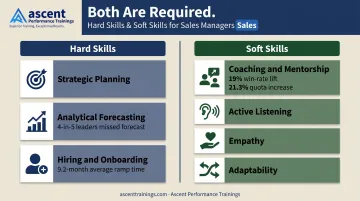
Strategic thinking and sales planning means more than setting a number. Managers must identify high-value customer segments, analyze market conditions, and build revenue plans that are data-backed and aligned with company goals — not just extrapolated from last year's results.
Analytical and forecasting ability separates managers who react from those who plan ahead. Xactly's 2024 research found that 4 in 5 sales and finance leaders missed a quarterly forecast in the prior year, and 52% reported variance of 10% or more. Managers who interpret pipeline data, calculate probability-weighted outcomes, and translate metrics into clear decisions provide a real competitive edge.
Hiring and onboarding is underestimated as a management skill. Knowing how to write effective job profiles, conduct structured interviews, evaluate cultural fit, and ramp new reps quickly directly impacts team capacity. CSO Insights reported that it takes an average of 9.2 months for a new hire to reach full productivity — a timeline the manager's onboarding approach either compresses or extends.
Soft Skills for Sales Management
Coaching and mentorship is the highest-leverage activity a sales manager can engage in. CSO Insights found that dynamic coaching produces a 19% win-rate improvement and a 21.3% quota-attainment increase — yet 62.9% of organizations still rely on random or informal coaching.
Effective coaching means identifying individual rep weaknesses and addressing them through structured feedback, role-play, and deliberate development conversations — not just running performance reviews once a quarter.
Three interpersonal skills complete the leadership picture:
- Active listening — helps managers understand what reps actually need, not just what's being said
- Empathy — enables productive conflict resolution and builds the trust that makes feedback land
- Adaptability — allows managers to adjust their approach for a struggling new hire versus a seasoned rep hitting a plateau
Formal Requirements: Education, Experience & Certifications
Education and Experience
Most employers expect a bachelor's degree in business administration, marketing, or management. O*NET data shows that 71% of surveyed respondents indicated a bachelor's degree is required for sales manager roles, with roughly 61% of the current workforce holding a bachelor's degree or higher.
Experience requirements are equally consistent: most companies want three to five years as a sales representative before moving into management, with demonstrated performance in quota achievement, territory management, or team leadership. An MBA can accelerate advancement into senior sales leadership roles but is rarely a prerequisite for first-line management.
Relevant Certifications
Certifications don't replace experience, but they validate competency and give managers a structured foundation to build on:
| Certification | Issuing Body | Focus |
|---|---|---|
| Certified Professional Sales Leader (CPSL) | NASP | Leadership strategies, communication styles, emotional intelligence in sales |
| Certified Sales Executive (CSE) | SMEI | Recruiting, training, managing, goal-setting, and motivating salespeople |
| Ascent Performance Training Certificate | Ascent Performance Trainings | Sales management competencies: consultative selling, coaching, pipeline management, and sales leadership |
The Ascent Performance Training Certificate is awarded upon completion of structured programs, including the Ascent Sales Academy and Leadership Academy. Each engagement includes 8 weeks of post-training reinforcement to embed behavior change on the job. It's built for sales professionals who need to demonstrate applied skills, not just classroom completion.
The Mindset Shift: From Top Rep to Team Leader
This is where most newly promoted managers fail — not because of skill gaps, but because of an identity gap.
As an individual contributor, success is personal: your pipeline, your quota, your deals. As a sales manager, success is entirely vicarious. Your number is now your team's number. The best managers absorb this shift quickly. The rest spend months trying to be both player and coach — and usually fall short at both.
The Player-Manager Trap
New managers who continue selling instead of coaching create a specific kind of dysfunction:
- Reps become dependent on the manager to close deals
- Coaching time disappears into deal execution
- Team development stalls while the manager burns out
- The manager's personal pipeline becomes a distraction from team-level accountability
This pattern is one of the most common failure points in newly promoted managers, and it's almost always a byproduct of unclear role expectations — not bad intentions.
Leading Through Others
Tim Carlisle, founder of Ascent Performance Trainings and author of PERFORM Leadership, frames this transition as moving from individual performance to enabling others' performance. The PERFORM framework — built around 10 essential elements of high-impact leadership — provides a structured model for managers who need to shift how they measure their own success.
That shift plays out in daily habits:
- Set clear expectations so reps know what good looks like
- Give consistent, specific feedback tied to observable behavior
- Create an environment where reps feel both challenged and supported
- Own team failures without blame-shifting — accountability flows upward as well as down
- Stay curious about evolving sales methods rather than defaulting to how you personally used to sell
That last point is where many managers quietly resist. Managers who still measure their worth by personal deal outcomes tend to stall here. Those who shift to measuring success through team quota attainment, rep development, and retention build stronger teams — and do it faster.
Proven Training Methods That Develop High-Performing Sales Managers
One-size-fits-all training rarely produces lasting change. The research is clear on why.
ATD reports that single-session, lecture-based training often results in participants forgetting 75% of information without immediate review or application. Research published in Psychological Science in the Public Interest confirms that distributed practice and retrieval testing produce stronger retention than massed learning — for virtually every content type.
Effective sales manager training isn't a single event — it's a structured, reinforced experience.
Multi-Modality Delivery
Programs that combine in-person workshops, live virtual sessions, 1:1 coaching, and self-paced learning consistently outperform single-format training. Each modality serves a distinct purpose:
- In-person classroom: Deepest behavior change through role-play, simulation, and live facilitation
- Live virtual micro-learnings: 60–90 minute focused sessions for ongoing skill development (flexible around busy schedules)
- 1:1 coaching: Personalized feedback on individual challenges, including "coach the coach" sessions where managers receive coaching on their coaching
- On-demand platform: 24/7 reinforcement and concept review between live sessions
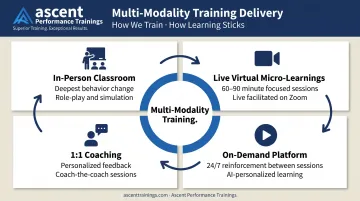
Ascent Performance Trainings structures its sales manager programs across all four modalities, with an 8-week post-training reinforcement layer — weekly micro-learning videos, application prompts, and monthly coaching sessions — specifically designed to prevent the knowledge decay that follows single-event training.
Field Coaching and Call Observation
Managers learn coaching by doing it. Shadowing reps on live calls, reviewing recordings, and delivering structured real-time feedback builds judgment faster than classroom instruction alone. Ascent's Sales Coaching Skills for Sales Managers program incorporates live shadow sessions with the manager's actual team, so skill development happens in the real work environment, not a simulated one.
The 1:1 Meeting as a Coaching Instrument
Most managers treat 1:1 meetings as status updates. High-performing managers treat them as structured coaching conversations. The difference requires training: managers need to know how to prepare an agenda, diagnose rep-specific gaps, set development goals, and deliver feedback that changes behavior. Feedback that only informs without changing behavior is a missed coaching opportunity.
Real-World Simulations and Case Studies
Managerial judgment builds faster through case walk-throughs of actual sales scenarios — examining what worked, what didn't, and the reasoning behind both — than through abstract frameworks alone. The industry context matters just as much as the format. A pipeline coaching role-play looks entirely different depending on the sales environment:
- SaaS / B2B tech: Multi-stakeholder deals, product demos, expansion revenue conversations
- Oil and gas / energy: Long procurement cycles, technical specifications, relationship-heavy closing
- Financial services: Compliance constraints, consultative advisory conversations, trust-building at scale
- Professional services: Scoping discussions, value justification, and managing client expectations
Training that mirrors the manager's actual buyer dynamics and deal structures transfers directly to the job — not just to a hypothetical scenario.
How to Build a Continuous Sales Manager Development Plan
The skills that made someone a strong manager three years ago may not be sufficient today. Markets shift, team compositions evolve, and new sales methodologies emerge. Development is not a one-time event. It's a competitive input that compounds over time.
CSO Insights found that higher levels of sales manager training investment were directly correlated with above-average win rates and revenue plan attainment. Despite this, 60.9% of organizations spent only $500 to $2,500 per manager annually on training — an amount that typically funds one workshop, not a development program.
Components of a Practical Development Plan
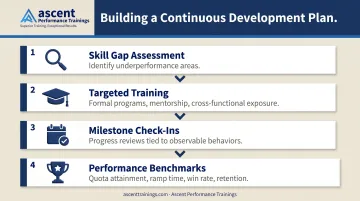
A structured plan includes:
- Skill gap assessment — Identify where the manager currently underperforms against the demands of the role
- Targeted training — Formal programs, peer mentorship, and cross-functional exposure (not just sales-specific content)
- Milestone check-ins — Regular progress reviews tied to observable behaviors, not just training completion
- Performance benchmarks — Measured against team outcomes: quota attainment, rep ramp time, win rate, retention — not manager activity metrics
Building a Professional Network
Development doesn't only happen inside formal programs. Managers who grow fastest draw from multiple sources:
- Join industry organizations and attend peer workshops to benchmark against outside practices
- Seek mentorship from senior sales leaders who have navigated similar team challenges
- Build a network of fellow managers — candid peer conversation surfaces problems faster than internal reviews
- Supplement structured training with an 8-week reinforcement phase to convert new skills into durable habits (the approach Ascent Performance Trainings embeds into every program)
The compounding effect of formal training, peer exposure, and behavioral reinforcement is what separates a development plan from a single workshop.
Frequently Asked Questions
What is a sales manager in training?
A sales manager in training is typically a high-performing sales rep being prepared for a management role through structured coaching, shadowing, and skill development programs. The goal is to bridge the gap between individual contributor and team leader before the formal promotion occurs.
What are the top 5 skills of a sales manager?
The five most critical skills are coaching and team development, strategic thinking and planning, data analysis and forecasting, communication and active listening, and adaptability. No single skill defines an effective manager. What separates good managers from great ones is how these skills work together under pressure.
What education is required to become a sales manager?
Most employers prefer a bachelor's degree in business, marketing, or management, though significant field experience can substitute in many industries. An MBA can accelerate advancement into senior sales leadership roles but is rarely required for first-line management positions.
How long does it typically take to become a sales manager?
Most professionals spend three to five years as a sales representative before transitioning into management, though this varies by company, industry, and how quickly the individual demonstrates leadership capability and consistent performance.
What is the difference between sales management training and sales leadership training?
Sales management training focuses on operational competencies: pipeline management, reporting, hiring, and coaching processes. Sales leadership training focuses on vision, culture-setting, and inspiring long-term performance. Both are needed and often overlap in comprehensive programs.
How do I know if a sales manager training program is working?
Measure outcomes, not completion rates. Effective programs produce observable results: improved team quota attainment, shorter rep ramp times, reduced turnover, higher close rates, and manager-reported confidence in coaching. If those metrics aren't moving within one to two quarters, the program design — not just delivery — needs a closer look.