

Introduction
Picture two customer service agents. Same product knowledge, same training manual, same difficult caller on the line. One de-escalates the situation in three minutes, leaves the customer feeling genuinely heard, and closes with a five-star rating. The other triggers a callback, an escalation, and a cancellation request.
The difference isn't script adherence or technical skill. It's emotional intelligence.
Qualtrics XM Institute's 2024 study of 10,000 consumers found that emotion — not effort or success alone — had the largest impact on loyalty behaviors including trust, forgiveness, and willingness to purchase more. Agents who can read and respond to customer emotions don't just resolve tickets. They build the kind of trust that keeps customers coming back.
This guide covers what emotional intelligence (EI) actually means in a customer service context, why it moves your key metrics, and how to spot low EI on your team. You'll also find the skills that matter most and a practical framework for training and measuring EI at scale.
Key Takeaways
- Five core EI components — self-awareness, self-regulation, empathy, motivation, and social skills — directly shape how agents handle customer interactions
- Teams with stronger EI consistently post higher CSAT scores, lower escalation rates, and better customer retention
- Managers can spot low-EI warning signs early — before churn, complaints, or team friction compound
- EI is a learnable skill: structured training and reinforcement produce measurable, lasting behavior change
What Is Emotional Intelligence in Customer Service?
Emotional intelligence is the ability to recognize, understand, and manage your own emotions — and to perceive and respond appropriately to the emotions of others. In customer service, where tone and empathy directly shape whether an interaction ends in resolution or frustration, EI often matters more than technical product knowledge.
As Daniel Goleman's foundational HBR research established, IQ and technical skill create a baseline, but EI differentiates effectiveness in roles requiring human relationships. A customer service agent who knows every feature of your product but responds defensively to an upset caller will underperform one who listens, adapts, and connects. Technical knowledge opens the door; EI determines what happens next.
Goleman's model identifies five core components. Here's how each one operates in customer service specifically.
Self-Awareness and Self-Regulation
Self-awareness means knowing what's happening inside you during a call. An agent with high self-awareness notices when frustration is building — after a difficult back-to-back shift, for example — and catches themselves before that tension leaks into the next customer interaction. Without it, agents unknowingly project stress onto callers who have nothing to do with the previous call.
Self-regulation is what happens next: the ability to control that emotional response in real time. A self-regulated agent faced with an angry customer doesn't respond defensively. Instead of "Well, that's our policy," they pause, choose calm language, and redirect: "I hear you. Let me look at what options we have here." That two-second gap between reaction and response is where de-escalation either happens or doesn't.
Empathy, Motivation, and Social Skills
Empathy is the component most people focus on, and also the one most often faked. Scripted phrases like "I understand your frustration" signal empathy without expressing it. Genuine empathy shifts the mood of a conversation because customers feel their emotional state has been recognized, not processed.
A practical framework many trainers use is the 5 A's — and the sequence matters:
- Acknowledge the emotion before anything else
- Align with the customer's perspective
- Affirm that their concern is valid
- Assure them you'll help
- Act on a solution
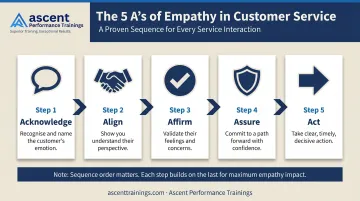
Moving straight to "Act" before the first four steps typically makes customers feel dismissed, not helped.
Motivation in this context means internal drive — the commitment to create a genuinely positive outcome even during a long, difficult shift. Motivated agents treat interaction number 47 of the day with the same care as interaction number one. It's harder to train than technique, but it's shaped directly by team culture, recognition practices, and how managers model the behavior they expect.
Social skills are what tie the other four components together. Applied EI in action looks like this: adjusting your tone to match a stressed caller, reading when to be direct versus when to slow down, and knowing how to close a conversation so the customer feels genuinely helped. An agent might have strong self-awareness but still struggle if they can't adapt their communication style to match where the customer is emotionally.
Why Emotional Intelligence Matters in Customer Service
The business case for EI in customer service is grounded in how customers actually make loyalty decisions — and what causes them to leave.
Emotion Drives Retention — and Defection
PwC reports that 32% of customers would stop buying from a brand they love after just one bad experience. The emotional quality of service interactions is not a soft metric — it directly affects revenue.
Meanwhile, the HBR/CEB analysis of over 75,000 service interactions found that 96% of customers who experienced high-effort interactions became more disloyal, compared to just 9% after low-effort interactions. High emotional labor on the customer's part — having to explain themselves repeatedly, manage an agent's attitude, or fight for a reasonable resolution — produces disloyalty far more reliably than product failures.
EI-equipped agents reduce that customer effort. When agents acknowledge feelings before jumping to solutions, customers feel heard. Customers who feel heard are more patient, more forgiving, and more likely to stay.
De-Escalation as a Business Outcome
When an agent lacks EI, a tense interaction typically follows a predictable path: the customer expresses frustration, the agent responds defensively or robotically, the customer escalates, and the issue now requires a supervisor, a follow-up call, or a cancellation. Each step adds cost.
Emotionally intelligent agents interrupt that cycle early. Calm acknowledgment reduces the customer's emotional temperature, which makes problem-solving faster and more effective. The call gets resolved, the customer feels respected, and the queue moves forward.
Internal Benefits: Agent Wellbeing and Burnout
These benefits extend to the team behind the customer. ICMI reports that 54% of contact centers experience attrition rates between 21% and over 50%, with nearly 80% saying attrition increased or didn't improve. Emotional labor — the effort of suppressing real emotions to perform required ones — is a primary driver of burnout in customer service roles.
Agents who develop genuine EI rather than just surface-acting their way through difficult calls experience less psychological strain. Self-regulation and self-awareness reduce the toll that high-volume emotional work takes.
For organizations, the downstream impact is tangible:
- Reduced turnover and the recruitment costs that come with it
- More consistent service quality across the team
- Lower supervisor burden from fewer escalations
- Less time and budget spent constantly backfilling open roles
7 Signs of Low Emotional Intelligence on Your Customer Service Team
Before you can improve EI, you need to identify where it's missing. These are observable behaviors — not personality judgments — that managers can spot in call reviews, QA sessions, or direct observation.
- Defensiveness with upset customers — responding to complaints with justifications or policy recitations rather than acknowledgment
- Robotic, scripted language — reading from canned responses without adapting tone, making customers feel like ticket numbers
- Emotional carryover between calls — carrying frustration from one call into the next, affecting an unrelated customer
- Rushing to solutions — interrupting customers or jumping to fixes before the customer has finished explaining the problem
- Tone inflexibility — using the same pace, register, and communication style regardless of whether the customer is anxious, angry, or confused
- Blame-shifting — attributing issues to "the system," "the policy," or the customer rather than focusing on what can be resolved
- Defensiveness to feedback — reacting to coaching or performance input with resistance rather than curiosity
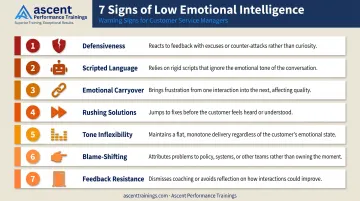
Every one of these behaviors is addressable through targeted coaching and structured training. They signal skill gaps — which means they can be closed.
Key Emotional Intelligence Skills for Customer Service Professionals
Active Listening
Research from peer-reviewed hospitality settings confirms that active listening after service failure directly increases customer satisfaction and perceived preferential treatment. In practice, active listening means more than not interrupting. Three techniques agents can apply immediately:
- Paraphrase before responding — "So what I'm hearing is the order arrived damaged and you need a replacement before Friday — is that right?" confirms understanding and signals attention
- Use verbal cues — brief affirmations like "That makes sense" or "I hear you" keep the customer talking and feeling acknowledged
- Allow brief silences — resist the urge to fill every pause. Silence after a customer finishes speaking gives them space to add detail and signals that you're not rushing them
Emotional Adaptability and Positive Language
Adaptability means reading where the customer is emotionally and adjusting tone, pace, and language to match — then leading them toward a calmer state. A customer who's panicked needs a steady, slower-paced response. A frustrated customer needs direct acknowledgment before any explanation.
Pair adaptability with positive language. Two shifts that make an immediate difference:
- Reframe restrictions — "I can't process that request" becomes "Here's what I can do right now." The words are different; the emotional effect is not.
- Lead with solutions — restrictive language puts customers on the defensive. Solution-framed language keeps the conversation moving forward.
Emotional Self-Control Under Pressure
Managing composure when customers are rude or unreasonable is genuinely difficult — and genuinely trainable. Three practical techniques:
- Brief mental reset between calls — even 30 seconds of deliberate disengagement prevents emotional carryover
- Focus on the problem, not the person's tone — mentally separating "this customer is upset about a billing error" from "this customer is yelling at me" reduces the personal sting of difficult interactions
- Avoid matching escalation — when a customer raises their voice, slow down and lower yours. Matching their energy accelerates conflict; contrasting it de-escalates
How to Train Your Team in Emotional Intelligence
Role-Playing and Scenario Practice
Role-playing is among the most effective methods for EI training because it creates a consequence-free environment to practice emotional responses before agents face them with real customers. The most effective formats go beyond basic scripts:
- Trainers pause mid-scenario to ask "What are you noticing right now? What would you do differently?"
- Agents test multiple approaches to the same scenario rather than rehearsing one "correct" answer
- Scenario difficulty increases as proficiency develops — starting with mildly frustrated customers before working up to hostile or irrational ones

Active practice with feedback consistently outperforms passive instruction for transferring workplace skills. Role-playing is where that principle applies most directly to EI development.
Coaching with Feedback Loops
Call quality reviews typically focus on efficiency: handle time, resolution rate, hold time. Adding EI criteria to QA reviews changes what gets measured — and what gets prioritized.
Supervisors reviewing calls with an EI lens ask:
- Did the agent acknowledge the customer's emotion before offering a solution?
- Did the agent's tone adapt to the customer's emotional state?
- Was the language solution-focused or restrictive?
When EI criteria appear consistently on scorecards and in coaching sessions, agents receive a clear signal: emotional skill is a real performance priority, not a soft-skills afterthought.
Self-Reflection Practices
Structured self-reflection builds the self-awareness that underpins every other EI component. Brief post-call check-ins with specific questions are more useful than general debriefs:
- "Did I acknowledge the customer's emotion before explaining the solution?"
- "Was I reactive to their tone, or did I stay focused on the problem?"
- "Did I rush to resolution before they finished explaining?"
Agents who score their own calls against EI criteria begin noticing patterns in their behavior that they weren't previously aware of — which is the foundation for genuine improvement.
Sustained Development Through Micro-Learning and Reinforcement
Single training events don't build EI. The skill requires continuous reinforcement to embed as actual behavior rather than a temporary adjustment.
Short, frequent learning touchpoints — brief scenario reviews, real-call analysis, focused skill refreshers — outperform infrequent intensive workshops precisely because EI is a behavioral skill that fades without practice. That's the structure behind Ascent Performance Trainings' Customer Service Academy: an 8-week post-training reinforcement program that delivers weekly AI-personalized micro-learning videos and monthly 1:1 coaching sessions, ensuring EI skills are practiced and embedded in real work rather than forgotten within weeks of the initial training.
Building a Culture That Values EI
Training only works if the organizational culture reinforces what's learned. When leaders model emotionally intelligent behavior, they set the standard agents follow.
That means visible behavior from the top — and deliberate recognition at the team level. Leaders who reinforce EI effectively tend to:
- Acknowledge team frustrations openly rather than dismissing them
- Respond to mistakes with curiosity rather than blame
- Celebrate empathetic handling of difficult callers alongside speed metrics
- Make EI criteria visible on scorecards, not buried in annual reviews
Without those signals, agents optimize for whatever gets measured and praised — and EI falls off the priority list.
How to Measure Emotional Intelligence in Customer Service
EI is qualitative by nature, but it produces quantifiable outcomes. Four metrics in particular show where emotional intelligence is — or isn't — showing up on the floor:
| Metric | What It Measures | EI Connection |
|---|---|---|
| CSAT score | Customer satisfaction post-interaction | Rises when customers feel genuinely heard |
| First-contact resolution (FCR) | Issues resolved without follow-up | Improves when agents understand root issues, not just surface requests |
| Customer retention rate | Long-term loyalty | Reflects the emotional quality of relationships built over time |
| Escalation rate | Calls requiring supervisor intervention | Decreases when agents de-escalate effectively |
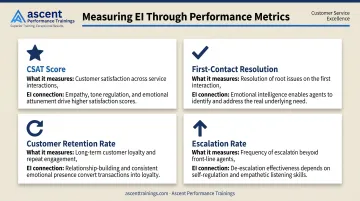
ICMI data shows that 75% of organizations that improved first-contact resolution also saw CSAT improve over the following 12 months. FCR benchmarks for call centers typically fall between 70% and 79% — teams that consistently exceed this range tend to have agents who read customer situations accurately, not just efficiently. That's EI at work.
EI Scorecards and QA Integration
Adding EI criteria to existing QA frameworks is one of the most direct ways to make emotional intelligence measurable. Relevant scorecard criteria include:
- Tone acknowledgment — did the agent validate the customer's emotion?
- Language framing — was language solution-focused or restrictive?
- Adaptability — did the agent adjust communication style to the customer's state?
- De-escalation behavior — did the agent slow down and stabilize a tense interaction?
Self-assessment versions of these same scorecards can be particularly powerful. When agents score their own calls, they start noticing emotional patterns — moments where they cut short an acknowledgment, or matched a frustrated customer's pace instead of slowing it down — that no manager would catch in a standard QA review.
Qualitative Feedback as an EI Signal
Numerical scores tell part of the story — customer comments fill in the rest. When post-interaction surveys return language like "she really understood what I was going through" or "he didn't make me feel like I was being difficult" — that's EI working. Mining survey responses for emotional language (feeling heard, respected, or genuinely understood) gives managers a qualitative read on EI performance that no efficiency metric captures.
Frequently Asked Questions
What is the role of emotional intelligence in customer service?
EI enables agents to recognize and respond to customer emotions effectively — turning tense or frustrating interactions into trust-building moments. It influences both the outcome of each individual call and the long-term loyalty customers develop toward a brand over multiple interactions.
What are the 5 C's of emotional intelligence?
The 5 C's — Consciousness, Control, Commitment, Compassion, and Collaboration — are a practical lens some practitioners use to discuss EI in professional settings. They're not a formally verified academic framework, so treat them as a complementary reference rather than a replacement for Goleman's established five-component model.
What are 7 signs of low emotional intelligence?
The key behavioral indicators include defensiveness with upset customers, robotic scripted responses, emotional carryover between calls, interrupting before customers finish, tone inflexibility, blame-shifting to policies or systems, and defensiveness toward feedback.
What are the 5 A's of empathy in customer service?
The 5 A's — Acknowledge, Align, Affirm, Assure, Act — give agents a clear sequence for ensuring customers feel heard before any solution is introduced. The order matters: moving to "Act" too early makes customers feel dismissed rather than supported.
Can emotional intelligence be learned and trained?
EI is not a fixed personality trait. Research confirms it can be developed through structured training, regular coaching, and consistent practice — with measurable gains appearing after as little as six months. Organizations that invest in EI training see real improvements in agent behavior and downstream CSAT and retention outcomes.
How do you measure emotional intelligence in customer service teams?
Start with CSAT scores, first-contact resolution rates, customer retention rates, and escalation frequency. Layering EI-specific criteria onto QA scorecards — such as tone acknowledgment and de-escalation behavior — adds a more direct dimension, and qualitative customer feedback about feeling heard provides equally useful data points alongside the numbers.