Introduction
According to the Sales Management Association, 77% of sales management respondents believe their reps receive too little coaching — and 55% of firms report their coaching programs are wholly ineffective. Yet CSO Insights found that dynamic, structured coaching correlates with a 21.3% improvement in quota attainment over study averages. Most organizations are leaving that gap wide open.
That gap is structural. Most sales managers were promoted because they were exceptional sellers — not because they knew how to develop others. That mismatch compounds over time, showing up as missed quotas, high rep turnover, and unpredictable revenue. This guide gives you the framework, skills, and KPIs to fix it.
Key Takeaways:
- Sales management coaching is a structured, ongoing process — not a one-time training event
- Five core skills distinguish effective coaches from managers who only inspect pipelines
- A five-step framework moves reps from self-diagnosis to sustained behavior change
- Specific KPIs measure whether coaching is actually working
- The right formal program includes post-training reinforcement, not just a workshop
What Is Sales Management Coaching?
Sales management coaching is a structured, ongoing process in which sales managers guide individual reps to self-diagnose their performance gaps, take ownership of their development, and build better selling habits over time. The operative word is ongoing — a single conversation is not coaching. Coaching works through repetition, accountability, and compounding behavior change.
Coaching vs. Training vs. Mentoring
These three terms are often used interchangeably — but they serve very different purposes:
| Format | Audience | Focus | Time Horizon |
|---|---|---|---|
| Training | Groups | Generalized skills and knowledge | Short-term event |
| Mentoring | Individual | Long-term career trajectory | Relationship-based |
| Coaching | Individual | Current performance and daily behaviors | Ongoing, anchored in real deals |
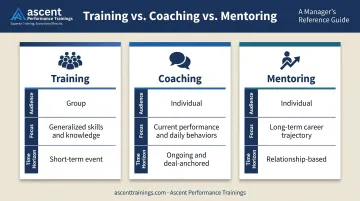
Sales management coaching sits in the middle — personalized, performance-focused, and grounded in what happened on yesterday's call, not abstract principles.
Understanding where coaching fits is only half the equation. The harder part is actually doing it well. The most important shift for any manager moving into a coaching role: stop directing, start questioning. Telling a rep what to do is management. Asking questions that help a rep discover the answer themselves is coaching — and that difference is what separates managers who develop people from those who simply supervise them.
Why Sales Management Coaching Matters in 2026
Organizations that optimize both the quality and quantity of coaching see 16.7% higher annual revenue growth than firms that provide no coaching at all. And yet, CSO Insights found that 62.9% of organizations still rely on random or informal coaching — meaning the majority treat it as an ad-hoc activity rather than a strategic function.
Who Benefits — and How
- Reps gain a safe space to address skill gaps, build confidence, and receive feedback tied to real deals
- Managers build stronger team relationships and reduce voluntary turnover
- Organizations see more consistent buyer experiences and more predictable revenue
Those benefits don't materialize on their own — and three converging market forces are making the timing of structured coaching more consequential than ever.
Why 2026 Raises the Stakes
Three forces are compressing the margin for error:
- Buyer self-sufficiency is accelerating. Gartner reports that 67% of B2B buyers now prefer a rep-free purchase experience — meaning when buyers do engage a rep, that interaction needs to deliver real insight or expertise from the first exchange
- Buying cycles are compressing. 6sense's 2025 B2B Buyer Experience Report found cycles shortened from 11.3 months to 9.7 months, leaving less room for reps to course-correct on their own
- AI is reshaping how buyers research and decide. Reps who can't add value beyond what a prospect already found online lose deals at the first conversation
One-time training events were never built to address this kind of continuous pressure. Personalized coaching that runs alongside live deals is what actually moves rep performance in real time.
The Top 5 Skills of an Effective Sales Management Coach
1. Active Listening and Empathy
Effective coaching starts before any feedback is given. A manager who jumps straight to solutions — before understanding how the rep experienced the call or deal — creates defensiveness, not growth.
What active listening looks like in practice: a rep debriefs a lost deal, and the manager's first response is silence, then a question: "Walk me through what you were thinking when the prospect pushed back on price." The manager learns something. The rep feels heard. The conversation goes somewhere productive.
2. Asking Powerful Open-Ended Questions
Great coaches guide reps to self-identify problems rather than diagnosing for them. Discovery-style questions — "What do you think went differently on that call?" or "If you ran that demo again, what would you change?" — do more work than any prescribed fix.
Self-discovered insights drive lasting behavior change. Insights handed down from a manager create temporary compliance.
3. Data Literacy and Performance Analysis
Coaching without data is guesswork. Effective coaches use rep-level metrics to set a targeted agenda before the session begins:
- Quota attainment trends — is this a consistency issue or a skill gap?
- Win rate by stage — where are deals actually dying?
- Deal velocity — is the rep advancing opportunities or letting them stall?
- Conversion rates — are discovery calls converting to demos at the expected rate?
This data shapes the agenda before the coaching session starts.
4. Delivering Constructive Feedback With Balance
Feedback that only surfaces failures demoralizes reps. Feedback that leads with genuine strengths — before addressing gaps — builds confidence and opens the rep to change.
A practical structure: identify what the rep did well and why it worked, then address one specific development area with behavioral precision, not personal judgment.
5. Accountability and Consistent Follow-Through
A coaching conversation without a follow-up sends a message: improvement isn't really expected. Coaches who document action plans and revisit them — session after session — create the repetition that behavior change requires. Without that follow-through, even the best conversation fades within a week.
How to Build a Sales Management Coaching Framework
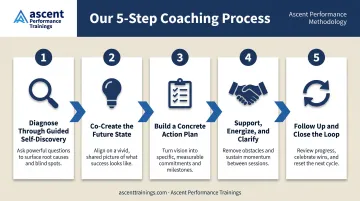
Step 1 — Diagnose Through Guided Self-Discovery
Before offering any feedback, ask the rep to assess themselves: "What went well? What would you do differently?" When reps identify their own gaps, they own the solution. When managers diagnose for them, reps defend against it.
The goal of Step 1 is to understand the rep's perspective before forming yours.
Step 2 — Co-Create the Future State
Ask the rep to describe what success looks like from their view, then explore what stands in the way. This builds intrinsic motivation. A plan the rep helped design feels like their plan — which makes execution far more likely than a plan handed down from above.
Step 3 — Build a Concrete, Documented Action Plan
Vague commitments produce vague results. A good coaching action plan includes:
- 1-2 specific behavior changes the rep can apply this week
- A realistic timeline with defined milestones
- Manager support commitments — what will the manager do to help?
- Documentation stored somewhere both parties can reference
Without documentation, action plans evaporate between sessions.
Step 4 — Support, Energize, and Clarify
After the plan is built, check in on how the rep feels about it. Remove ambiguity. Every coaching session should end with a rep feeling more capable than when it started — not more scrutinized.
Structured frameworks make this step repeatable. Tim Carlisle of Ascent Performance Trainings built the PERFORM Leadership methodology around exactly this principle: translating a manager's coaching conversations into measurable team outcomes, not just good intentions.
Step 5 — Follow Up Consistently and Close the Loop
Subsequent sessions should revisit the action plan, track progress against milestones, and adjust where needed. Wins should be recognized — and where appropriate, shared with the broader team. Public recognition of improvement reinforces coaching culture and motivates peers.
Consistent follow-through is what separates a coaching conversation from a coaching culture. The framework only works if the loop keeps turning.
How to Measure the Impact of Sales Management Coaching
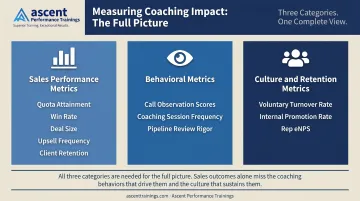
Sales Performance Metrics
Track these at the individual rep level — team averages obscure what is actually happening:
- Quota attainment rate — the baseline indicator of rep performance
- Win rate — measures selling effectiveness, not just activity
- Deal size and profitability — are reps discounting to close?
- Upsell and cross-sell frequency — signals depth of customer relationships
- Client retention — a lagging indicator of how well reps serve accounts post-close
Avoid relying on team averages. One or two strong performers can mask five struggling reps, and coaching that matters most is the coaching directed at the middle and bottom of the distribution.
Observational and Behavioral Metrics
Performance numbers tell you what happened. Observational metrics tell you why.
Downward feedback — where directors or second-line managers assess whether frontline managers are consistently applying coaching guidance — reveals whether a program is being executed or quietly shelved. Managers can complete training and return to the same behaviors. Observation-based accountability closes that gap.
Track these behavioral signals to gauge real-world application:
- Call and demo observation scores — are managers coaching to the methodology or reverting to old habits?
- Coaching session frequency and quality — are 1:1s happening, and are they structured?
- Pipeline review rigor — are managers using data to drive conversations, not just check a box?
Culture and Retention Metrics
Coaching quality shows up in culture over time. CSO Insights found that fully engaged sales forces have 5.7% voluntary turnover versus 10.2% for unengaged teams. Use these indicators to gauge whether coaching is creating a high-performance environment:
- Voluntary turnover rate — signals whether reps feel developed or stagnant
- Internal promotion rate — is the team producing its own next-level leaders?
- Rep satisfaction scores and eNPS — are reps recommending the team as a great place to work?
These metrics will not shift in a single quarter. They move when coaching becomes consistent over months — which is exactly why tracking all three categories together (performance, behavioral, and cultural) gives revenue leaders the full picture of whether a coaching program is actually working.
What to Look for in a Sales Management Coaching Program
Not all programs are built the same. Here is what separates programs that produce durable change from those that produce memorable workshops.
Multi-modal, flexible delivery. Look for a blend of in-person workshops, live virtual sessions, one-on-one coaching, and self-paced modules. Different managers learn differently, and schedules rarely accommodate a single delivery format.
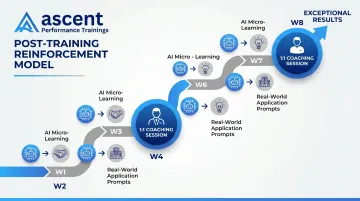
Post-training reinforcement that sustains behavior change. A single training event rarely produces lasting change without deliberate follow-through. The most effective programs build reinforcement into the design from the start.
Ascent Performance Trainings does this through an 8-week post-training reinforcement model — weekly AI-generated micro-learning videos, real-world application prompts, and monthly 1:1 coaching sessions that embed skills into daily behavior. Founder Tim Carlisle built this structure after watching behavior change fade when reinforcement was absent.
Industry relevance and customization. Generic programs teach managers to coach generically. The challenges facing a SaaS sales manager coaching enterprise reps on MEDDPICC are fundamentally different from those facing an oil and gas manager coaching technical sales engineers on project pursuit. Look for programs that tailor content to the rep's actual industry, role, and customer base:
- Sales methodology alignment (MEDDPICC, Challenger, SPIN, Sandler) matched to deal type
- Industry-specific deal scenarios and objection sets, not generic role-plays
- Coaching frameworks built around the manager's actual team structure and sales cycle
Frequently Asked Questions
How much does a sales management coaching program cost?
Pricing varies based on format, duration, and provider. Single-session workshops run in the low thousands; multi-quarter enterprise engagements — covering custom program design, multi-modal delivery, and post-training reinforcement — are scoped on a proposal basis. Key cost drivers include group versus one-on-one format, customization depth, and engagement length.
What are the top 5 skills of a sales manager?
The five skills covered in this guide: active listening and empathy, asking open-ended questions that guide self-discovery, data literacy and performance analysis, delivering balanced constructive feedback, and maintaining accountability through consistent follow-through. These are coaching competencies — distinct from general management skills — and developing them directly drives rep performance.
What are the 5 C's of coaching?
The 5 C's framework typically includes Clarity, Communication (or Compassion), Commitment, Consistency, and Celebration. Each supports a different phase of the coaching process — from setting clear expectations and maintaining honest dialogue, to sustaining effort and recognizing progress when it happens.
What is the 70/30 rule in coaching?
In a coaching context, the 70/30 rule holds that the rep should be speaking roughly 70% of the time while the coach speaks 30%. This reflects the guided-discovery model — a coaching session dominated by the manager's voice is closer to a lecture than a conversation, and lectures do not produce behavior change.
What is the difference between sales coaching and sales training?
Training delivers generalized skills to groups in a defined event. Coaching is an ongoing, personalized process that helps individual reps apply, adapt, and sustain those skills in real selling situations. Training introduces the capability; coaching is what turns it into consistent on-the-job performance.
How often should sales managers conduct coaching sessions?
Biweekly 1:1s are a reasonable minimum for most teams. The Sales Management Association found managers average just 36 minutes per week per rep on coaching — less than 8% of total workload — well below what most respondents considered adequate. Newer reps, those on active action plans, and anyone navigating complex deals warrant more frequent check-ins.