Introduction
Most sales managers earn their promotion by being exceptional at selling. They hit quota, they close big deals, they hustle harder than anyone else on the team. Then they step into management — and discover that everything that made them great as an individual contributor is now working against them.
The instinct to jump into deals. The competitive drive that's self-directed rather than team-directed. The habit of measuring success by what they personally closed this week.
This tension between doing and leading is the defining challenge of sales management. Research from Benson, Li, and Shue found that pre-promotion sales performance is actually negatively correlated with managerial quality — and that average managerial quality could be 30% higher if organizations promoted the best potential managers rather than the best sellers.
The good news: leadership is a learnable skillset, not a personality trait. This guide breaks down the specific skills sales managers must build — and gives you a practical path to develop them before the gaps show up in your team's numbers.
Key Takeaways
- Top sellers often make poor sales managers without deliberate skill development
- The core shift: from "I close deals" to "I develop people who close deals consistently"
- Great sales leaders master three domains: people development, strategic decision-making, and leadership presence
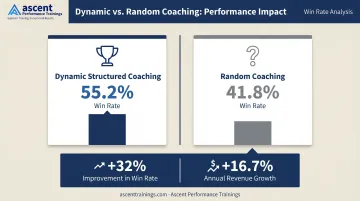
- Dynamic coaching drives 55.2% win rates vs. 41.8% for random coaching — structured beats inspection every time
- Leadership skills compound over time; ongoing development always outperforms one-time training
Why Sales Management Requires Different Skills Than Selling
The Promotion Problem
71% of new B2B sales managers are promoted from within their organizations, according to the Sales Management Association. That's not inherently problematic — but what happens next often is.
Most organizations don't invest proportionally in preparing these new managers. The same SMA research found that while 71% of firms budgeted for salesperson training, only 59% budgeted for sales manager training. Worse, nearly half of that manager training was generic management content — not tailored to the specific demands of leading a sales team.
The result is predictable: new managers default to what they know. They jump into deals instead of coaching reps to win them. They measure their contribution by personal output rather than team performance. They become the team's best seller rather than its most effective developer.
What This Costs Organizations
The organizational consequences aren't minor. When managers operate as super-sellers, teams develop critical dependencies:
- Reps don't develop their own skills — they wait for the manager to rescue deals
- Pipeline quality suffers because no one is coaching qualification rigorously
- Morale erodes as high-potential reps feel stunted rather than developed
- Turnover accelerates among the strongest performers, who leave for environments where they can grow
Gartner data underscores just how significant the performance gap is: effective sales managers can boost seller performance by up to 6x, yet only 18% of managers currently lead high-performing teams.
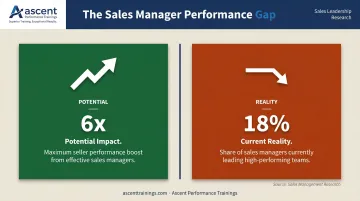
Those numbers point to the same root cause: the skills that make someone a great seller are not the skills that make someone a great manager.
What Successful Sales Leadership Actually Looks Like
A sales manager's primary output isn't closed revenue — it's the capability of the team to generate closed revenue consistently. That single reframe reshapes how you spend your time, what you measure, how you run one-on-ones, and what you treat as a win.
Managers who make this shift deliberately build teams that perform whether or not the manager is in the room. Those who don't become a bottleneck — and the team's ceiling drops to whatever the manager can personally carry.
The Essential Leadership Skills Every Sales Manager Must Master
These skills fall across three domains: people development, strategic decision-making, and personal leadership presence. The Sales Management Association rated sales coaching as the most important sales manager competency (5.8 out of 7), with the largest competency gaps in hiring, coaching, and forecasting — precisely the areas most managers receive the least training.
Communication and Feedback Delivery
Clear communication operates in two directions for a sales manager:
- Outward — setting expectations with reps, briefing the team on goal changes, giving timely and specific performance feedback
- Upward — translating team performance data into coherent narratives that senior leadership can act on
Feedback is where many managers struggle most. Generic feedback tied to numbers ("your pipeline is light") doesn't change behavior. Specific, behaviorally-grounded feedback ("I noticed you skipped discovery questions on that call — here's what that cost you") does. The cadence matters too: RAIN Group found that top-performing sales managers are 51% more likely to have regular, ongoing coaching rhythms.
Strategic Thinking and Sales Planning
Sales managers who only track closed deals are permanently reactive. Strategic managers do the opposite — they forecast proactively, identify pipeline gaps before they become quota problems, and align territory strategy to where revenue is most likely to be generated.
Translating company-wide revenue goals into rep-level activity plans is a distinct skill. It requires understanding conversion rates, sales cycle length, and capacity — then communicating those realities to reps in ways that feel motivating rather than mechanical.
Hiring, Onboarding, and Team Building
Hiring is the highest-leverage activity a sales manager performs. One great hire multiplies every coaching investment; a poor one can consume it entirely.
Effective hiring requires more than evaluating past sales performance. It demands clear role profiles, structured interviews that assess coachability and culture fit, and onboarding programs built around measurable ramp milestones — 30/60/90-day plans with proficiency checkpoints rather than loose orientation schedules.
Delegation and Empowerment
Managers who can't delegate create two problems simultaneously: they become bottlenecks, and they deprive reps of the ownership that builds capability.
Assign ownership to build capability, not just to offload work. When a rep owns a process, they develop judgment that no amount of observation can replicate. Managers who intervene too quickly rob reps of that development.
Change Leadership and Customer-Centric Decision Making
Market shifts, quota changes, restructuring, new processes — how a manager communicates during disruption determines whether reps freeze or adapt. Effective change communication comes down to three things:
- Being transparent about what is known
- Being honest about what isn't yet clear
- Being specific about what the team should do next
The best managers also filter coaching conversations through a customer-value lens. Coaching reps to deeply understand buyer outcomes — not just to hit activity metrics — produces better qualification, stronger relationships, and higher win rates over time.
Building a Coaching Culture That Develops Your Whole Team
Inspection vs. Coaching: The Critical Distinction
Pipeline reviews that interrogate numbers are inspection. Coaching develops the skills, mindset, and behaviors that produce those numbers.
This is not a semantic difference. CSO Insights found that organizations using dynamic, structured coaching achieved a 55.2% win rate compared to 41.8% for random coaching — a 32% improvement. Formalized coaching also correlated with a 16.7% increase in annual revenue growth across a study of 99 B2B firms.
Yet most managers invest almost nothing in genuine coaching. The same research found managers averaged just 36 minutes per week of one-on-one coaching per rep — less than 8% of their total workload.
Tim Carlisle's PERFORM Leadership methodology frames this as a fundamental shift: from performance monitoring to performance enablement. Coaching is the management skill most correlated with team performance — and the one most consistently underdeveloped at the frontline manager level.
Deal Coaching vs. Skill Development Coaching
Not all coaching is the same. Effective managers distinguish clearly between two modes:
Deal-specific coaching zeroes in on a live opportunity — the strategy, the sticking point, the next move. It's immediate and action-oriented.
Skill-development coaching goes deeper — it targets the capability gap underneath the deal. Why does this rep lose at discovery? What pattern shows up across lost deals? How do we close that gap over time?
Effective one-on-ones draw on both modes. The key is reading what the rep needs in the moment — sometimes it's tactical support on a live deal, sometimes it's a longer conversation about an underlying skill gap. The best managers move fluidly between the two without treating every check-in as a pipeline review.
Building a Coaching Ecosystem
Mature coaching cultures don't route everything through the manager. Reps learn from each other. Skill wins get celebrated publicly. Problems surface early because psychological safety exists — reps aren't afraid that surfacing a struggling deal will be met with blame rather than support.
Research on field sales and service teams found that psychological safety positively affected team learning behavior (coefficient 0.747) and team efficacy (coefficient 0.596), both of which improved overall team effectiveness.
That connection between safety and performance translates directly into management behavior. To build this environment consistently:
- Ask questions before making judgments
- Separate the person from the performance
- Model vulnerability by acknowledging your own skill gaps
- Recognize learning in public, not just outcomes
Personalized Development Plans as a Coaching Tool
Managers who treat individual development with the same rigor as quota attainment see results that build on each other. That means:
- Assessing each rep's strengths and gaps through observation, call reviews, and win/loss analysis
- Setting specific skill-growth targets alongside revenue targets
- Tracking progress over time with the same consistency applied to pipeline metrics
When skill development is structured, it's measurable. When it's measurable, reps take it seriously.
Accountability, Motivation, and Emotional Intelligence in Sales Leadership
Holding Both at Once
The most common accountability failure is binary thinking — either high pressure or low standards, and both extremes fail. Too much pressure without support drives burnout and attrition; too little accountability produces complacency.
Effective managers hold both simultaneously: clear SMART goals, regular progress check-ins, and direct but constructive conversations when performance falls short. CSO Insights data shows that where managers effectively motivate and engage reps, 82.8% of organizations achieve a fully engaged sales force.
Recognition and Intrinsic Motivation
Monetary incentives matter, but they're not the whole picture. Public acknowledgment of skill wins — not just deal wins — creates a culture where reps feel valued for how they're growing, not just what they closed.
Managers who build this habit retain top performers longer. Strong performers leave environments where they feel invisible — not just ones where they're underpaid.
Emotional Intelligence as a Leadership Skill
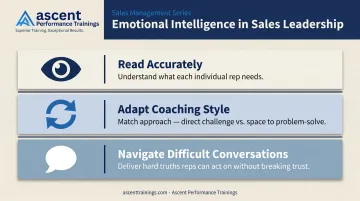
EQ in sales management means three specific things:
- Read individual reps accurately — understand what each person needs, not what works generically
- Adapt coaching style to the rep: some need direct challenge, others need space to problem-solve
- Navigate difficult conversations without breaking trust, delivering hard truths in ways reps can act on
A 2023 analysis of 104 peer-reviewed studies found that emotionally intelligent leaders improve both team behaviors and business results. Unlike technical selling skills, EQ develops through deliberate practice — which is why structured coaching and reinforcement programs produce measurably stronger outcomes than one-time workshops.
Using Data and Metrics to Lead with Clarity
Beyond Closed Revenue
Data-driven leadership means using metrics to guide coaching and decision-making — not just to report upward. The metrics that actually reveal team health:
| Metric | What It Reveals |
|---|---|
| Pipeline velocity | Overall revenue momentum and cycle efficiency |
| Stage conversion rates | Where deals are breaking down in the process |
| Activity levels | Whether reps are generating enough raw opportunity |
| Lead response time | HBR found only 37% of companies respond within an hour; this is a direct coaching opportunity |
| Win/loss ratios | Where rep skillsets are consistently failing or succeeding |
Each metric points to a different coaching conversation. A manager who reads these signals proactively coaches before problems compound.
Active vs. Passive Forecasting
Passive forecasting aggregates rep estimates. Active forecasting interrogates the pipeline. That means challenging optimistic assumptions, adjusting for leading indicators, and delivering honest projections to leadership — even when the numbers are uncomfortable.
Accurate forecasting builds credibility with leadership and gives the team clearer, more achievable targets. Sandbagging or inflating numbers creates ambiguity that erodes trust on both sides of the conversation.
Data-Driven Coaching in Practice
Generic feedback ("close more deals," "prospect harder") rarely changes behavior. Data-backed coaching does. Pull specific evidence before the conversation:
- Call recordings that show where discovery breaks down
- Stage conversion rates that reveal where deals stall
- Win/loss ratios that expose recurring skill gaps
Show the rep exactly where the pattern breaks down. This makes coaching feel precise and fair — not arbitrary — and reps engage with the developmental conversation rather than defend against it.
How to Build and Strengthen Your Sales Leadership Skills
The Habits That Accelerate Growth
Leadership development is a practice, not an event. The habits that compound fastest:
- Seek honest feedback from your team about what's working and what isn't — few managers do this, and it's an immediate differentiator
- Reflect deliberately after coaching sessions, not just in annual reviews
- Experiment with small changes in approach rather than waiting for a dramatic overhaul
Consistent, directional improvement — not perfection — is what separates developing managers from stagnant ones.
The Role of Structured Learning
Reading, peer-learning groups, mentorship, and formal training programs all compress the development timeline. The distinction that matters is between passive exposure and applied learning — frameworks that get tested in real team interactions the same week they're introduced.
Ascent Performance Trainings' sales leadership programs are built on that principle: combining practical frameworks and motivational coaching with an 8-week post-training reinforcement program — including weekly micro-learning videos and monthly one-on-one coaching sessions — to convert what's learned in training into measurable behavior change on the floor.
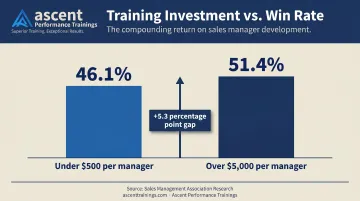
CSO Insights reinforces the investment case: firms spending more than $5,000 per sales manager on development achieved 51.4% win rates compared to 46.1% for firms investing under $500. The gap is real, and it's compounding.
The Compounding Return
Managers who invest consistently in their own leadership skills don't just perform better — they build organizations that outperform. They develop future leaders within their teams. They create cultures that attract and retain top talent. They build systems that produce results beyond what any individual seller's effort could generate.
That's the strategic argument for treating self-development as part of the job, not a bonus when time allows.
Frequently Asked Questions
What are the critical leadership skills for sales managers?
The core skills are:
- Coaching and developing reps
- Clear communication
- Accountability paired with motivation
- Data-driven decision-making
- Emotional intelligence
- Strategic planning
Technical sales knowledge matters, but these people-leadership capabilities are what drive consistent team performance.
What is the difference between a sales manager and a sales leader?
Sales management focuses on processes, targets, and operational execution. Sales leadership focuses on people, culture, and long-term capability building. The most effective individuals do both — managing the business while genuinely leading the people within it.
How does a top salesperson successfully transition into a sales manager role?
The critical shift is redefining personal success: from individual deal closure to team-wide performance. This requires deliberately building coaching skills, learning to delegate rather than take over, and resisting the instinct to sell instead of developing reps.
How important is emotional intelligence for sales managers?
EQ directly shapes a manager's ability to adapt coaching style to individual reps, handle conflict constructively, and create the psychological safety that allows teams to perform under pressure. Crucially, it's a developable skill — not a fixed personality trait.
How can organizations measure whether their sales managers are leading effectively?
Key indicators include rep retention rates, quota attainment consistency across the full team (not just top performers), speed of new rep ramp-up, and qualitative signals like team morale and rep-reported satisfaction with coaching quality.
How long does it take to develop strong sales leadership skills?
Foundational shifts — like moving from seller to coach mindset — can begin within weeks with structured training. Mastery develops over 12–24 months of consistent practice, feedback, and reinforcement; programs that include structured post-training support (such as an 8-week reinforcement period) consistently produce more durable behavior change than single workshops.