
That gap—between a correct answer and a satisfying interaction—is exactly what customer service empathy training is designed to close. And for service leaders tracking retention, escalation rates, and satisfaction scores, closing it is no longer optional.
Empathy gets dismissed as a soft skill, but its impact shows up in hard numbers. According to Qualtrics XM Institute, how customers feel after an interaction is a stronger loyalty driver than whether their issue was actually resolved—customers who felt delighted were 10.3x more likely to recommend a brand than those who felt upset.
This article explains what customer service empathy training is, what measurable advantages it creates, what happens when it's missing, and how to apply it in a way that produces lasting results.
Key Takeaways
- Empathy training teaches agents to recognize and respond to customer emotions, shifting service from transactional to genuinely human
- Structured training embeds lasting behavioral change — the kind that survives high-pressure interactions
- Teams without empathy training default to transactional service that erodes loyalty over time
- The strongest results come from ongoing reinforcement, not one-time workshops
- Measurable outcomes include stronger retention, fewer escalations, and more confident agents
What Is Customer Service Empathy Training?
Customer service empathy training is a structured program that equips service professionals with the skills to understand what a customer is experiencing emotionally— responding in a way that makes the customer feel genuinely heard before any solution is offered.
It applies across any customer-facing role where human connection shapes the interaction: tech support, financial services, insurance claims, B2B account management, healthcare operations, and beyond.
Empathy as a Learnable Skill Set
A common misconception is that empathy training is a personality makeover — it isn't. It's a skill set built through deliberate repetition.
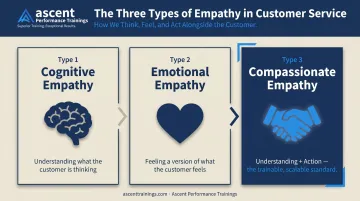
There are three types of empathy relevant to service work:
- Cognitive empathy — understanding what the customer is thinking or experiencing
- Emotional empathy — feeling a version of what the customer feels
- Compassionate empathy — understanding plus action; responding in a way that addresses both the emotion and the problem
Customer service training focuses on the third. Compassionate empathy is what drives resolution. It's also what's trainable, measurable, and scalable—which is why it's the foundation of structured empathy programs.
A 2023 systematic review published in PMC confirmed that empathy training can improve service employees' empathic skills and their ability to cope with emotional distress. For organizations, that means empathy development belongs in the training roadmap alongside communication skills, product knowledge, and conflict resolution.
Key Advantages of Customer Service Empathy Training
The advantages below are grounded in operational outcomes that organizations actually track—retention, resolution efficiency, and team performance. Each advantage builds on the others, which is why empathy training produces its highest return when applied as an ongoing discipline rather than a single initiative.
Advantage 1: Stronger Customer Retention and Loyalty
Customers who feel genuinely understood during difficult interactions are significantly more likely to stay—and to recommend the brand. Empathy training bridges the gap between technically correct service and emotionally satisfying service.
Agents learn to acknowledge a customer's specific situation before jumping to solutions. That acknowledgment defuses tension and signals that the customer is being treated as an individual, not a ticket number.
The numbers reflect this:
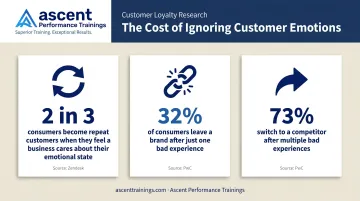
- Two-thirds of consumers who believe a business cares about their emotional state are likely to become repeat customers (Zendesk, 2024)
- 32% of consumers will walk away from a brand they love after just one bad experience (PwC)
- More than half of consumers will switch to a competitor after a single bad experience—and 73% will switch after multiple bad experiences (Zendesk)
KPIs impacted: Customer retention rate, Net Promoter Score (NPS), Customer Satisfaction Score (CSAT), churn rate, repeat purchase and renewal rate
When this advantage matters most: High-stakes or recurring interactions—renewal conversations, billing disputes, multi-contact issues—where the emotional quality of the interaction weighs as heavily as the resolution itself.
Advantage 2: Reduced Escalations and Faster Issue Resolution
Empathy-trained agents de-escalate emotionally charged situations more efficiently. The mechanism is straightforward: when customers feel acknowledged, they lower their defenses. That makes them more open to hearing the answer—even when the answer isn't what they wanted.
What does this look like in practice? An agent who validates a customer's frustration before presenting a resolution path shortens the time spent managing resistance. One customer isn't arguing with the policy anymore; they're working with the agent toward a solution.
Research from HBR and CEB supports this directionally. A U.K. mortgage company reduced repeat calls by 40% after training representatives to recognize customer personality types and address the emotional side of interactions. The same research found that emotional disconnects—customers not trusting the agent's information or not sensing confidence—accounted for 24% of repeat calls.
ICMI's research on first-contact resolution confirms that agent training hours are the single biggest driver of FCR rates. More training translates directly to more issues resolved on the first contact.
KPIs impacted: Escalation rate, first-contact resolution (FCR) rate, average handle time (AHT), repeat contact rate
When this advantage matters most: Complex or emotionally charged scenarios—product failures, billing errors, or situations where the customer has already contacted the team multiple times without resolution.
Advantage 3: Greater Agent Confidence and Team Performance
Empathy training doesn't just improve the customer's experience—it equips agents with a clear framework for navigating difficult conversations. That framework reduces uncertainty, lowers stress, and builds professional confidence over time.
Agents who practice empathy through role-playing, feedback loops, and reinforcement exercises develop a repeatable approach to emotionally loaded interactions. They become more consistent and less reactive under pressure—not because they're naturally calmer, but because they have a process to rely on.
Research from the European Journal of Work and Organizational Psychology found that only up to 30% of training content is typically transferred and implemented in the workplace. The difference between programs that hit that ceiling and those that exceed it comes down to post-training reinforcement—supervisor support, peer coaching, and repeated application in real scenarios.
This is where training design matters. Ascent Performance Trainings builds an 8-week post-training reinforcement program into every engagement—weekly AI-generated micro-learning videos, real-world application prompts, and monthly 1:1 coaching sessions—specifically designed to move empathy skills from the training room into actual customer interactions.
For customer service teams, that means the behaviors covered in the Ascent Customer Service Academy continue to be practiced and refined long after the initial sessions conclude.
KPIs impacted: Agent confidence scores, QA empathy rubric scores, employee satisfaction and retention, onboarding ramp time for new hires
When this advantage matters most: Teams experiencing high turnover, new hire onboarding periods, or scaling phases where consistent service quality is difficult to maintain without a shared behavioral framework.
What Happens When Empathy Training Is Missing
Without structured empathy training, teams default to scripted, transactional responses. Problems get resolved on paper, but customers feel processed—and the business consequences build until they're impossible to ignore.
The Pattern That Emerges
Agents revert to what's comfortable under pressure: scripts, templates, deflections. A customer dealing with a billing error hears the right policy language but feels like they're talking to a wall. They escalate. Or they don't escalate—they just churn and tell people about it.
HBR/CEB research found that 65% of customers with negative experiences tell 10 or more people, compared to just 23% of customers with positive experiences. The negative word-of-mouth cost of a single poorly handled interaction is disproportionate to the cost of the interaction itself. That asymmetry compounds at the organizational level—which is where the real damage accumulates.
Compounding Consequences Over Time
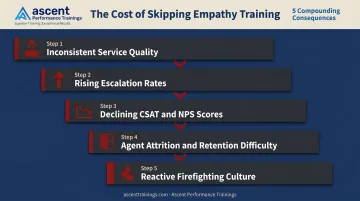
Organizations that skip empathy training follow a predictable pattern:
- Inconsistent service quality across agents and channels
- Rising escalation rates as customers who feel dismissed push harder for attention
- Declining CSAT and NPS scores—early warning signals before churn actually occurs
- Difficulty retaining skilled agents who feel ill-equipped for emotionally demanding work
- Reactive firefighting instead of proactive, confidence-driven service delivery
Qualtrics estimated in 2024 that poor customer experiences put $3.8 trillion in global sales at risk as consumers cut spending after bad experiences. Employee interactions were identified as the primary factor in 39% of bad customer experiences—ranking above price or product quality.
The structural problem: without training, empathy remains dependent on individual personality rather than team-wide capability. That makes it impossible to scale, manage as a performance standard, or replicate across new hires.
How to Get the Most Value from Customer Service Empathy Training
Empathy training works best when it's built into a recurring rhythm. Treat it as an ongoing practice, not a one-time event.
Build It Into the Weekly Cadence
Weekly micro-sessions—brief role-plays, feedback reviews, empathy statement practice—build the skill into team culture more effectively than quarterly workshops. The repetition matters. Empathy in difficult conversations is a motor skill as much as a cognitive one; it needs practice in realistic conditions to become consistent behavior.
A practical starting point: dedicate 15-20 minutes per team meeting to reviewing one real interaction, identifying where emotional acknowledgment was strong or missing, and practicing one alternative phrasing.
Three Conditions for Maximum Return
Empathy training produces its highest return when:
- Practiced consistently across all channels and team members — not only during onboarding or for struggling agents
- Outcomes are tracked through CSAT empathy scores, QA rubric criteria, and escalation data — so patterns drive action, not just observation
- Managers model empathetic behavior internally, because teams mirror how leadership communicates under pressure
That third condition is often the most overlooked. When managers default to pressure-driven language internally, no amount of agent training compensates for it. Programs like Ascent Performance Trainings' Customer Service Academy are built around this reality — combining in-person workshops, live virtual micro-learnings, 1:1 coaching, and an 8-week reinforcement program specifically designed to bridge the gap between training and on-the-job behavior change.
Turn QA Insights Into Behavioral Change
Insights from empathy-focused QA reviews are only valuable if they're acted on. That means:
- Sharing examples of strong empathetic interactions in team meetings, not just flagging failures
- Celebrating customer feedback that specifically mentions feeling understood—those moments are replicable
- Coaching on specific language patterns: the difference between "I understand your frustration" (generic) and "That sounds genuinely stressful, especially since you've already called twice" (specific and human)
These QA habits are what close the reinforcement gap. The difference between training that sticks and training that fades usually isn't a design problem — it's what happens (or doesn't happen) in the six weeks after the workshop ends.
Conclusion
Customer service empathy training creates consistency, connection, and measurable business outcomes—not just isolated moments of good service. Its advantages compound: stronger retention reduces acquisition costs, fewer escalations free up team capacity, and more confident agents stay longer and perform more consistently.
As automation handles more routine interactions, human empathy becomes the actual differentiating factor. The organizations that invest in training for it—and build reinforcement into their culture—are the ones customers choose to stay with.
Frequently Asked Questions
What are the 5 A's of empathy in customer service?
The 5 A's—typically Acknowledge, Align, Assure, Act, and Appreciate—guide agents through an empathetic interaction from recognizing the emotion to resolving and closing with care. Each step addresses both the emotional and practical dimensions of the customer's situation, so nothing gets skipped in the rush to resolution.
What are the 4 A's of customer empathy?
The 4 A's—commonly Acknowledge, Apologize, Act, and Appreciate—give frontline teams a practical, memorable structure for empathetic customer conversations. This simplified model is particularly useful for new agents who need a consistent framework before more nuanced approaches become second nature.
What are the 5 C's of empathy in customer service?
The 5 C's—typically Connect, Care, Clarify, Communicate, and Confirm—help agents move through a complete empathetic interaction rather than jumping straight to resolution. Working through each step builds rapport, surfaces full context, and confirms the customer feels genuinely heard before the conversation ends.
Can empathy be taught to customer service professionals?
Yes. Situational empathy—the type most relevant to customer service—is a learnable professional skill. A 2023 peer-reviewed systematic review confirmed that structured empathy training produces measurable and lasting behavioral improvements in service employees, particularly when followed by consistent coaching and practice.
How do you measure the impact of empathy training in customer service?
Three approaches work well together: add an empathy-specific question to CSAT surveys (for example, "Did the agent make you feel understood?"), build empathy criteria into QA ticket review rubrics, and correlate empathy scores with retention and escalation metrics over time to establish the business link.
What is the difference between empathy and sympathy in customer service?
Sympathy acknowledges a customer's feelings from a distance—"I'm sorry you're dealing with that." Empathy means understanding their specific situation from their perspective. Compassionate empathy goes further: understanding plus action. That combination—feeling with the customer and then doing something about it—is the standard customer service training should aim to build.